

Cart
0
TL;DR:
- Bone broth collagen is a protein-rich extract from simmered animal bones, providing essential amino acids, minerals, and gelatin. Proper preparation, including long simmering times and added acid, maximizes collagen yield, which benefits skin, joints, and gut health. Consuming one cup daily supplies enough collagen to support overall wellness, making bone broth a valuable holistic food source.
Bone broth collagen is the protein-rich compound extracted when animal bones and connective tissues are simmered slowly in water, releasing gelatin, amino acids, and minerals into a nourishing liquid. A single cup delivers 6–12 grams of collagen, making it one of the most concentrated whole-food sources available. Clinical trials from 2019 and 2021 confirm that 2.5–10g of collagen daily improves skin elasticity and hydration within 8–12 weeks. That dose is achievable from one cup of well-made broth. For gut health, joint integrity, and skin support, bone broth collagen offers a whole-food advantage that isolated supplements cannot fully replicate.
What types of collagen does bone broth contain?
Bone broth contains three primary collagen types, and the animal source determines which type dominates. Understanding this distinction helps you choose the right broth for your specific health goals.

According to experts at Bubs Naturals, chicken bone broth is rich in Type II collagen, which is the structural protein found in cartilage. Type II collagen directly supports joint cushioning and is particularly relevant for anyone managing knee discomfort or recovering from physical activity. Beef bone broth, by contrast, is richer in Types I and III collagen, which are the proteins responsible for skin firmness, connective tissue strength, and gut lining integrity.
Here is a breakdown of collagen types by source:
-
Type I collagen: Found in beef broth. Supports skin elasticity, bone density, and tendon strength.
-
Type II collagen: Found in chicken broth, especially from cartilage-rich parts like chicken feet and carcasses. Supports joint cartilage and reduces inflammation.
-
Type III collagen: Found alongside Type I in beef broth. Supports the structure of muscles, organs, and blood vessels.
-
Marrow bones: Beef marrow bones add fat-soluble nutrients and reinforce the mineral content of the broth alongside collagen.
Rotating between beef and chicken bone broth provides a well-rounded collagen intake that supports the whole body rather than targeting one system alone. A practical approach is to use chicken broth on days when joint recovery is the priority and beef broth when skin and gut support is the focus.
Pro Tip: When making chicken broth, include chicken feet in the pot. They are exceptionally high in cartilage and significantly increase the Type II collagen yield per cup.
The bones you choose also affect mineral content. Knuckle bones and joints from beef provide the highest gelatin yield. Chicken carcasses and necks offer a lighter broth with a softer gel. Both are valid choices with distinct nutritional profiles.
How is collagen extracted from bones during cooking?
Collagen extraction depends on three variables: time, temperature, and acidity. Getting these right is the difference between a thin, watery stock and a collagen-dense broth that gels firmly in the fridge.
Follow these steps to maximise collagen extraction at home:
-
Choose the right bones. Use knuckle bones, joints, and feet for maximum gelatin. Marrow bones add flavour and nutrients but contribute less gelatin on their own.
-
Add an acidic ingredient. Adding apple cider vinegar or lemon juice to the pot significantly improves collagen and mineral extraction during simmering. The acid breaks down the dense bone matrix, releasing gelatin and minerals more efficiently. One to two tablespoons per litre of water is sufficient.
-
Simmer at the correct temperature. A gentle simmer, not a rolling boil, preserves the collagen structure. Boiling aggressively can break down the proteins into smaller fragments and cloud the broth.
-
Simmer for long enough. Beef broth requires 12–24 hours to fully extract collagen from dense bones. Chicken broth reaches its peak collagen content in 6–12 hours. Shorter cooking times produce stock rather than true bone broth, with noticeably lower collagen levels.
-
Perform the jiggle test. Pour a small amount of broth into a bowl and refrigerate it. A firm, wobbly gel confirms that sufficient gelatin has been extracted. A liquid that stays runny when cold indicates insufficient collagen content.
Pro Tip: Do not skip the acid step. Many home cooks omit vinegar because they worry about the taste, but the acidity fully cooks off during simmering. The flavour of the finished broth is unaffected, and the collagen yield improves measurably.
The difference between bone broth and stock is not just culinary terminology. Stock is typically simmered for 2–4 hours and produces a flavourful liquid with minimal gelatin. Bone broth is simmered for far longer, producing a gel-forming liquid with meaningful collagen content. If your broth does not pass the jiggle test, it is closer to stock in nutritional terms.
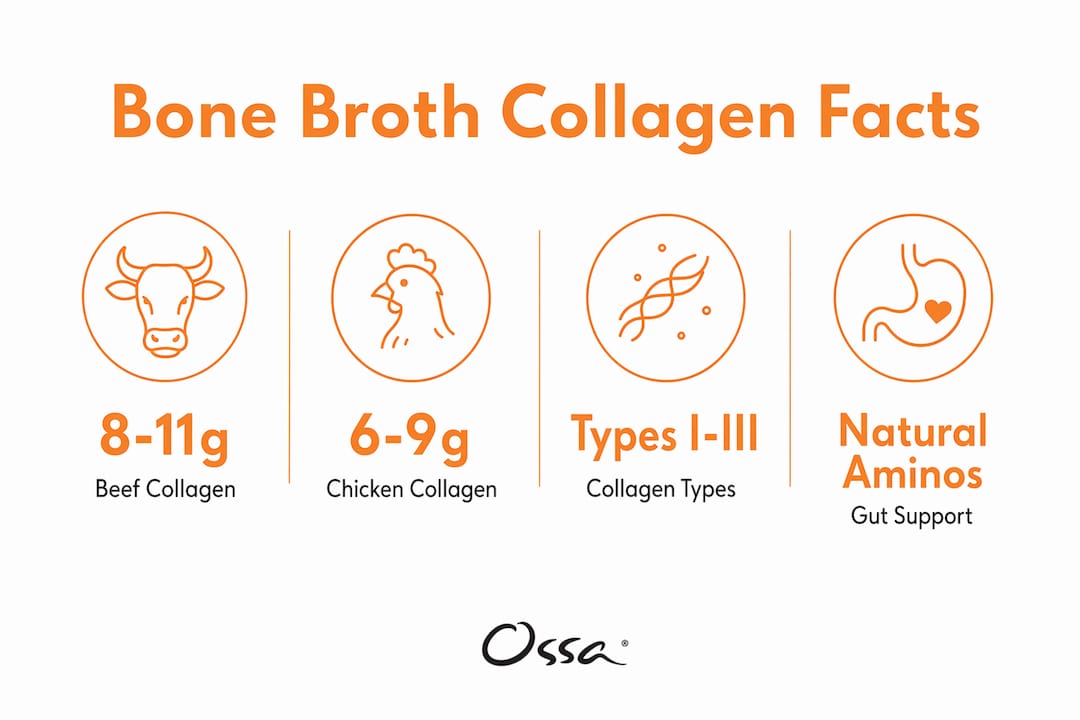
Beef broth made from grass-fed bones typically delivers 8–11g of collagen per cup, while chicken broth from free-range carcasses delivers 6–9g. These figures assume correct preparation with adequate simmer time and acid addition.
Bone broth collagen vs collagen supplements and whey protein
The supplement market offers isolated collagen peptides, hydrolysed collagen powders, and whey protein as alternatives to whole-food sources. Each has a distinct nutritional profile and a different best use case.
How does bone broth compare to collagen supplements?
Isolated collagen supplements typically deliver 10–20g of collagen peptides per serving. That is a higher dose than a single cup of broth. However, bone broth provides a whole-food matrix of minerals, electrolytes, and amino acids including calcium, magnesium, and potassium alongside the collagen. Isolated peptides deliver collagen alone, without the co-factors that support its absorption and use in the body.
Bone broth also supplies glycine and proline in meaningful quantities. These amino acids are the direct building blocks of endogenous collagen synthesis. When paired with vitamin C, which is required for collagen formation in the body, the amino acids from broth actively support your body’s own collagen production rather than simply supplying pre-formed collagen.
Bone broth protein vs whey: key differences
| Feature | Bone Broth Protein | Whey Protein |
|---|---|---|
| Collagen content | High (collagen-dominant peptides) | Negligible |
| Leucine content | ~3% | ~11% |
| Best use case | Skin, joints, gut lining | Muscle synthesis and recovery |
| Mineral content | Calcium, magnesium, potassium | Low |
| Complete protein | No | Yes |
| Digestibility | High | High |
Whey protein has superior leucine content at approximately 11% compared to around 3% in bone broth protein. Leucine is the key amino acid that triggers muscle protein synthesis. For post-workout recovery and muscle building, whey protein remains the more effective choice. Bone broth protein is not a complete protein. It lacks essential amino acids including tryptophan and methionine.
The practical conclusion is straightforward. Use whey protein if muscle gain is your primary goal. Use bone broth collagen if you are focused on skin health, joint support, or gut lining repair. The two are not in competition. Many people use both for different purposes.
Bone broth protein powder delivers 18–20g per serving with the added benefit of natural electrolytes. That makes it a useful option for those who want the nutritional profile of broth in a convenient format, particularly when travelling or at work.
How to use bone broth collagen daily for gut health and wellness
The clinical dose for visible collagen benefits is 2.5–10g per day. One cup of well-made bone broth meets this threshold. The practical challenge is building a consistent daily habit rather than occasional use.
Here are the most effective ways to incorporate bone broth collagen into your routine:
-
Drink it from a mug. A warm bone broth mug in the morning or before bed is the simplest delivery method. It requires no preparation beyond reheating and provides the full collagen and mineral content in one serving.
-
Use it as a cooking base. Replace water with bone broth when cooking grains, pulses, or vegetables. The collagen and minerals transfer into the food during cooking.
-
Make bone broth noodle soups. Chicken bone broth noodle soup is one of the most practical and satisfying ways to consume collagen regularly. Use a rich chicken bone broth as the base, add rice noodles or egg noodles, and include vegetables for a complete meal. Chicken noodle soup with bone broth delivers collagen, glycine, and minerals in a format that is easy to digest and genuinely nourishing.
-
Cook bone broth pasta. Use bone broth in place of water when cooking pasta, or reduce it into a sauce. The collagen concentrates as the liquid reduces, increasing the dose per serving.
-
Use bone broth cubes. Frozen bone broth cubes are a practical way to add small amounts of collagen to sauces, stews, and soups without committing to a full cup. They are particularly useful for adding collagen to everyday cooking without changing the recipe significantly.
Pairing bone broth with vitamin C-rich foods amplifies the benefit. Vitamin C is required for the hydroxylation of proline and lysine, which are the steps that convert raw amino acids into stable collagen fibres. Add a squeeze of lemon juice to your broth, or serve bone broth noodle soups with fresh herbs and peppers to increase vitamin C intake alongside the collagen.
The role of amino acids in bone broth extends beyond collagen. Glycine supports the gut lining by strengthening tight junctions between intestinal cells. Proline contributes to tissue repair. Together, these amino acids make bone broth a meaningful tool for gut health, not just a collagen source.
For recipe ideas that go beyond basic soups, bone broth pasta dishes and slow-cooked stews built on a broth base are excellent ways to increase weekly collagen intake without it feeling like a supplement protocol. You can find a full range of collagen-focused recipes that make this practical and varied.
Key takeaways
Bone broth collagen delivers meaningful doses of Types I, II, and III collagen alongside gut-supporting amino acids, making it a more complete wellness tool than isolated collagen supplements.
| Point | Details |
|---|---|
| Collagen content per cup | Beef broth provides 8–11g; chicken broth provides 6–9g per cup when properly prepared. |
| Collagen type by source | Chicken broth supplies Type II for joints; beef broth supplies Types I and III for skin and connective tissue. |
| Extraction quality check | Refrigerate broth and check for a firm gel. A wobbly set confirms sufficient collagen extraction. |
| Whole-food advantage | Bone broth delivers collagen alongside minerals and amino acids that isolated peptides do not provide. |
| Daily dose strategy | One cup of broth meets the 2.5–10g clinical threshold. Pair with vitamin C foods to support collagen synthesis. |
Bone broth collagen: what we have learned at ossa organic
The most common mistake people make with bone broth is treating it as a supplement to take occasionally rather than a food to eat consistently. Collagen production declines with age, particularly after the mid-twenties, and the body cannot compensate for that decline without a reliable supply of the right building blocks. One cup a day, every day, produces results that sporadic use never will.
We have also found that quality of preparation matters more than most people realise. A broth that does not gel in the fridge is not delivering meaningful collagen. The jiggle test is not a marketing concept. It is a direct measure of whether the simmering process has done its job. At Ossa Organic, every batch is made to gel. That is the standard we hold ourselves to.
The bone broth protein vs whey protein debate misses the point for most people. Whey is a muscle-building tool. Bone broth is a structural repair tool. They serve different biological functions. Choosing between them based on protein grams per serving is like choosing between a spanner and a screwdriver based on weight. The right question is what you are trying to fix.
We believe bone broth belongs in daily life as food, not as a supplement protocol. Chicken noodle soup with bone broth, a morning mug, pasta cooked in broth. These are not wellness rituals. They are the way people ate before food became industrialised. The tradition is the point.
— Ossa Organic
Explore ossa organic bone broth products
Ossa Organic produces certified organic bone broths made from grass-fed beef bones and free-range chicken carcasses, slow-simmered to achieve a firm gel and maximum collagen yield. The organic beef bone broth is rich in Types I and III collagen and comes in a convenient ambient 515ml format, ready to heat and drink or use in cooking. The organic chicken bone broth delivers Type II collagen from free-range birds and is ideal for joint support and lighter soups. Both are shelf-stable, free from preservatives, and made without additives. For guidance on how to build bone broth into your daily routine, visit the how to use page for practical ideas and recipes.
FAQ
How much collagen is in a cup of bone broth?
A well-made cup of bone broth delivers 6–12g of collagen, with beef broth providing 8–11g and chicken broth 6–9g per cup. Collagen content depends on bone type, simmer time, and whether an acidic ingredient was added during cooking.
Is bone broth collagen better than collagen supplements?
Bone broth provides collagen alongside minerals, electrolytes, and amino acids that isolated supplements do not contain. The whole-food matrix may support better absorption and gut lining health, though supplements offer a higher collagen dose per serving.
What is the difference between bone broth protein vs whey protein?
Bone broth protein is collagen-dominant and supports skin, joints, and gut health but is not a complete protein. Whey protein contains approximately 11% leucine and is superior for muscle synthesis. The two serve different nutritional purposes.
Does bone broth support gut health beyond collagen?
Bone broth supplies glycine and proline, which strengthen the gut lining by supporting tight junctions between intestinal cells. These amino acids make bone broth a direct gut health tool, not just a collagen source.
How do i know if my bone broth has enough collagen?
Refrigerate a small amount of finished broth. If it sets into a firm, wobbly gel, sufficient gelatin has been extracted and the collagen content is meaningful. Broth that stays liquid when cold is closer to stock and contains significantly less collagen.