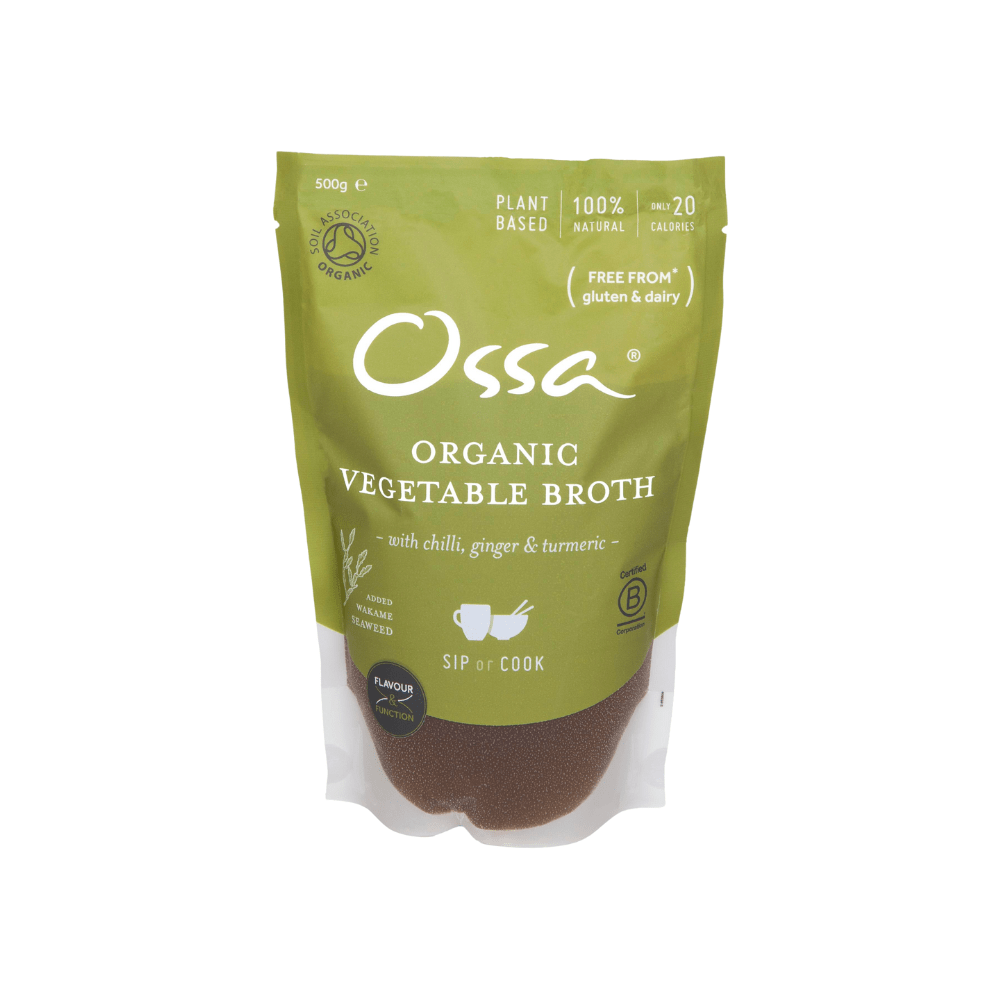
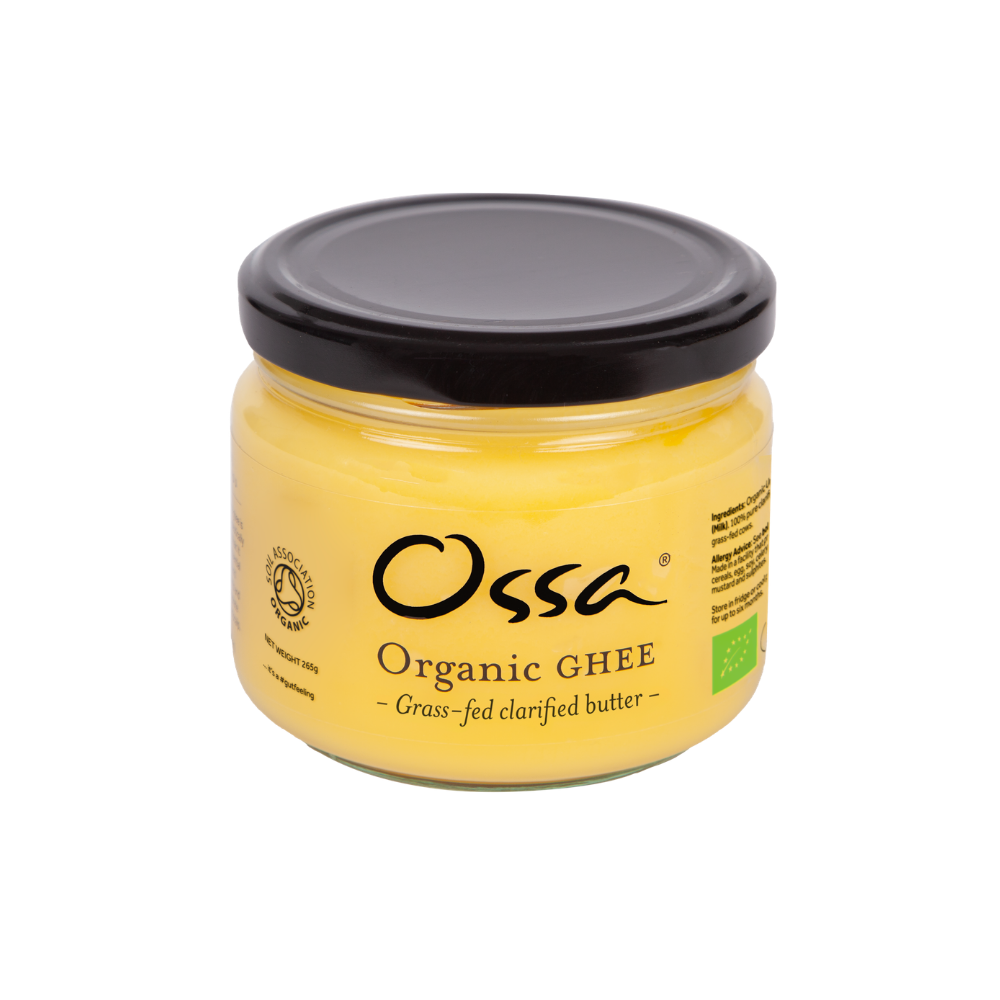
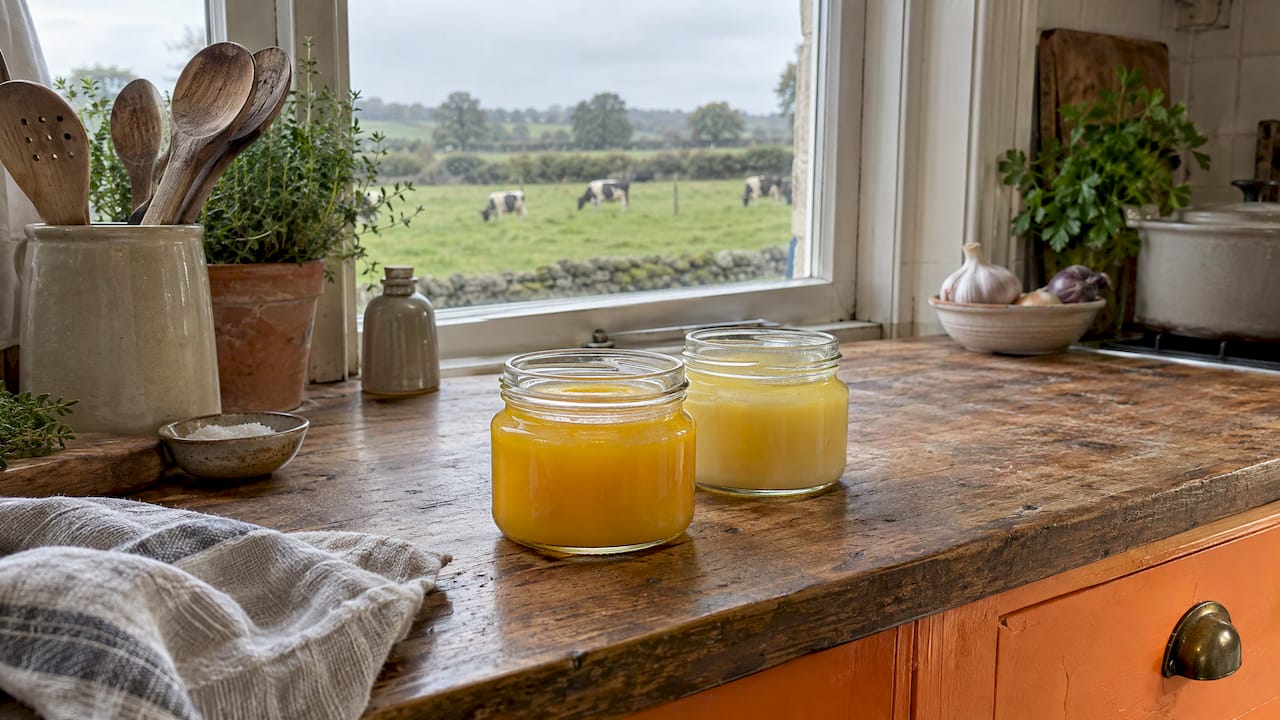
Grass-fed describes what the cows ate. Organic describes how the whole farm and the dairy were run, under UK law and with a certifier checking. The two are not rivals, and a single jar of ghee can carry both. If you want ghee that is organic and made from the milk of pasture-fed cows, look for both claims on the label, plus a certifier code. Our own range of grass-fed fats includes organic, grass-fed ghee, and the rest of this guide shows you how to read any jar, ours included, with confidence.
Ossa Organic
Find Organic, Grass-Fed Ghee
Explore Ossa Organic’s range of grass-fed fats, including organic, grass-fed ghee, made in keeping with its natural-food approach.
TL;DR
-
Grass-fed is a statement about the cows’ diet. In the UK it has no legal definition unless a third-party certification stands behind it.
-
Organic is a legally defined, certified status. It covers feed, farming practice, animal welfare and the certification of every business in the supply chain.
- A jar can be both organic and grass-fed. One label does not automatically guarantee the other.
- On a UK organic jar, look for the word organic plus a certifier code in the format GB-ORG-XX (XI-ORG-XX in Northern Ireland).
- For the cleanest ingredient list, choose ghee made from one thing only: butter from organic, grass-fed cows, with no additives or preservatives.
Table of Contents
Two labels that answer two different questions
Shoppers often treat “grass-fed” and “organic” as two names for the same good thing. They are not. They answer different questions.
Grass-fed asks: what did the cows eat? The claim is about diet, and specifically about time spent on pasture and the share of the diet that comes from grass and forage rather than grain and concentrates.
Organic asks: how was the milk produced, and who checked? The claim covers the feed, the way the land is farmed, how the animals are kept and treated, and the processing of the butter into ghee. It also means an approved control body has certified each business that handles the product.
Ghee is clarified butter. Butter is gently simmered until the water evaporates and the milk solids separate and are removed, leaving a pure golden fat. Whatever the cows ate and however they were kept ends up in that fat. That is why the label on the jar matters: the process of making ghee is the same, but the starting butter can be very different.
The practical consequence is simple. Grass-fed on its own tells you about the diet. Organic on its own tells you about the farming system. Only when you see both do you know about both.

What “grass-fed” means on a UK jar
In everyday language, grass-fed means the cows graze on pasture and eat mostly grass. On a label, though, the picture is less tidy.
A Greener World, a UK certifier of grass-fed farming, states that there is no legal definition of “grassfed” in the UK. A business can use the word as long as the animals are described as predominantly grass-fed, which could be as little as 51% of the diet. The certification it runs, Certified Grassfed by AGW, goes further: it guarantees a 100% grass-and-forage diet, outdoor pasture raising, and no growth hormones or sub-therapeutic antibiotics.
That gap is the reason to read the whole label rather than one word on it. A plain “grass-fed” claim is a promise from the brand. A grass-fed claim with a recognised third-party seal behind it is a promise that someone else has inspected.
Why do people look for grass-fed ghee at all? Because the cows’ diet shapes the fat. Milk from cows grazing on pasture is associated with a richer golden colour, a fuller flavour and higher levels of fat-soluble vitamins, conjugated linoleic acid (CLA) and omega-3 fatty acids. CLA is a naturally occurring fatty acid found in the fat of ruminant animals such as cows. Omega-3s are the family of fats that are found in grass and clover and carried into the milk.
The colour clue
Ghee from pasture-fed cows often looks deeper golden, because grass carries carotenoids, the natural pigments that give the fat its colour. It is a helpful visual cue, but not proof of anything on its own. Colour varies with the season, with the pasture and with how long the ghee has been cooked. Treat it as a pointer, and let the label do the confirming.
What “organic” guarantees
Organic is the stronger legal claim. In the UK, food can only be sold as organic if it has been produced under the organic regulations, if farmers and processors are certified by an approved organisation, and if the certifier’s code appears on the label.
GOV.UK sets out the labelling rules. Organic-labelled food must meet the organic production rules and contain at least 95% organic agricultural ingredients. Any other ingredients and additives must be on the permitted list. Every business that produces, prepares, stores, imports, exports or sells organic products must be certified by an approved UK organic control body, and so must any third party contracted to do those jobs. The label must carry the certifier code, written GB-ORG-XX in Great Britain and XI-ORG-XX in Northern Ireland. For example, products packed and labelled in Great Britain by an operator certified by the Soil Association carry GB-ORG-05.
What this means on the farm
The Soil Association, the UK’s best-known organic certifier, sets out what organic dairy farming involves:
- Cows are free-range and grass-based, and must eat a diet with at least 60% forage.
- Routine use of antibiotics and wormers is banned.
- GM ingredients are banned in feed.
- Cows must have pasture access whenever conditions allow. Zero-grazing, where indoor cows are fed cut grass or soya, is not allowed.
- Fossil-fuel-based fertilisers are forbidden, so organic pasture leans on clover, which fixes nitrogen from the air into the soil.
The Soil Association links that clover-rich pasture with higher omega-3 levels in organic milk. It also reports that, on average, non-organic cows receive a third more concentrated feed, and that organic dairy yields are around 20% lower. Lower yield per cow is part of why organic dairy products cost more to produce.
GB organic standards also require livestock to be fed organic feed made from ingredients farmed organically, and to have regular exercise and access to open-air areas, with pasture where appropriate.
The limit of organic on its own
Organic means a minimum 60% forage diet, and organic farmers may use certified-organic energy-dense and high-protein feed in addition to grass. So an organic jar does not automatically mean the cows ate nothing but grass. That is precisely why the combination of both labels is the more complete answer: organic for the certified system, grass-fed for the emphasis on pasture.
Can ghee be both grass-fed and organic?
Yes. The two labels sit comfortably together. Several UK ghees are made from organic British butter from grass-fed cows on certified organic farms, and sold as organic and grass-fed. The result is a jar where the certified system covers feed, welfare and the supply chain, and the pasture emphasis covers the diet.
The four combinations you will meet on shelves look like this:
| Label on the jar |
What it tells you |
What it does not tell you |
| Grass-fed only |
The brand says the cows ate mainly grass |
How much grass, unless a third-party seal is shown; no certified farming system |
| Organic only |
Certified organic production, a certifier code, no routine antibiotics, at least 60% forage |
That the diet was 100% grass |
| Organic and grass-fed |
Certified system plus a pasture-based diet |
Nothing further is needed for most home cooks |
| Neither, or only “natural” |
Very little: “natural” has no fixed meaning |
Farming system, diet or welfare |
Our own organic, grass-fed ghee sits in the third row, and that is the combination we would point any reader towards.
Does the nutrition really differ?
This is the question behind many searches, so it deserves a careful answer. There is not yet a large study that compares grass-fed ghee directly with ghee from conventionally fed cows. What exists is research on the milk the ghee is made from.
A widely cited 2018 analysis of US milk by Benbrook and colleagues compared three types of milk per 100g:
| Milk type |
Omega-3 |
CLA |
Omega-6 to omega-3 ratio |
| 100% grass-fed |
0.049g |
0.043g |
0.95 to 1 |
| Organic |
0.032g |
0.023g |
2.28 to 1 |
| Conventional |
0.020g |
0.019g |
5.77 to 1 |
The pattern is consistent: the more pasture in the cows’ diet, the more omega-3 and CLA in the milk, and the closer the balance of omega-6 to omega-3 fats. Organic milk sits between conventional and fully grass-fed, which fits the picture above: organic cows eat more forage than conventionally fed ones, though not necessarily 100% grass.
There are three things to keep in mind when reading these numbers.
-
They are about US milk, not UK ghee. They show the direction of the effect rather than the exact content of a given jar.
-
They come from the cow’s diet. The advantage is linked to what the animal eats, not to the breed or to the word on the label.
-
Ghee is a fat you use by the teaspoon. A teaspoon of ghee is about 5g, so the amounts of any individual fatty acid are small in absolute terms. Ghee is best seen as a stable, flavourful cooking fat made from better-sourced milk, within a varied diet, and not as a supplement.
Where the diet of the cow is strongest, so are the colour, the aroma and the natural fat-soluble vitamins A, E and K that ghee carries. That is the practical reason to choose ghee from pasture-fed cows.
Organic ghee versus conventional ghee
If you are comparing organic with conventional ghee, the differences come down to how the cows were kept and what went into the supply chain.
Feed and land. Organic feed comes from land farmed without synthetic pesticides and fertilisers, and without GM crops. Conventional dairy can use a wider range of feed and a higher share of concentrates.
Medicines. Organic standards ban routine use of antibiotics and wormers. The Soil Association explains the rationale: limiting routine use helps protect the effectiveness of treatments and reduces the risk of antimicrobial resistance.
Welfare and pasture. Organic cows must have access to pasture whenever conditions permit. The Soil Association notes that time outdoors, over 200 days a year, lets cows graze and behave naturally and helps reduce stress and disease.
Traceability. Every organic business in the chain is certified, and the certifier code on the label lets you trace who certified the product. A conventional jar has no equivalent legal requirement behind it.
Ingredients. Organic rules limit additives and processing aids. For ghee this matters less, since good ghee is a single ingredient, but it is another reason the organic jar is the simpler purchase.
So, does it matter if your ghee is organic? If you buy ghee because you want to cook with fewer unwanted inputs, and you want the certified system behind the milk, then yes: organic is the label that delivers that in a way the law defines. Add grass-fed and you also get the emphasis on pasture.
One point of honest labelling is worth knowing. Organic certification speaks to how the product was produced and certified. It does not by itself describe the skill and care of the maker. That is why it helps to buy from a producer that is open about where the butter comes from and how the ghee is made.
How to read a jar of ghee
Use this short routine in the shop or on a product page.
-
Find the word organic and the certifier code. In Great Britain it is GB-ORG-XX, in Northern Ireland XI-ORG-XX. A claim of organic without a code is incomplete.
-
Look for where the butter comes from. British butter from named organic farms tells you more than a generic “pure cow ghee”.
-
Check how grass-fed is described. A recognised third-party seal is firmer than a plain claim. A plain claim from a brand that also shows organic certification is still a good combination, since organic pasture and forage rules apply.
-
Read the ingredient list. The ideal is one line: ghee, or butter from organic, grass-fed cows. No preservatives, no flavourings, no added oils.
-
Treat “natural” and “pure” as marketing words. They have no fixed legal meaning, and they overlap with organic and grass-fed in ways that can blur things.
-
Look at the colour and aroma once opened. Golden yellow with a warm, nutty, slightly toasty smell is what you want.
For storage once you have a jar, our guide to ghee shelf life, including how to store it in the pantry, fridge or freezer sets out the timings. If you want to know what to look for when buying ghee, that section covers it in more detail, and how to tell if ghee has gone bad is a useful check for any jar that has been open a while.
Labels and rules that change
UK organic rules are updated from time to time. Amendments to the Organic Production Regulations came into force on 1 January 2026, and they deal mainly with exemptions for livestock and feed, such as limited use of non-organic protein feed when organic supplies are unavailable. Import rules for organic goods have also tightened in recent years, with a GB certificate of inspection required for organic goods coming in from the EU since 1 February 2025. None of this changes what you look for on the jar: the word organic and the certifier code. The GOV.UK organic labelling guidance is the page to consult for the current rules.
Flavour and cooking: what to expect
Ghee gets its taste from slow simmering. The butter is cooked until the milk solids turn a toasty brown, which gives ghee a warm, slightly caramelised, nutty character. Arla UK notes that the milk solids turn dark brown when the temperature reaches about 118°C, which is the point at which the nutty aroma develops.

Because the water and milk solids are removed, ghee tolerates high cooking heat better than butter, which is why it suits roasting, frying and sauteing. It is also good for spreading on toast, stirring into rice and dal, and finishing vegetables. A London-based nutritionist quoted by the New York Times describes using it in rice and khichdi, and even to cook bananas to top oatmeal.
If you cook with ghee often, the choice between grass-fed and organic shows up most clearly in the flavour. Ghee from pasture-fed cows tends to taste fuller and more aromatic, and when it is also organic you know the farming and handling behind it was certified. For ideas, our organic grass-fed ghee recipes cover everyday dishes, and there are collections that are gluten-free, low-carb and dessert.
Ghee or grass-fed butter?
Grass-fed versions of both offer more fat-soluble vitamins and CLA than butter from grain-fed cows. The better choice depends on how you cook. Ghee has had its milk solids removed, so it keeps longer and copes with higher heat, and it suits people who want to avoid the milk solids in butter. Butter is better for baking where you want the water and milk flavour. For everyday frying and roasting, ghee is the more practical fat.
Where to find organic, grass-fed ghee
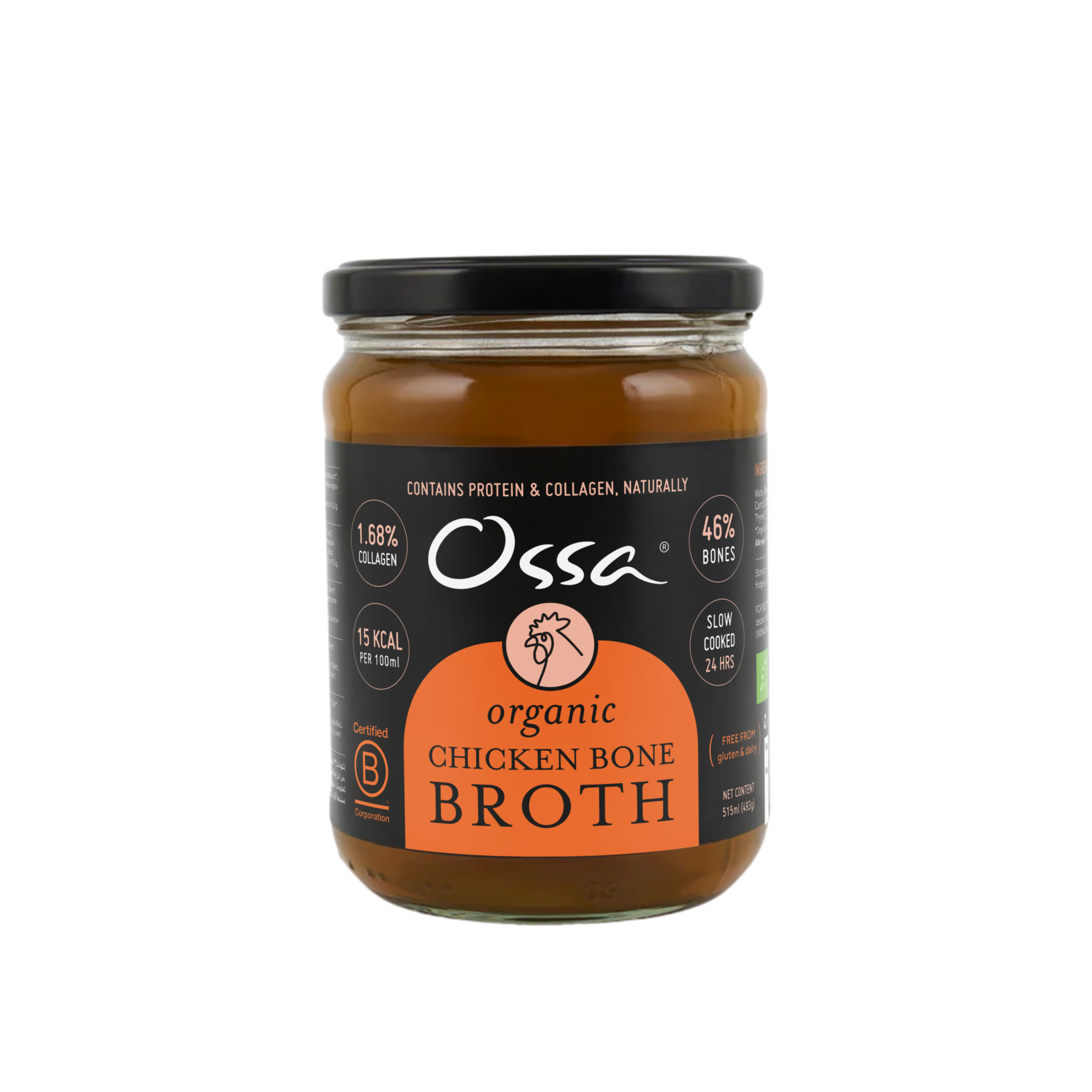
We make organic, grass-fed ghee part of our range of grass-fed fats, alongside tallow for cooking. Everything we sell is free from preservatives and artificial ingredients, and we focus on organic, ethically sourced, grass-fed ingredients and traditional slow cooking. You can see the range on our shop, together with our organic bone broths and collagen powders, which many customers add to the same weekly order.
Our view on grass-fed and organic
We set up Ossa Organic because of what natural, traditional food did for our own family. We eat mostly paleo, we avoid inflammatory foods, and we cook with fats that have a clear origin. When we think about ghee, that background shapes the answer.
We do not see grass-fed and organic as a choice between two good things. We see them as two halves of the same idea. Organic gives you the certified system: feed, welfare and a supply chain where every business has been checked. Grass-fed gives you the emphasis on pasture, which is where the colour, the flavour and the fat-soluble vitamins in the fat come from. Our approach is built on tradition, not trend, and for ghee that means organic, grass-fed ingredients, slow cooking and nothing else in the jar.
That is also why we keep the ingredient list short. Ghee is a simple food. It should be made from good butter, from cows that lived well, and it should not need preservatives or additives to last, because the way it is made is what keeps it.
If you take one thing from this guide, let it be this: read past the front of the jar. Look for the certifier code, ask where the butter comes from, and choose the ghee that can answer both questions. That is the standard we hold our own range to.
Ossa Organic
FAQ
Is grass-fed better than organic?
They measure different things, so neither is simply better. Grass-fed describes the cows’ diet and has no legal definition in the UK without a third-party seal. Organic is legally defined and certified, and includes a minimum 60% forage diet, no routine antibiotics and pasture access. The best choice is ghee that is both.
Does it matter if ghee is organic?
It matters if you want the milk behind your ghee to come from a certified system. Organic means certified feed, no routine antibiotics or wormers, no GM feed and pasture access, with every business in the supply chain certified. You can confirm it by finding the certifier code, such as GB-ORG-XX, on the label.
Is an organic jar of ghee automatically grass-fed?
No. Organic cows must eat at least 60% forage, but organic farmers can also use certified-organic concentrate feed. If you want ghee from pasture-fed cows, look for a jar that states both organic and grass-fed, with British butter named as the source.
Is ghee better than grass-fed butter?
They suit different jobs. Ghee has the water and milk solids removed, so it handles higher heat and keeps for longer, which makes it a practical choice for frying, roasting and sauteing. Butter is better when you want its milk flavour in baking. Grass-fed versions of both carry more fat-soluble vitamins and CLA than butter from grain-fed cows.
Recommended