
Cart
0
Ghee works for most Indian cooking techniques because of its nutty flavour and high smoke point. It tolerates the heat of a tadka or deep-frying without burning, and it finishes a dal or biryani with a richness oil cannot match. This guide covers how ghee is made, how to use it dish by dish, and how to store it so it stays fresh.
TL;DR:
- Ghee’s nutty flavor and high smoke point make it ideal for high-heat Indian cooking techniques like frying and tempering.
- Properly made ghee is shelf-stable at room temperature for months, provided it is stored in a dry, sealed container away from sunlight.
- Using grass-fed butter during production yields a more even browning, deeper flavor, and a nuttier finish in ghee.
- Ghee contains nutrients like butyric acid and vitamins A, D, E, and K, but should be used in moderation due to its high saturated fat content.
- Regional use varies: north Indian cuisine favors ghee as a finishing and cooking fat, while southern cuisine uses it more for tempering and flavoring.
Table of Contents
- What ghee is and how it differs from butter and clarified butter
- How to make ghee at home
- How to use ghee in Indian cooking
- Storage, shelf life and signs of spoilage
- Nutrition and health context
- Regional variations in ghee usage across India
- Traditional cultural and religious significance of ghee
- Ossa Organic’s perspective on using ghee in family cooking
- Ossa Organic product spotlight: organic grass-fed ghee
- Further reading and sources
- FAQ
What ghee is and how it differs from butter and clarified butter
Ghee is butter that has been simmered until its water content evaporates and its milk solids separate and brown, then strained clear. Clarified butter stops at the point the solids are removed. Ghee goes further: the solids are left to brown before straining, and that browning is what gives ghee its nutty, caramel-edged flavour, a taste ordinary clarified butter does not have.
This extra step changes how the fat behaves in the kitchen.
- Ghee has a high smoke point, around 250°C, well above butter’s.
- Removing the milk solids takes most of the lactose and casein with them, which is why some dairy-sensitive cooks tolerate ghee better than butter.
- Properly made and sealed, ghee is shelf-stable at room temperature for months, unlike fresh butter.
These three points explain why ghee turns up across so many Indian techniques, from shallow frying to simple tempering.
How to make ghee at home
Ghee needs one ingredient and patience. Unsalted butter is the standard choice, and grass-fed butter gives a deeper, more golden result because of its higher fat content.
You will need a heavy-bottomed saucepan, a fine sieve or muslin cloth, and a clean glass jar for storage.
- Cut unsalted butter into chunks and place it in the saucepan over low to medium heat.
- Let it melt fully, then simmer gently as the water bubbles off and the surface foams.
- Watch for the foam to subside and the milk solids to sink and turn golden brown, releasing a nutty, caramel smell.
- Remove from the heat the moment the solids are golden, not dark, to avoid a burnt taste.
- Strain through muslin or a fine sieve into a clean, dry glass jar and let it cool before sealing.
For a lower-attention method, melt the butter in an oven set low, around 90 to 100°C, and check every 20 minutes until the solids brown, then strain the same way.
The most common mistakes are rushing the heat, which browns the solids unevenly, and walking away too long, which lets them burn and turns the whole batch bitter.
Pro Tip: Use grass-fed butter if you can get it. The higher fat content browns more evenly and gives a rounder, nuttier finish.
How to use ghee in Indian cooking
Ghee’s role changes depending on the stage of the dish. Tempering, known as tadka, is the clearest example: whole spices such as cumin seeds, mustard seeds or dried chillies are dropped into hot ghee for a few seconds until they crackle and release their oils, then the whole mixture is poured over dal or a vegetable curry just before serving. The ghee carries the aroma straight into the dish.
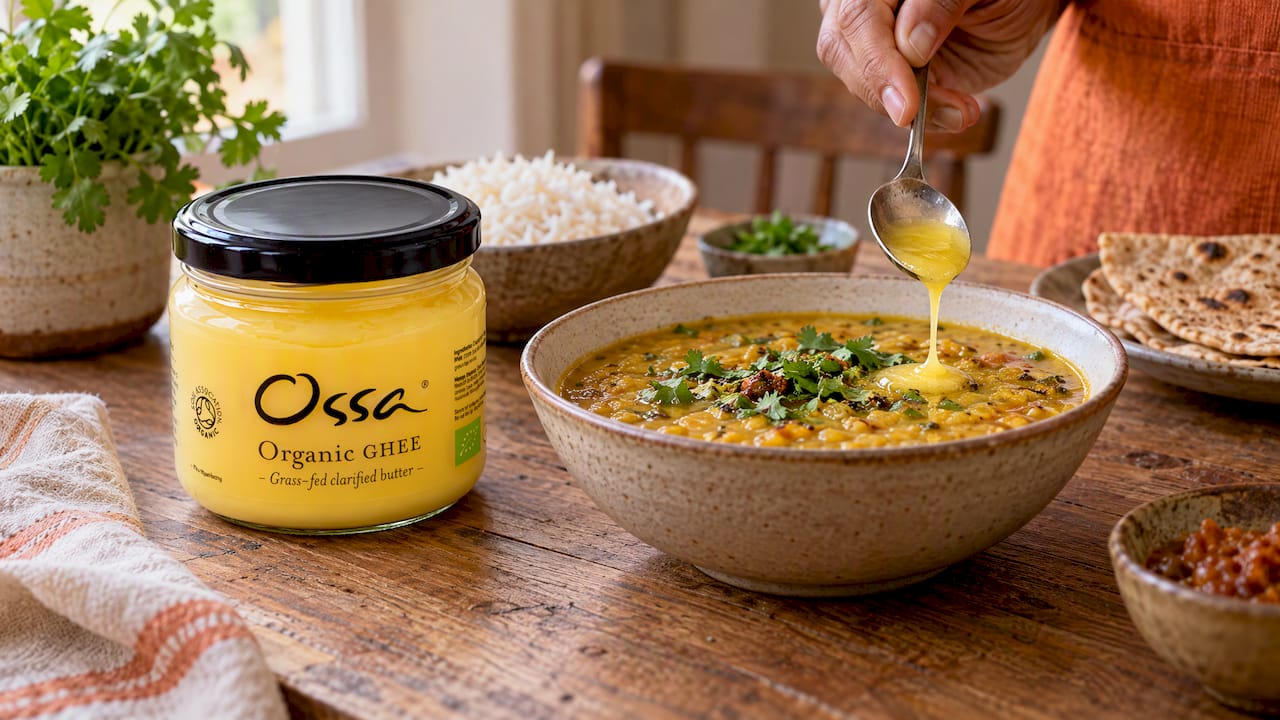
At high heat, ghee’s smoke point makes it reliable for shallow frying parathas, puris and other flatbreads without the fat breaking down or smoking. For finishing, a small spoonful stirred into a dal just off the heat, brushed onto a hot roti, or folded through biryani rice at the end adds a gloss and aroma that oil does not replicate. A teaspoon or two per serving is usually enough for finishing, more when frying.
- Dal: finish with a small spoonful off the heat, plus a tadka of cumin and garlic.
- Rotis and parathas: brush on straight from the pan for softness and shine.
- Biryani: fold through the rice during the final steam to carry the spices.
- Tadka or tempering: fry whole spices briefly in hot ghee before adding to the main dish.
Oil still makes sense for dishes that need a neutral flavour or for very high-volume deep frying where cost matters, and butter can stand in where a milder, less nutty note is wanted. For the dishes above, ghee is usually the better fit. The Ossa Organic ghee recipe collection has more ideas for working it into everyday cooking.
Storage, shelf life and signs of spoilage
Ghee’s low moisture content is what makes it shelf-stable, but that stability depends on keeping it dry and sealed.
- Store ghee in a clean, dry glass jar, away from direct sunlight and heat.
- At room temperature in a sealed jar, ghee keeps for at least three months; refrigeration extends that further.
- Moisture or food particles introduced by a wet or dirty spoon are the main cause of early spoilage.
- A rancid, sour or cheese-like smell, or visible mould, means it should be discarded rather than used.
Always use a dry spoon, and let ghee cool fully before sealing the jar to avoid trapping condensation. For a fuller breakdown of pantry versus fridge timelines, see the ghee shelf life guide.
Nutrition and health context
Ghee contains butyric acid, also called butyrate, along with conjugated linoleic acid and fat-soluble vitamins A, D, E and K. It is also energy dense and high in saturated fat, which is why it works best as part of a balanced diet rather than an unlimited pantry staple.
A 2024 systematic review found a disconnect between traditional Ayurvedic claims about ghee’s medicinal properties and the current clinical evidence, noting that trials are limited and that more collaborative research is needed before claims about immune or gut effects can be confirmed. That gap between tradition and evidence is worth keeping in mind when ghee is marketed as a health food rather than a cooking fat.
In practice, that means treating ghee as a flavourful cooking fat used in sensible portions alongside fibre-rich vegetables, pulses and grains, not as a medicinal supplement. For more on how ghee compares with butter from a gut health angle, see why ghee is a gut-loving alternative to butter.
Regional variations in ghee usage across India
Ghee is not used the same way everywhere in India. In the north, it leans towards richer, more generous use: brushed liberally onto rotis and parathas, stirred into dal makhani, and folded through pulao and biryani for a glossy finish. Punjabi cooking in particular treats ghee as a finishing fat almost as often as a cooking one.
In the south, ghee tends to play a lighter, more targeted role. It is used for tempering in sambar and rasam, drizzled over hot rice, or added in small amounts to sweets like payasam and ladoo, where its aroma matters more than its quantity. Gujarati and Rajasthani cooking use ghee heavily in sweets and in dishes meant for festivals, where richness is part of the occasion.
Bengali cooking tends to reserve ghee for finishing rather than frying, adding a spoonful to khichuri or luchi dough for fragrance rather than using it as the main cooking medium. These differences are partly about climate and ingredient availability, and partly about which dishes a region considers worth the extra richness. The common thread is that ghee is rarely the only fat in a kitchen. It is the one reached for when a dish needs a lift.

Traditional cultural and religious significance of ghee
Ghee’s role in Indian cooking goes beyond flavour. In Hindu ritual practice, ghee is used to light diyas, offered in religious ceremonies, and poured into havan fires during yagnas, where it is considered a purifying substance. Its use in these contexts predates its everyday culinary role and is tied to its long shelf life, since a fat that does not spoil easily was practical for ritual use long before refrigeration existed.
Ayurvedic texts classify ghee in several forms and attribute a range of restorative properties to it, treating it as more than a cooking medium. Traditional production methods reflect this status too: some households still make ghee from cultured curd rather than straight from cream, a method that produces a slightly different flavour and is tied to particular regional and family traditions.
Ghee is also woven into life events. It appears in wedding feasts, naming ceremonies and festival sweets, often as the fat that signals a dish is meant for a special occasion rather than daily eating. That association with celebration and ritual is part of why ghee still carries a weight that ordinary cooking oil does not, even in households that use both regularly.

Ossa Organic’s perspective on using ghee in family cooking
The brand began with bone broth, inspired by exploring how traditional, slow-cooked foods could support family health during pregnancy. That same thinking shapes a perspective on ghee: made the traditional way, from grass-fed butter, without shortcuts. It is used in kitchens for everyday dal, roasted vegetables and finishing rice, as it has traditionally been used.
— Ossa Organic
Ossa Organic product spotlight: organic grass-fed ghee
Our Organic Ghee, made from grass-fed British cows to organic standards, is clarified slowly for a nutty flavour that suits tadka, frying and finishing alike. It comes in a jar sized for regular pantry use, no fridge space required until opened. For dish ideas, browse the ghee recipe collection or see the full range on our shop page.
Further reading and sources
Background used in this guide includes a 2024 systematic review on ghee’s Ayurvedic and modern evidence, a WebMD nutrition summary on ghee’s fat and vitamin content, and practical ghee-making notes from America’s Test Kitchen.
FAQ
What is ghee used for in Indian cooking?
Ghee is used for tempering spices, frying flatbreads, and finishing dishes like dal, rice and biryani. Its high smoke point and nutty flavour make it suited to both high-heat frying and last-minute finishing touches.
Is ghee less healthy than butter?
Ghee and butter are both high in saturated fat and similarly energy dense, so neither is clearly better across the board. Ghee has had its milk solids removed, which lowers its lactose and casein content compared with butter, making it easier for some dairy-sensitive people to tolerate.
Which ghee is best for Indian cooking?
Organic, grass-fed ghee made by traditional slow-clarifying methods tends to give the most consistent flavour and aroma for Indian recipes. Ossa Organic’s grass-fed ghee is made this way, from British cows, for cooks who want that traditional result.
What should not be eaten with ghee?
There is no strict food that must be avoided with ghee, but because it is energy dense and high in saturated fat, it is worth using in moderation alongside very fatty or fried foods rather than piling it on top of them. Pairing ghee-cooked dishes with fibre-rich vegetables and pulses keeps a meal balanced.