

Cart
0
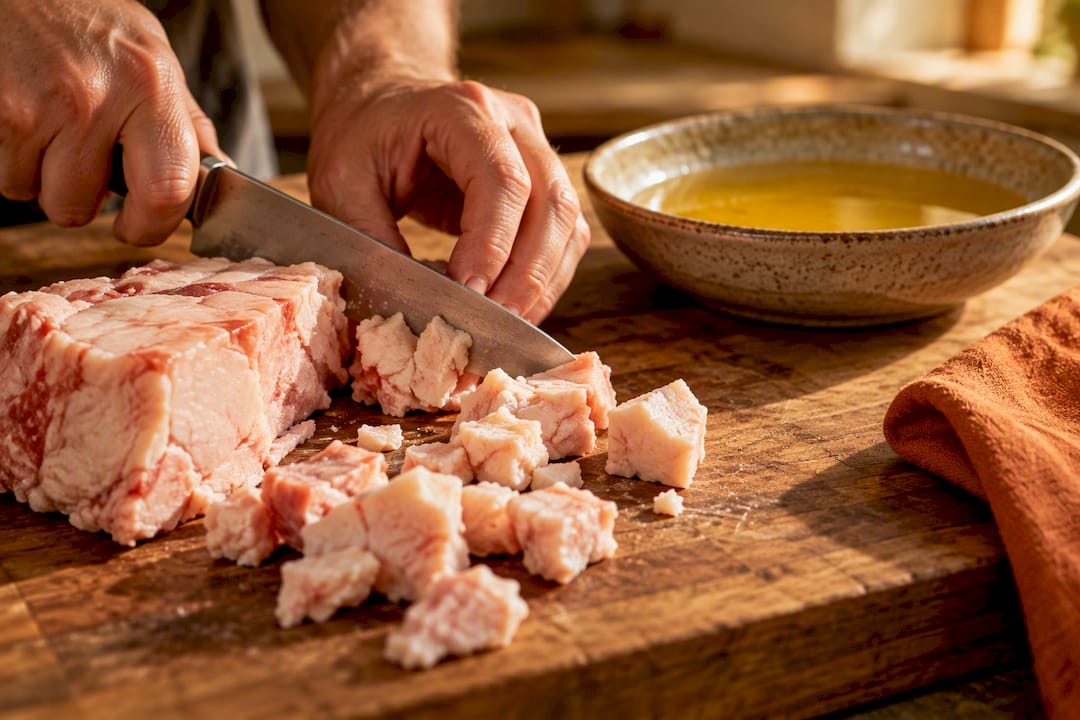
Suet is the raw, hard fat found around beef kidneys and loins; tallow is what you get once that suet (or other beef fat) has been slowly rendered down. For everyday cooking, tallow wins in versatility. It fries, roasts, and stores for months. Suet stays essential for one thing above all: traditional British puddings and pastry, where its dry, crumbly texture cannot be replicated. Keep reading for the rendering method, storage rules, and swap guidance.
TL;DR:
- Tallow is a cleaner, more neutral fat with a higher smoke point than dripping and is suitable for frying and roasting at temperatures around 220°C.
- Suet remains essential for traditional British puddings due to its dry, crumbly texture, which cannot be replicated with other fats.
- Proper rendering of suet requires low, steady heat and patience, with a second strain improving purity and shelf life.
- Fully clarified tallow can be stored at room temperature for weeks or longer in the refrigerator or freezer, whereas raw suet must be refrigerated or frozen promptly.
- Using grass-fed, organic suet or tallow supports sustainable and ethical farming practices, with minimal environmental impact compared to imported vegetable oils.
Table of Contents
- What is suet, and what is tallow?
- How do you render suet into tallow?
- When should you cook with suet, tallow, or dripping?
- How long do suet and tallow last in storage?
- Is tallow good for you, and how much is too much?
- Can you use tallow for skincare and soap?
- Ossa Organic’s perspective on suet and tallow
- Where do suet and tallow come from historically?
- Is grass-fed tallow more sustainable and ethical?
- The simple verdict on suet vs tallow
- Ossa Organic’s grass-fed fats for your kitchen
- Further reading on suet and tallow
- FAQ
What is suet, and what is tallow?
Suet is the firm, crumbly fat that surrounds a cow’s kidneys and loins. Butchers prize it because of where it sits on the animal: it is drier and harder than the fat found around muscle cuts, which means it renders cleanly with very little residue left behind. That clean render is the whole story behind why suet, specifically, makes the best tallow.
Tallow is what results once suet has been melted down, strained, and cooled into a smooth, shelf-stable block. The word gets used loosely today, though: some cooks call any rendered beef fat “tallow”, including fat trimmed from muscle cuts rather than the kidney area.
That looseness causes the most common confusion in this topic: is beef dripping the same as tallow? Not quite. Beef dripping traditionally refers to the fat collected from a roasting tin, mixed with meat juices, which gives it a stronger, beefier flavour. Tallow rendered specifically from suet is cleaner tasting and higher yielding, because suet contains far less connective tissue than the trimmings that produce dripping.
A few terms worth knowing before you render your own:
- Suet: raw, unrendered kidney or loin fat.
- Tallow: suet (or other beef fat) melted, strained, and set solid.
- Dripping: fat collected from roasting meat, often mixed with juices.
- Greaves (or “cracklings”): the crisp solid bits left behind after rendering, once used in feed or pet treats.
How do you render suet into tallow?
Rendering suet at home is straightforward, though it rewards patience over speed. Rushing the heat is the single biggest mistake people make, and it is what turns a clean, neutral tallow into something scorched and bitter.
Preparation
- Trim the suet of any visible membrane, blood, or connective tissue, then chop or mince it into small, even pieces. The smaller the pieces, the faster and more evenly it renders.
- Choose your method: wet or dry. The wet method adds a small amount of water to the pot at the start, which helps prevent scorching and is more forgiving for beginners. The dry method skips the water and relies purely on low, steady heat.
- For stovetop rendering, heat the fat on the lowest setting your hob allows, stirring occasionally, for roughly two to four hours until the solid pieces (the greaves) turn golden and float.
- For oven or slow-cooker rendering, set the temperature no higher than 110°C to 120°C and leave it for four to eight hours, checking periodically.
- Strain the liquid fat through a fine sieve lined with muslin or a coffee filter while it is still warm, discarding or reserving the greaves.
- Pour the strained tallow into clean jars and let it cool at room temperature before sealing.
- For a purer, longer-lasting tallow, repeat the melt-and-strain process a second time. Chefs and butchers note that this second pass produces a cleaner, more neutral fat with a longer shelf life, since it removes the last traces of protein that can cause spoilage.
Pro Tip: Keep a thermometer in the pot. If the fat starts smoking or the greaves turn dark brown rather than golden, the heat is too high, and the whole batch will carry a scorched, slightly bitter aftertaste no amount of straining will fix.
Handle hot fat with the same caution as hot oil. Never leave a pot unattended, keep the handle turned inward, and let jars cool fully before moving them, since a full jar of hot tallow is heavy and can crack a cold glass surface.
When should you cook with suet, tallow, or dripping?
The right fat depends entirely on what you are making, and the differences are not subtle once you know what to look for.
- Suet belongs in traditional British baking: suet puddings, dumplings, and mincemeat all rely on its dry, granular texture to create light, tender crumb rather than a greasy one. Butter or lard behave too wet for these recipes; suet is what gives steamed puddings their characteristic lightness.
- Tallow is the better choice for high-heat cooking. Well-rendered tallow has a smoke point of around 220°C, well above butter and most vegetable oils, which makes it suited to frying, searing, and roasting potatoes without breaking down or turning acrid. Its neutral flavour also makes it a strong stand-in for shortening in pastry.
- Beef dripping earns its place when you want the stronger, meatier flavour that comes from fat rendered alongside roasting juices. Roast potatoes cooked in dripping have a depth that neutral tallow simply does not deliver.
If a recipe calls for one and you only have another, substitution is usually possible with a little adjustment. Tallow can generally replace suet in pastry at a similar quantity, though you will lose some of the light, crumbly texture suet gives to steamed puddings. Suet cannot easily replace tallow for frying, since it contains more moisture and burns faster. For inspiration on where tallow performs best, Ossa Organic’s tallow recipes collection is a useful starting point, and dressings built around rendered fats also work well in lighter dishes, as shown in this collection of bowl sauces.
How long do suet and tallow last in storage?
Storage requirements differ sharply between the two, mostly because of moisture content.
- Raw suet should be kept refrigerated and used within a few days, or frozen for several months if you are not rendering it immediately.
- Fully clarified tallow is far more stable. Once strained clean of protein and moisture, it can sit at room temperature in a cool, dark cupboard for weeks, and refrigerated or frozen tallow keeps for many months.
- Store tallow in an airtight glass jar, labelled with the render date, away from direct heat and light, since both accelerate rancidity.
- Rancid tallow smells sour or waxy rather than neutral; if in doubt, discard it. Homemade batches that were not double-rendered spoil faster than shop-bought tallow, since residual protein shortens shelf life.
The smoke point and shelf life of a batch depend heavily on how carefully it was rendered and stored, a point covered in more depth on Ossa Organic’s tallow smoke point guide.
Is tallow good for you, and how much is too much?
Tallow is a saturated fat, and mainstream nutrition guidance is consistent on this point: saturated fats should be limited, not treated as a health food to consume freely. Peer-reviewed research on animal fats and cardiovascular risk generally supports moderation over restriction-free enthusiasm, and tallow is no exception to that pattern.
Tallow’s nutritional profile: it carries fat-soluble vitamins including A, D, E and K in modest amounts, along with small quantities of conjugated linoleic acid (CLA), a fatty acid studied for various metabolic effects. These are real properties, but they do not amount to a health claim, and hospital nutrition teams are explicit that tallow offers no unique clinical benefit beyond being a traditional, minimally processed fat.
Recent wellness-trend enthusiasm has pushed tallow as a near-miracle ingredient, and that framing deserves scepticism. Dietitians reviewing these claims point out there is nothing in the research to support tallow outperforming other fats for skin or gut health specifically. Use it because it tastes good, renders cleanly, and comes from an animal raised well, not because it promises outcomes the evidence does not support.
Practically, this means treating tallow the way earlier generations did: as one cooking fat among several, used in reasonable amounts alongside olive oil, butter, and other fats, rather than as a daily supplement.

Can you use tallow for skincare and soap?
Tallow’s traditional non-food uses go back centuries, and the same properties that make it useful in the kitchen (a firm texture and long shelf stability) explain why it turns up in balms, soaps, and salves.
- Balms and salves: tallow is often blended with a plant oil in roughly equal parts, then set with a small amount of beeswax for firmness.
- Soap making: tallow’s saturated fat content produces a hard, long-lasting bar, which is why it has been a soap-making staple historically.
- Sourcing matters: for topical use, choose well-rendered, filtered tallow, ideally from organic, grass-fed sources, since impurities left in poorly strained batches can irritate skin.
None of this amounts to a medical claim. Tallow-based skincare sits firmly in the traditional and cosmetic category, not a treatment for skin conditions, and any DIY formulation should be treated as an experiment rather than a remedy.
Ossa Organic’s perspective on suet and tallow
The conviction about slow, traditional food shapes how some think about suet and tallow. Some favour organic, grass-fed sourcing and traditional rendering methods over shortcuts, because the fat’s quality depends entirely on how the animal was raised and how gently it was rendered.
That approach carries through every use discussed here, from frying and pastry work to the odd topical experiment. Grass-fed tallow, rendered slowly and filtered properly, is preferred by some, whether it is made at home or bought ready-made.
Where do suet and tallow come from historically?
Suet and tallow predate refrigeration by centuries, and their popularity was never really about flavour first. Before electricity, tallow was one of the few fats that stayed solid and stable at room temperature for months, which made it indispensable for candle making, soap production, and food preservation long before anyone thought of it as a cooking ingredient in its own right.
British kitchens have used suet in puddings since at least the eighteenth century. Suet pudding, spotted dick, and Christmas pudding all rely on a technique that predates modern baking fats entirely: suet’s dry texture, worked into flour and steamed rather than baked, creates a dense, moist crumb that butter cannot replicate. Rationing during the Second World War cemented suet’s place in British households further, since it was cheap, filling, and kept well without refrigeration.
Tallow’s history stretches wider still. It was a staple trade good across Europe for candle making until paraffin wax largely replaced it in the nineteenth century, and it remained a common cooking fat across working households well into the twentieth century, before vegetable oils and margarine took over supermarket shelves in the postwar decades. The current return to tallow is, in that sense, less a trend and more a rediscovery of what kitchens relied on for generations before industrial seed oils became the default.
Is grass-fed tallow more sustainable and ethical?
Sourcing matters more with suet and tallow than with almost any other cooking fat, because both are by-products of beef farming rather than crops grown specifically for oil.
Using suet and tallow, rather than letting them go to waste, is arguably one of the more sustainable choices available in the fat aisle. Both make full use of an animal that has already been raised for meat, reducing the amount of the carcass that goes unused. That “nose to tail” principle sits at the heart of traditional butchery and is one of the strongest ethical arguments in favour of rendering your own fat rather than buying imported vegetable oils shipped long distances.
Grass-fed sourcing adds a further layer to the ethical case. Cattle raised on pasture rather than grain-heavy feedlots generally have a lower environmental footprint per animal in terms of land degradation and antibiotic use, though grazing systems vary widely in efficiency depending on the land and region. Organic certification adds assurance that the animals were not treated with routine hormones or unnecessary antibiotics, which matters to anyone trying to move away from processed, chemically treated food.
Choosing organic, grass-fed suet or tallow, whether rendered at home from a trusted butcher’s cut or bought ready-made, is a small but meaningful way to support farming practices that treat the whole animal, and the land it grazed on, with more care.

The simple verdict on suet vs tallow
Suet and tallow are not competitors; they are two stages of the same fat, suited to different jobs. Reach for tallow when you need a high-heat, long-storing, neutral cooking fat, and keep suet for the traditional puddings and pastry it was always meant for. Use both in moderation, as part of a varied diet rather than a daily staple.
If you want to try this yourself, there are three easy next steps: render a batch of suet at home using the method above, try a traditional suet pudding recipe to feel the texture difference for yourself, or pick up a ready-made organic tallow to skip the rendering entirely. Whichever route you take, sourcing well matters more than the method you choose.
— Ossa Organic
Ossa Organic’s grass-fed fats for your kitchen
Rendering your own tallow is satisfying, but it takes time most home cooks do not always have, which is exactly the gap Ossa Organic’s grass-fed fat range fills. Our Organic Tallow is rendered from British, grass-fed beef fat to organic standards, ready to use straight from the jar for frying, roasting, or pastry work without a single hour spent watching a stovetop. For a different cooking fat with the same traditional grounding, the Organic Ghee, also grass-fed and organic, suits baking and high-heat cooking where a buttery note works better than a neutral one. If you would rather taste tallow before cooking with it, the Tallow Potato Crisps are fried in it, giving you a direct sense of the flavour it brings. Browse the full range of grass-fed fats or explore the wider shop to find the format that suits your kitchen.
Further reading on suet and tallow
- Suet — Wikipedia — background on anatomical sourcing and the traditional rendering process.
- NCBI (PMC6101675) — peer-reviewed context on saturated fatty acids and cardiovascular health.
FAQ
Can I use tallow instead of suet?
Tallow can often replace suet in pastry and general cooking, but traditional steamed puddings rely on suet’s dry, granular texture for their light crumb. Swap in similar quantities for pastry, but expect a denser result in puddings made with tallow instead.
Is tallow the same as suet?
No. Suet is the raw, unrendered fat from around the kidneys and loin, while tallow is what results once that suet has been melted, strained, and cooled solid. They come from the same source but behave very differently in cooking.
Why avoid beef tallow?
Tallow is a saturated fat, and mainstream nutrition guidance recommends limiting saturated fat intake rather than avoiding it entirely. There is no clinical reason to avoid it outright, but it should be used in moderation as part of a varied diet, the same as any other traditional animal fat.
Can I turn suet into tallow?
Yes. Chop the suet finely, then heat it gently, either on the stovetop for two to four hours or in a low oven for four to eight hours, until it melts and the solid greaves separate out. Strain through muslin, and repeat the process once more for a cleaner, longer-lasting tallow.