
Cart
0
Store fresh homemade bone broth in the fridge for a few days, or in the freezer for several months, depending on your container and how much fat is in the batch. Cool it quickly, portion it before chilling, and label every container with the date. Unopened shelf-stable cartons are the exception. They keep in a cool cupboard until the printed date, but once opened, they follow the same short fridge storage rule as anything homemade.
The number that matters most here isn’t the fridge life. It’s the temperature range your broth must avoid sitting in for too long: the bacterial danger zone ranging from just above refrigeration temperatures up to warm temperatures where bacteria multiply quickly. A big pot of hot broth left cooling on the counter can sit in it for hours if you let it. Split it into smaller containers before it goes anywhere near the fridge.
-
Fridge: A few days for homemade broth, in a sealed container.
-
Freezer: Several months for quality, longer for safety, but flavour and texture start to fade past that window.
-
Unopened ambient cartons: follow the printed best-before date, stored in a cool, dry cupboard.
-
Opened cartons: treat exactly like homemade broth once the seal is broken.
Pro Tip: Never leave a full pot of broth cooling on the hob “until it’s ready to go in the fridge.” Ladle it into shallow containers first, then chill. Speed is the entire game.
Key Takeaways
Correct bone broth storage comes down to three numbers: cool within two hours, refrigerate for 3–4 days, and freeze for up to 4–6 months in portioned, labelled containers.
| Point | Details |
|---|---|
| Fridge window | Use homemade or opened broth within 3–4 days, stored in a sealed container. |
| Freezer window | Frozen broth holds good quality for 4–6 months in airtight, labelled packaging. |
| Cool fast | Portion into shallow containers and use an ice-water bath to clear the 4°C–60°C danger zone quickly. |
| Freeze smart | Freeze bags flat, leave headspace in jars, and label with date and volume before storing. |
| Ready-made backup | Ossa Organic’s ambient and chilled broths give a shelf-stable or fridge-ready option for weeks without time to batch-cook. |
Further reading on food storage and safety
-
General food storage and safety guidance covering fridge and freezer best practice, useful for cross-checking temperature rules beyond bone broth specifically.
-
Practical freezing guides covering jar headspace, container choice, and avoiding cracked glass when freezing liquids at home.
-
For broader meal-prep inspiration once your broth is safely stored, holiday meal prep tips for busy home cooks offers useful batch-cooking ideas that pair well with a freezer stocked in labelled portions.
If you’ve bought a commercial broth, always check the manufacturer’s own storage instructions on the pack alongside this guide, since processing methods can shift the exact recommended window slightly.
Table of Contents
-
How long does bone broth last? Fridge, freezer and shelf-stable timelines
-
Why does bone broth gel, and what do you do with the fat layer?
How long does bone broth last? Fridge, freezer and shelf-stable timelines
Homemade bone broth kept in a sealed container stays safely edible in the fridge for a few days. Some consumer guidance suggests a slightly longer timeframe, but the shorter end is the safer bet if your kitchen runs warm or your fridge isn’t consistently cold. If you know you won’t use it within that window, freeze it rather than gambling on extra time.
Opened store-bought broth behaves the same way as homemade once the seal is broken. It doesn’t matter that it came from a pouch or ambient carton with a long shelf life stamped on the box. The moment air gets in, the clock resets to the same 3 to 4 day fridge rule. Unopened ambient cartons are a different story entirely: pasteurisation and airtight packaging mean they’re shelf-stable at room temperature until the printed date, provided the carton itself is undamaged.
Freezer life is more forgiving but not infinite. Broth typically holds its quality for several months, though the range shifts depending on your container, how much fat you left in, and how well you sealed out air. A leaner, well-strained broth frozen flat in a proper freezer bag will outlast a fatty batch loosely covered in a tub with a gap of air above it.
| Storage method | Typical timeframe | Notes |
|---|---|---|
| Fridge (homemade or opened) | several days | Use a sealed, airtight container |
| Freezer | several months | Quality declines gradually past this point |
| Unopened ambient carton | Until printed date | Store in a cool, dry cupboard |
A word on refreezing: once broth has thawed, avoid refreezing it. Each freeze-thaw cycle degrades texture and flavour, and it adds an unnecessary safety risk if the broth spent any time at room temperature during thawing. Portion before you freeze the first time so you never need to refreeze at all.
-
Homemade broth: a few days refrigerated.
-
Store-bought, opened: similar fridge window.
-
Frozen broth: several months for best quality.
-
Refreezing thawed broth: avoid it where possible.
Best containers and portion sizes for bone broth storage
The container you choose affects three things: how fast the broth cools, how much freezer space it eats up, and whether you’ll actually use the small portions instead of letting a giant block go to waste. Bone broth storage isn’t just about temperature; it’s about setting yourself up to actually finish what you froze.
-
Straight-sided glass jars are excellent for the fridge and freezer, but only if they’re straight-sided with no shoulders. Curved jars can crack under the pressure of expanding liquid, so leave adequate headspace and avoid jars with narrow necks or shoulders.
-
Freezer-safe plastic containers stack well, don’t break, and work for larger family-sized portions you’ll defrost for a big pot of soup.
-
Zip-top freezer bags are the space-saving champion. Laid flat to freeze, they take up a fraction of the room a jar does, and once solid they store upright like files in a drawer, so you can flick through them and grab exactly what you need.
-
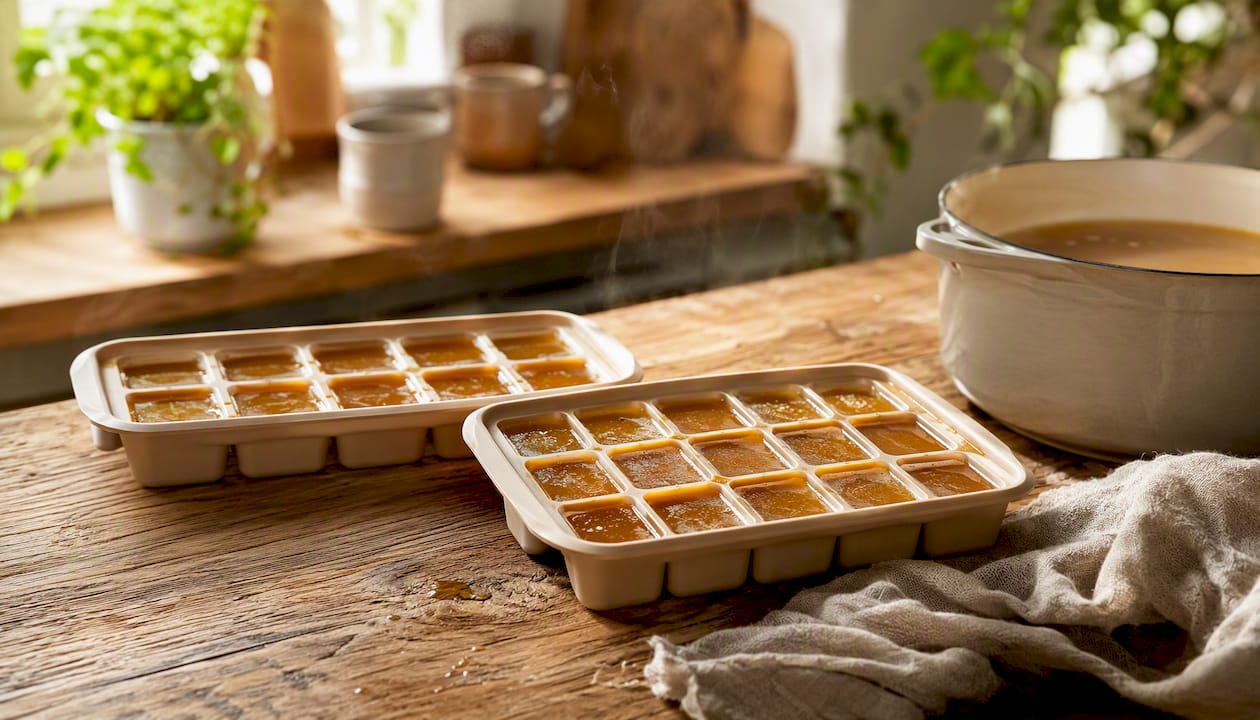
Silicone moulds or ice-cube trays are ideal for small, measured portions, perfect for a splash in a sauce or a stir-fry rather than a whole mugful.
Portion by use case, not by habit. A single-serve cube (roughly 15 to 30ml) suits sauces and pan deglazing. A 250ml portion covers one mug or a small soup base. A full litre bag suits a proper family batch of soup or stew. Measuring your cube volumes once, then labelling the bag with “approx. 20ml per cube,” saves you guesswork every single time you reach for the freezer.
Pro Tip: If you’re using flexible silicone moulds, set them on a rigid baking tray before filling. It stops spills on the way to the freezer and gives you clean, solid blocks once frozen, rather than a puddle in the bottom of your freezer drawer.
How to cool bone broth quickly and avoid the danger zone
Bacteria multiply fastest between 4°C and 60°C, and a large pot of broth cooling slowly on the counter can sit inside that range for far longer than feels intuitive. A stockpot holds heat stubbornly. Left as one big mass, it can take several hours to drop through the danger zone, which is exactly the window bacteria need to establish themselves. Splitting the broth into smaller volumes and actively cooling it is the single biggest safety upgrade you can make to your routine.
-
Strain the broth through a fine sieve to remove bones and solids.
-
Skim excess fat if you plan to store it long-term. Less fat means better freezer life and a cleaner cool.
-
Portion into shallow containers. Depth is your enemy here. A wide, shallow tray cools far faster than a deep jug of the same volume.
-
Set the containers in an ice-water bath in the sink, and stir occasionally. This pulls heat out fast and can shave a couple of hours off the cooling time compared with leaving broth to cool unassisted.
-
Once cooled to room temperature, refrigerate or freeze immediately. Don’t leave it sitting out “just for a bit longer” once it’s cool.
If you’re not planning to use the broth within 3 to 4 days, skip the fridge stage and freeze straight away rather than letting it linger and tempting you to push the fridge window.
Freezing and thawing bone broth: methods that actually work
Can you freeze bone broth? Yes, and it’s the best way to extend bone broth shelf life well beyond what the fridge allows. The trick is doing it in a way that makes future-you’s life easier, not harder.
-
Cool the broth fully first. Never put warm broth straight into the freezer; it raises the internal temperature of everything around it and slows freezing for the whole batch.
-
Choose your format. Silicone moulds and ice-cube trays suit small measured portions. Flat zip-top bags suit larger volumes and freeze faster because of their thin profile. Straight-sided jars work for anyone who prefers glass, provided you leave headspace.
-
Freeze flat. Lay filled bags on a baking tray until solid, then stand them upright like books in a freezer bin or drawer. This single habit transforms freezer organisation, because you can see and grab exactly the portion you need instead of digging through a pile.
-
Label everything with the date and the approximate volume before it goes in. A frozen block with no label is a mystery six weeks later.
When it comes to how to defrost bone broth, you have three realistic options, ranked by safety and flavour:
-
Fridge overnight is the gold standard. It thaws slowly and safely, keeping the broth out of the danger zone the entire time.
-
Cold-water bath works when you’re in more of a hurry. Submerge the sealed container in cold water, changing it every 30 minutes or so, and it’ll be usable within a couple of hours.
-
Microwave is the fastest option but should only be used when you’re going to heat and eat immediately afterwards, since microwave defrosting warms unevenly and can leave the broth partially in the danger zone if left to sit.
Pro Tip: Keep a few frozen blocks in reserve specifically for cooling. Dropping a frozen cube or block into a hot, fresh batch of broth speeds up cooling dramatically and gets it out of the danger zone faster than waiting for an ice bath alone.
How to reheat bone broth safely
Reheat bone broth until it’s steaming or gently simmering, right the way through, not just warm at the edges. A half-hearted reheat that leaves the centre lukewarm gives bacteria exactly the conditions they need, so don’t stop the moment steam appears at the surface. Get it properly hot before you drink it or use it in a recipe.
-
Stovetop reheating is the most reliable method. A gentle simmer for a few minutes, stirred occasionally, heats the broth evenly and lets you check the frozen chunks have fully melted through.
-
Microwave reheating works fine for a single mug, but stir halfway through. Microwaves heat unevenly, and you can end up with a scalding patch next to a lukewarm one.
-
Frozen blocks straight into a pot is a genuinely useful shortcut. Drop a frozen cube or brick directly into a saucepan on low heat rather than thawing first, and it’ll melt down and heat through together.
-
Only reheat what you’ll actually use. Reheating the whole batch to eat one mug, then putting the rest back in the fridge, means it’s cycled through the danger zone twice for no reason. Portioning solves this problem before it starts, which is exactly why the meal prep approach to bone broth works so well for busy households.
-
Don’t refreeze reheated broth. Once it’s been heated, use it or refrigerate the leftover portion for a day or two at most.
If you’re wondering is it safe to reheat bone broth more than once, the honest answer is: technically yes, but each cycle degrades flavour and texture, and increases the cumulative time spent in unsafe temperatures. For safer, faster warming from frozen, our guide on microwaving bone broth covers the exact settings that avoid the common pitfalls.
Does bone broth go bad? Signs to check before you drink it
Yes, bone broth does go bad, and your senses are usually the quickest way to tell. Trust a bad smell over a “well, it’s only been five days” mental calculation.
-
Off or sour smell is the most obvious red flag. Fresh broth smells savoury and meaty; spoiled broth smells sharp, sour, or faintly like ammonia.
-
Fizzing or bubbling when the container is opened, particularly if it hasn’t been heated, signals bacterial fermentation and means it should be discarded immediately.
-
Visible mould, whether a fuzzy spot on the surface or coloured patches around the container’s edge, is a hard stop. Don’t scrape it off and use the rest.
-
A slimy or tacky texture on the surface, separate from the normal fat layer, is another sign it’s turned.
If the broth passes the smell and appearance checks and is within its window, it’s almost certainly fine. If you’re genuinely unsure, warm a small spoonful and taste it before committing a whole mug, rather than guessing from the fridge. And label containers with the date you made or opened them. Uncertainty about “how long has this actually been in here” is one of the most common reasons people either waste good broth or risk eating bad broth.
Why does bone broth gel, and what do you do with the fat layer?
Gelling is a good sign, not a fault. When bone broth sets into a wobbly, jelly-like consistency in the fridge, it means the collagen extracted from the bones and connective tissue during cooking has converted into gelatine. The more pronounced the gel, the more collagen made it into the pot.
Gelled broth stores the same way as liquid broth, whether that’s fridge or freezer. It’ll simply need gentle reheating to loosen back into a liquid. A sitting layer of solid white fat across the top is normal too, and it actually helps preserve the broth underneath by sealing out air, a bit like the wax seal on a jar of preserves. If you want a leaner broth or you’re planning to freeze it for months, skim that fat layer off before storing. If you’re using it within a few days, leaving it in place is perfectly fine and adds flavour when reheated.
-
Gel in the fridge is a sign of good collagen extraction, not spoilage.
-
Reheat gelled broth gently on the stovetop until it loosens into liquid.
-
Skim the fat layer for longer-term freezer storage; leave it for short-term fridge use.
Pro Tip: Save a jar of solidified fat separately if you skim it off. It’s excellent for roasting vegetables and adds a rich, savoury note that plain oil doesn’t give you.
Storing shelf-stable bone broth vs a fresh homemade batch
Unopened ambient cartons of bone broth are shelf-stable because of how they’re processed and packaged, not because they’re fundamentally different from homemade broth. Commercial pasteurisation and an airtight, sterile seal mean the carton can sit safely in a cupboard at room temperature until the date printed on the box. Once you break that seal, though, the same rules that govern a pot of homemade broth apply immediately.
-
Unopened ambient cartons: store in a cool, dry cupboard away from direct heat or sunlight, and follow the printed date exactly.
-
Opened commercial cartons: refrigerate straight away and use within 3 to 4 days, identical to homemade.
-
Chilled, pre-made broths (as opposed to ambient) should be treated like fresh homemade broth from the moment you bring them home. Follow the pack instructions on the fridge window, since chilled products haven’t gone through the same shelf-stable processing as ambient cartons.
The packaging is doing real work here. It’s not a marketing distinction. Once oxygen gets back in and the sterile barrier is broken, whatever protection the pasteurisation gave the broth is gone, and normal spoilage timelines take over.
Can you store bone broth at room temperature?
Briefly, yes, but the window is much smaller than people assume. A pot of freshly made broth can sit at room temperature only for as long as it takes to cool it down properly, ideally no more than two hours before it needs to be in the fridge, freezer, or actively cooling in an ice bath. Beyond that, you’re deep into the 4°C to 60°C danger zone with no protection.
Unopened ambient cartons are the genuine exception, because commercial sterile processing makes them shelf-stable by design. That doesn’t extend to anything homemade or anything opened. Once a carton is opened or you’ve made a fresh pot, room temperature storage stops being an option and the fridge or freezer takes over. If you’re travelling with broth or transporting it somewhere, an insulated cool bag with ice packs is the safer choice over leaving it on a counter or in a car.
A note from our founder on why storage habits matter
I started making bone broth at home during my first pregnancy, long before Ossa Organic existed, and the habit that stuck with me most wasn’t the recipe. It was learning to portion everything into small containers the moment it came off the stove, rather than leaving one enormous pot to cool overnight and hoping for the best. That single habit, portion first, cool fast, label always, is still how our own kitchens operate today, just at a larger scale.
If you take one thing from this guide, make it portioning into single-serve cubes or small jars before anything goes in the fridge or freezer. It sounds like a small change, but it’s the difference between broth you actually use and broth you eventually throw away because you can’t tell how old it is or how much is left.
A ready-made option when you don’t have time to batch-cook
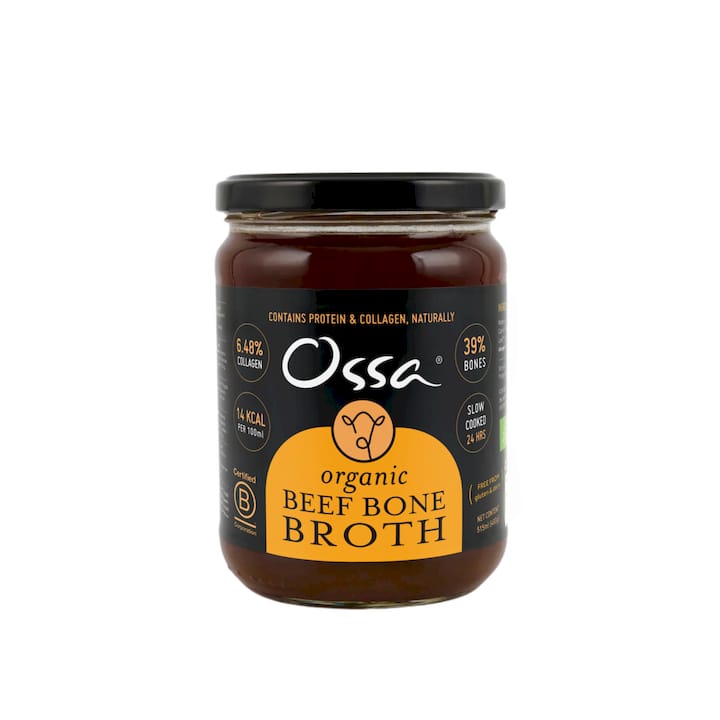
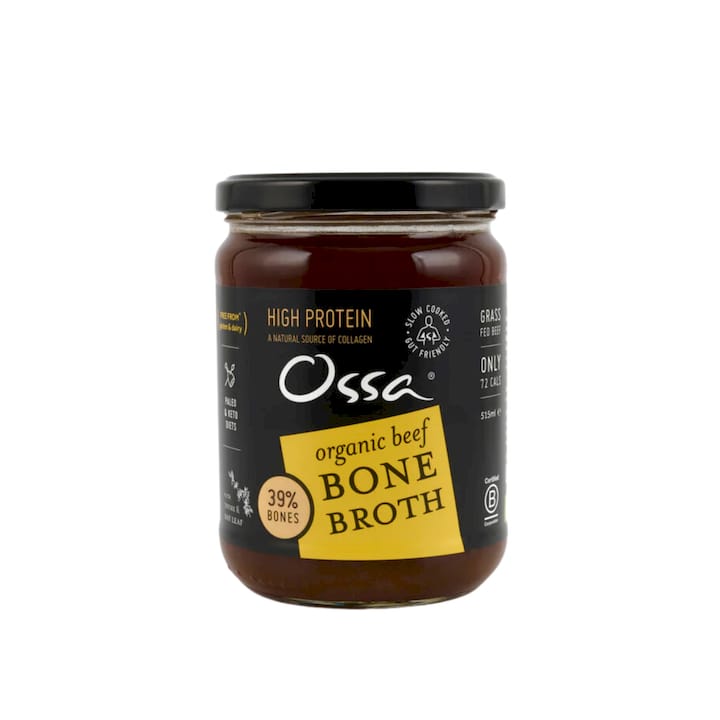
Not every week allows for a full stockpot session, and that’s precisely where a ready-made broth earns its place in the cupboard or fridge. Ossa Organic’s ambient beef bone broth is shelf-stable until opened, so it sits in the cupboard as backup stock without taking up fridge or freezer space at all. Once opened, it follows the same 3 to 4 day fridge rule as anything homemade, so there’s no guesswork.
For chilled convenience, the Organic Free Range Chicken Bone Broth gives you a ready-to-drink option with the same slow-cooked, organic approach we use for every batch. If pantry stability matters more to your routine, the ambient chicken bone broth covers that need without sacrificing the sourcing standards we’ve built the brand around. Have a look through the product pages to find the format, ambient or chilled, that fits how your household actually cooks and eats.
FAQ
What is the best way to store bone broth?
Cool it quickly in shallow containers or an ice bath, then refrigerate for up to 3–4 days or freeze in labelled, portioned containers for 4–6 months.
Are you supposed to keep bone broth in the fridge?
Yes, homemade or opened bone broth must be refrigerated and used within 3 to 4 days; only unopened, shelf-stable ambient cartons can sit safely in a cupboard.
Is it safe to reheat bone broth?
Yes, provided you heat it until steaming or simmering throughout, reheat only the portion you’ll use, and avoid refreezing broth once it’s been reheated.
Why do I feel weird after drinking bone broth?
This is usually unrelated to storage and more to do with high histamine content or sensitivity to rich, gelatine-heavy liquids in some people; if it happens consistently, check freshness first and consider a smaller portion.
Can you freeze bone broth in glass jars?
Yes, but only in straight-sided jars with roughly an inch of headspace left at the top; jars with a narrower neck or shoulders are prone to cracking as the liquid expands.