
Cart
0
A slow cooker reliably yields rich, gelatinous bone broth with minimal hands-on time. Roast your bones at 200°C for 30 minutes, transfer them to the slow cooker with aromatics, add 1–2 tablespoons of apple cider vinegar and enough cold filtered water to cover, then set to Low. Chicken bones need around half a day or more; beef and mixed bones benefit from a full day to two days. The gel test is simple: pour a small amount into a bowl and refrigerate overnight. If it sets to a jelly, the broth is ready. If it stays liquid, reduce it on the hob for 20–30 minutes and test again.
Key takeaways
A slow cooker set to Low for 12–48 hours, with roasted bones and apple cider vinegar, is the most reliable method for producing a gelatinous, nutrient-rich bone broth at home.
| Point | Details |
|---|---|
| Roast bones first | Roast at 200°C for 25–35 minutes to develop flavour before slow cooking. |
| Add acid before heating | Use 2 tablespoons of apple cider vinegar in cold water; soak for 20–30 minutes before switching on. |
| Cook time by bone type | Chicken: 12–24 hours; beef and mixed bones: 18–48 hours on Low. |
| Gel test and storage | Refrigerate overnight to test; store a few days in the fridge or 3–6 months in the freezer. |
| Ossa Organic ready-made | Organic beef and chicken broths (500–515ml) available ambient, with no preservatives or additives. |
Table of Contents
- What do you need to buy for slow-cooked bone broth?
- How to make slow-cooked bone broth step by step
- What does cook time actually do to your broth?
- Practical tips for maximum flavour, clarity and gel
- What to do when your broth won’t gel, goes cloudy, or tastes bitter
- How to cool, store and freeze slow-cooked bone broth safely
- Everyday ways to use slow-cooker bone broth in cooking and sipping
- What does homemade bone broth actually contain, and where should you source the bones?
- Why Ossa Organic recommends slow-cooked broth above all other methods
- Ready-made slow-cooked broth from Ossa Organic
- Useful sources
- FAQ
What do you need to buy for slow-cooked bone broth?
The bones are the foundation. Quantity and type determine gel strength more than any other variable.
Bones (choose one or combine):
- Chicken carcasses: 1–2 whole carcasses (roughly 500–800 g total), or a mix of backs, necks and feet for extra gelatin
- Beef knuckle or joint bones: 1–1.5 kg, ideally cut by the butcher to expose the marrow
- Beef marrow bones: 500 g, best combined with knuckle or oxtail rather than used alone
- Oxtail: 500–700 g, adds both gelatin and deep flavour
Aromatics:
- 1 large onion, halved (no need to peel)
- 2 medium carrots, roughly chopped
- 2 celery stalks, roughly chopped
- 1 teaspoon whole black peppercorns
- 2 bay leaves
- A small handful of flat-leaf parsley stalks
Acid:
- A couple of tablespoons apple cider vinegar or white wine vinegar
The vinegar does not make the broth taste sour. Its role is to help draw minerals from the bones and assist collagen breakdown, which improves gelatin extraction. Add it to the cold water before heating and allow the bones to sit in the acidulated water for 20–30 minutes before switching the slow cooker on.
Substitutions: Leftover roast chicken carcasses work well and are the most economical option. Fish bones and prawn shells produce a lighter broth with less gel, so expect a thinner result unless you add a split pig’s trotter. Lamb bones follow the same timing as beef.
For batch cooking ideas and planning ahead, the holiday meal prep tips from Wild Foodz are worth a look.
How to make slow-cooked bone broth step by step
Step 1: roast the bones
Spread the bones in a single layer on a roasting tray. Roast at 200°C (180°C fan) for 25–35 minutes until deeply browned. Do not rush this step. The Maillard reaction happening on the bone surface is what gives the finished broth its dark, savoury depth.
Once roasted, pour a small splash of cold water into the hot tray and scrape up the browned bits with a wooden spoon. Pour everything, including those dark pan juices, into the slow cooker. This deglazing step adds significant umami.
Step 2: load the slow cooker
Add the aromatics directly on top of the bones. Pour in the vinegar, then cover everything with cold filtered water. The water level should sit about 2 cm above the bones. Do not overfill: most 6-litre slow cookers should not be filled beyond three-quarters capacity.
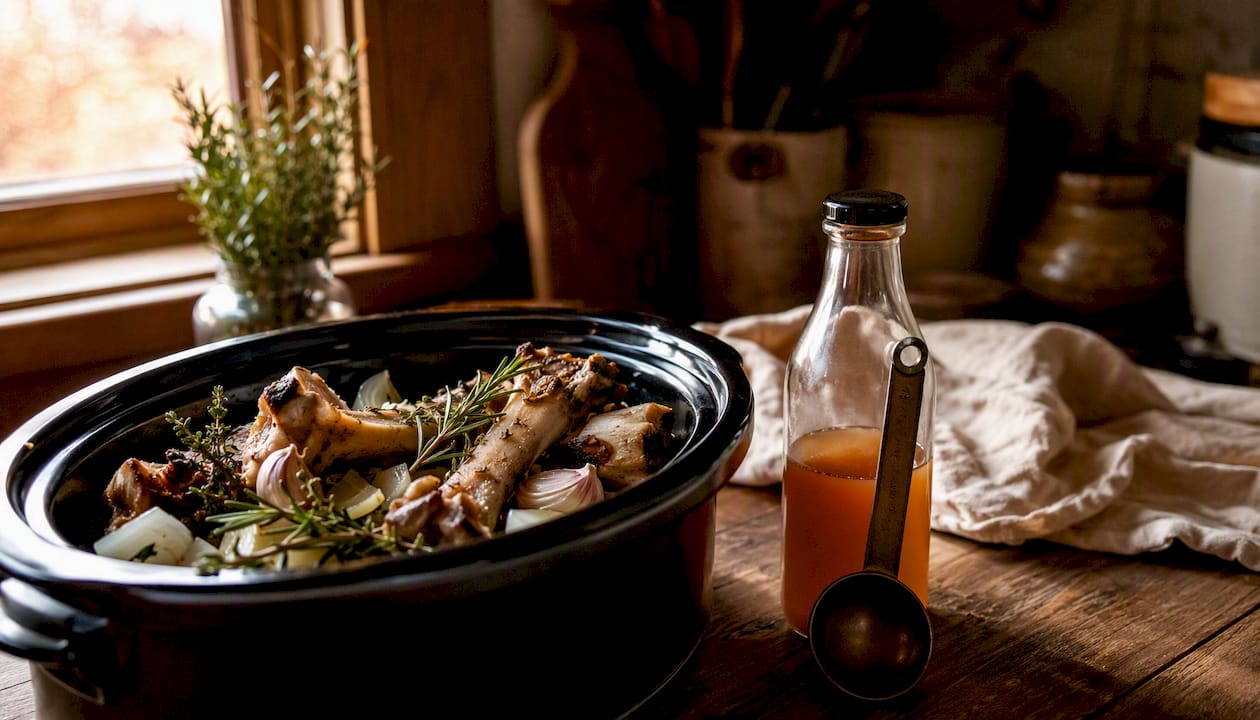
Pro Tip: Let the bones sit in the cold acidulated water for 20–30 minutes before switching the slow cooker on. This short soak gives the vinegar time to begin working on the bone surface before heat is applied.
Step 3: cook on Low
Set the slow cooker to Low. Do not use High: a rapid boil emulsifies fats into the liquid, producing a cloudy, greasy broth. Low heat keeps the simmer gentle and the gelatin extraction steady.
Check at the 12-hour mark for chicken bones. Beef and mixed batches benefit from a check at 18 hours. The bones are done when they feel brittle and crumble slightly when pressed. Skim any grey scum from the surface during the first two hours if you can; after that, the liquid should run relatively clear.
Step 4: strain, cool and test
Ladle the broth through a fine-mesh sieve into a large bowl or pot. Discard the solids. Allow the broth to cool at room temperature for no more than two hours, then transfer to the fridge. Once cold, a layer of fat will solidify on the surface. Lift it off with a spoon and discard or reserve it for cooking.
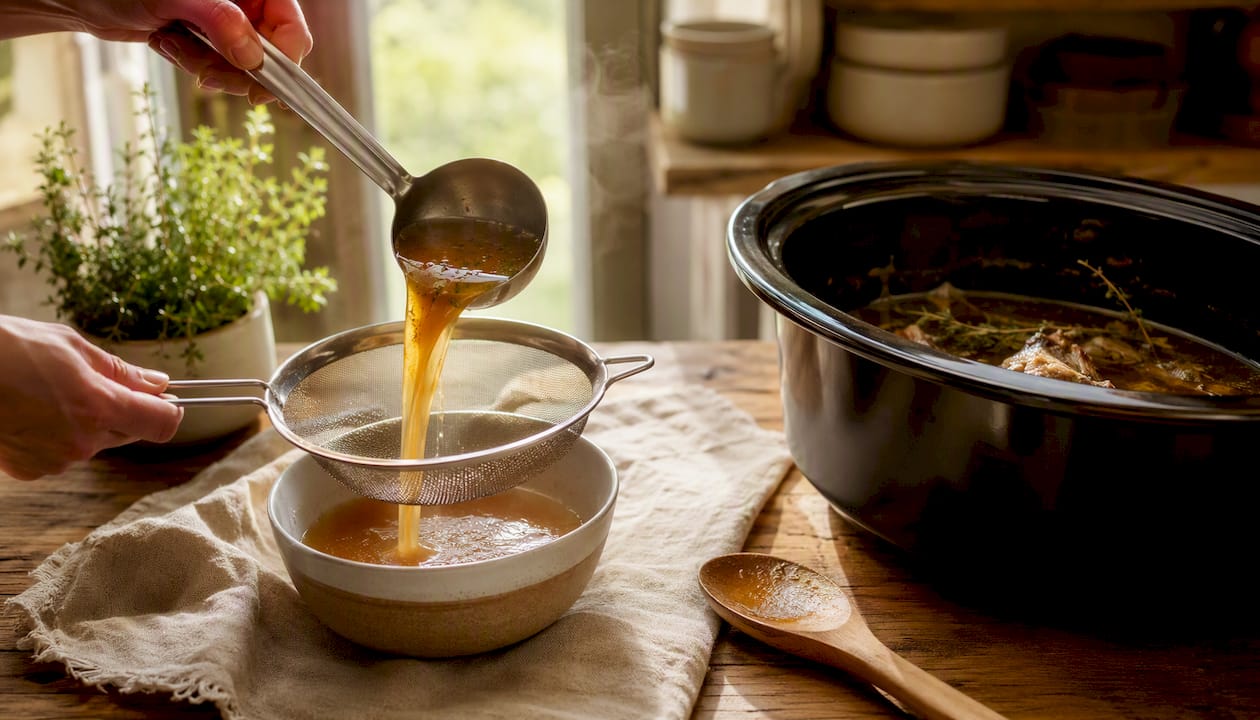
Check the gel: if the broth has set to a jelly, it is ready to portion and store. If it remains liquid, pour it into a saucepan and reduce over a medium heat for 20–30 minutes, then refrigerate and test again.
Handle the hot liquid carefully. Use oven gloves when lifting the slow-cooker insert, and ladle rather than pour to avoid splashing.
What does cook time actually do to your broth?
Longer is not always better. The relationship between time, gelatin and flavour is more nuanced than most recipes suggest.
At 12 hours, chicken broth is typically well-extracted and lightly gelatinous. Pushing to 18–24 hours deepens the flavour and increases gel strength. Beyond 24 hours, chicken broth can develop a slightly flat or mineral taste, particularly if the heat crept above a gentle simmer.
Beef and mixed-bone batches behave differently. The dense connective tissue in knuckle and oxtail needs sustained heat to break down fully, so 18–24 hours produces a good result and 36–48 hours gives a noticeably richer, more concentrated broth. Marrow-heavy batches without joint bones may not gel strongly regardless of time; the gelatin comes from collagen-rich connective tissue, not from marrow itself.
| Bone type | Suggested time | Expected gel result |
|---|---|---|
| Chicken carcass or backs | 12–24 hours | Firm jelly when cold |
| Mixed beef (knuckle + oxtail) | 18–48 hours | Very firm jelly |
| Beef marrow only | 18–36 hours | Light to moderate gel |
| Lamb bones | 18–36 hours | Moderate to firm gel |
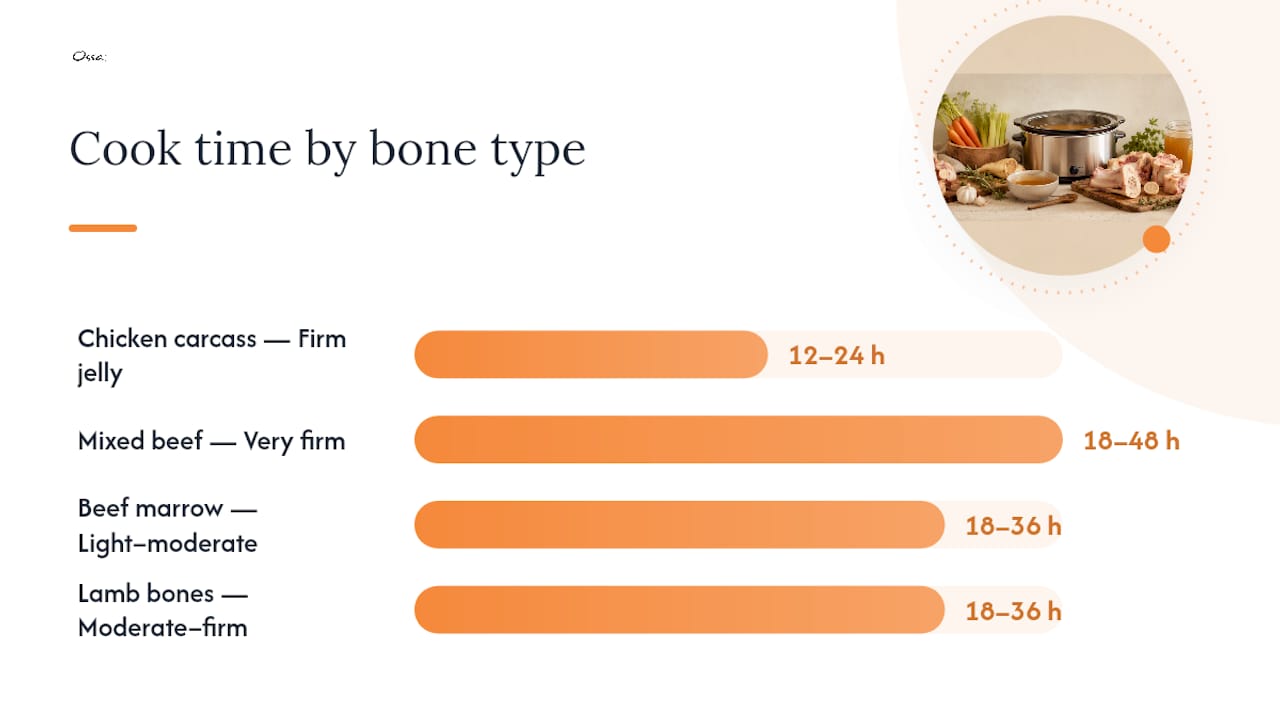
For comparison, an Instant Pot produces a very good result in 2–3 hours, and a stovetop simmer takes 12–24 hours. The slow cooker sits at 18–24 hours or more for beef and delivers excellent gelatin extraction because the temperature stays consistently low throughout.
Practical tips for maximum flavour, clarity and gel
Do roast the bones. Skipping this step produces a pale, flat broth. The only time you can reasonably skip it is when using leftover roast carcasses that are already well-browned from the oven.
Avoid these aromatics: leeks, cruciferous vegetables (broccoli, cabbage, Brussels sprouts) and starchy vegetables like potatoes. They make the broth bitter or starchy and muddy the flavour.
Skim early. The grey-brown scum that rises in the first hour is coagulated protein. Remove it with a ladle or spoon. If you miss it, the broth will not be ruined, but it will be cloudier.
For better gel:
- Use more joint bones (knuckle, feet, oxtail) relative to marrow bones
- Add a split pig’s trotter to any batch for a significant gelatin boost
- If the finished broth is thin, reduce it on the hob rather than extending the slow-cooker time
Pro Tip: Add the vinegar to cold water before the slow cooker goes on, not partway through cooking. The acid works most effectively at the start, when the bones are still cold and the surface is most accessible.
Choosing organic ingredients matters here. The same principle that applies to organic sourcing in coffee applies to bones: the quality of the raw material shapes the quality of the finished product.
What to do when your broth won’t gel, goes cloudy, or tastes bitter
-
Broth won’t gel. The most common cause is too much water relative to bones, or bones with insufficient connective tissue. Pour the broth into a saucepan, bring to a medium simmer and reduce by one-third. Refrigerate and test again. If it still does not gel, use it as a flavourful cooking liquid rather than discarding it.
-
Broth is cloudy. Cloudiness usually means the liquid boiled at some point rather than simmering gently. Check that your slow cooker’s Low setting is actually maintaining a gentle simmer, not a rolling boil. To clarify an already-cloudy broth, allow it to cool completely, then ladle it through a fine-mesh sieve lined with a piece of muslin cloth.
-
Broth tastes bitter or soapy. Over-roasted aromatics are the most likely culprit. Onion skins and carrots can turn bitter if they char rather than brown. Check roasting times and temperatures. If the bitterness is mild, a small squeeze of lemon juice or a pinch of salt can balance it. If the flavour is strongly unpleasant, the batch is unlikely to improve and is best discarded.
-
Broth tastes flat or mineral. Extended cook times, particularly beyond 48 hours for chicken, can produce this result. Reduce the time in future batches and add a small bunch of fresh parsley in the last 30 minutes of cooking to lift the flavour.
-
Accepting a thin broth. A thin but well-flavoured broth is still useful. Use it as a cooking liquid for grains, pulses or sauces rather than as a sipping broth.
How to cool, store and freeze slow-cooked bone broth safely
Cool the broth quickly. Place the bowl or pot in an ice bath (a larger bowl filled with cold water and ice) and stir occasionally. The aim is to bring the temperature below 8°C within two hours. Do not place a large pot of hot broth directly into the fridge: it raises the internal temperature and puts other food at risk.
Once cold and the fat layer has been removed, portion and store.
Portioning ideas: 250–500 ml glass jars are practical for single servings. Ice-cube trays work well for small amounts used in sauces and risottos; once frozen, transfer the cubes to a freezer bag. Label every container with the date and bone type.
To reheat, warm gently in a saucepan over a low-medium heat. Avoid boiling, which can affect the texture and flavour of a well-made gelatinous broth.
Everyday ways to use slow-cooker bone broth in cooking and sipping
The broth you have made is versatile enough to replace stock in almost any recipe, and rich enough to drink on its own.
- Sipping: warm a mug of broth with a pinch of sea salt, a squeeze of lemon and a few fresh herbs. This is the simplest and most direct way to use it, particularly first thing in the morning or as an afternoon alternative to tea.
- Soups and stews: use as the base for any soup. The gelatin gives body that a stock cube cannot replicate.
- Risotto: replace half or all of the stock with bone broth for a richer, more nutritious result.
- Braising liquid: use in place of water or wine when braising meat or vegetables in the oven or slow cooker.
- Cooking grains: cook rice, quinoa, lentils or pearl barley in broth instead of water for added depth.
- Pan sauces: deglaze a roasting tray or frying pan with broth and reduce to a quick sauce.
- Freezer cubes in sauces: drop two or three frozen broth cubes into a tomato sauce, curry base or stir-fry for an instant flavour lift.
For more ideas, Ossa Organic’s collection of bone broth recipes covers everything from simple soups to more involved weeknight meals. There are also 50 practical ways to use bone broth if you find yourself with a large batch and want to work through it efficiently.
What does homemade bone broth actually contain, and where should you source the bones?
Homemade slow-simmered bone broth typically supplies gelatin (from collagen), the amino acids glycine and proline, and trace minerals including calcium, magnesium and phosphorus. The exact amounts vary considerably depending on bone type, cook time and water volume, so treat these as general indicators rather than precise nutritional data.
Protein content is modest compared with meat or fish. Bone broth is not a primary protein source; its value lies in the gelatin and amino acid profile, which supports gut lining integrity and joint tissue. Vitamins are present in small amounts and are not the main nutritional argument for broth.
Nutritionists recommend using organic, pasture-raised or grass-fed bones wherever possible. Conventionally raised animals may carry higher levels of inflammatory residues, which can concentrate during long cooking. Choosing higher-quality bones produces a cleaner nutritional profile and aligns with gut-health goals.
For sourcing, a local butcher is the most reliable option. Ask specifically for knuckle bones, feet or oxtail if gel is the priority. Many butchers sell these cheaply or give them away. Whole-bird carcasses from a free-range or organic supplier are another practical and economical choice.
The gut-health and collagen benefits of slow-simmered broth are covered in more detail on the Ossa Organic blog, including the evidence around joint support and digestive health.
Why Ossa Organic recommends slow-cooked broth above all other methods
Slow cooking is not a shortcut. It is the method that most closely mirrors traditional broth-making, where bones simmered for a day or more over a low fire. At Ossa Organic, this approach sits at the centre of what the brand was built on: the belief that long, low heat extracts the most from quality ingredients without forcing the process.
The slow-cooker method described here reflects the same principles applied to Ossa Organic’s own products: organic bones, no additives, no shortcuts on time. The gel test matters because gelatin is the marker of a broth that has done its job. A thin, watery broth, however convenient, does not deliver the same nutritional profile.
For home cooks, the practical advantage of the slow cooker is that it removes the need to monitor a stove for 24 hours. Set it before bed, strain it in the morning. That simplicity is what makes batch cooking realistic for most households.
Ready-made slow-cooked broth from Ossa Organic
Making broth at home is rewarding, but it requires time, sourcing, and a 24-hour window. When that is not available, Ossa Organic’s ready-made broths offer the same slow-cooked quality without the preparation.
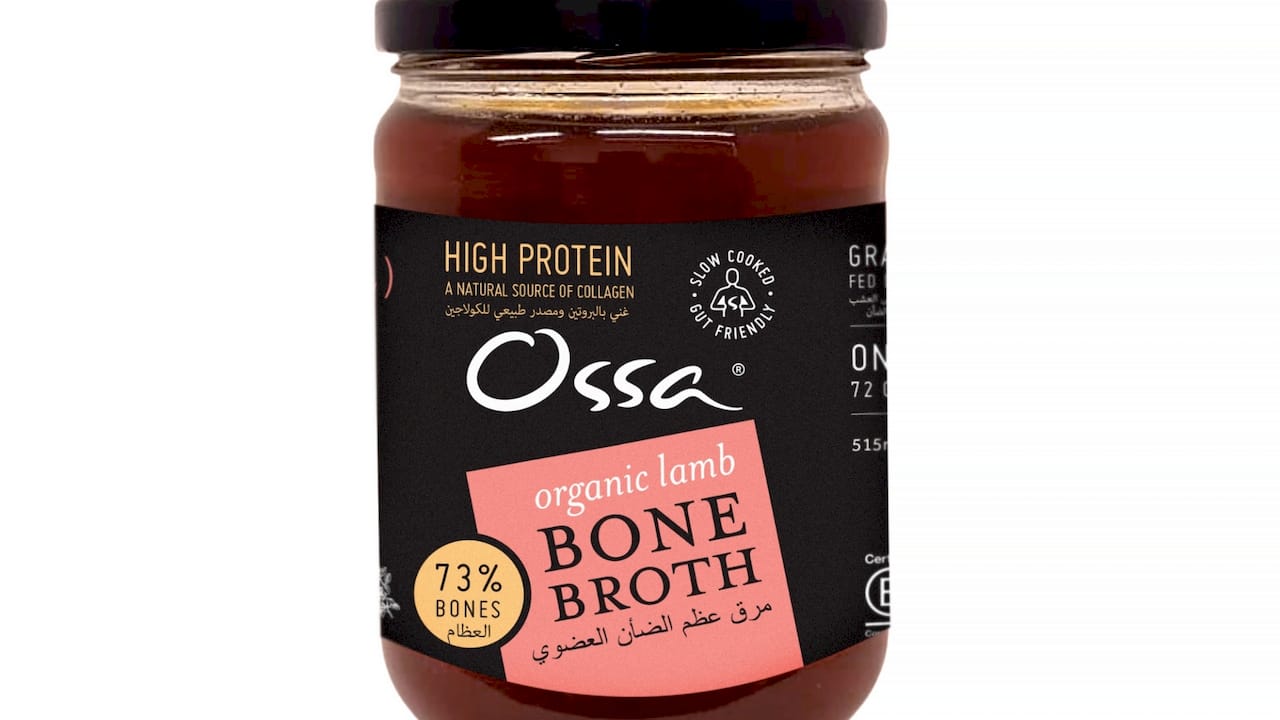
The Organic Beef Bone Broth (515ml) is made from grass-fed beef bones, slow-cooked and free from preservatives, additives or artificial ingredients. For poultry, the Organic Free Range Chicken Bone Broth (500ml) and the Organic Chicken Bone Broth (515ml) both deliver a consistent, gelatinous result with no preparation required. All three are ambient, so they store easily in a cupboard until needed.
The honest comparison: homemade broth gives you control over bone sourcing and batch size; Ossa Organic gives you consistency, convenience, and a verified organic supply chain. Browse the full range and order directly at Ossaorganic.
Useful sources
- BBC Good Food slow-cooker bone broth recipe: practical timings and technique guidance widely used by home cooks
- The Kitchn, “How to Make Bone Broth”: sourcing advice and nutritional context, including the case for organic and pasture-raised bones
- “Slow Cooker Bone Broth: Rich and Gelatinous (24 Hour Simmer)”: detailed method covering vinegar use, roasting and gel testing
- “24 Hour Crockpot Bone Broth” (Happily From Scratch) — gel test methodology and troubleshooting for thin broth
- “Bone Broth Recipe: How to Make It 3 Ways” (Slow Cooker, Instant Pot and Stovetop) — method comparison and timing data for all three approaches
- The Nourishing Home, “How to Make Slow Cooker Bone Broth”: storage timelines and portioning guidance
FAQ
Can you slow cook bone broth?
Yes. A slow cooker set to Low is one of the most effective methods for making bone broth at home. The steady, low heat extracts collagen and minerals from the bones over 12–48 hours without the aggressive boiling that causes cloudiness.
What happens if bone broth does not gel?
The most likely cause is insufficient collagen-rich bones or too much water. Reduce the broth on the hob by one-third, then refrigerate and test again. Adding knuckle bones, feet or oxtail to future batches will improve gel strength.
Does boiling bone broth destroy collagen?
A hard boil does not destroy collagen, but it emulsifies fats into the liquid, making the broth greasy and cloudy. Keeping the slow cooker on Low maintains a gentle simmer that extracts gelatin cleanly without affecting clarity.
What is the downside of drinking bone broth every day?
Bone broth is generally well-tolerated, but it is relatively high in sodium if salted, and some people are sensitive to the glutamate content in long-cooked broths. Using it as part of a varied diet rather than as a sole supplement is the practical approach.