

Cart
0
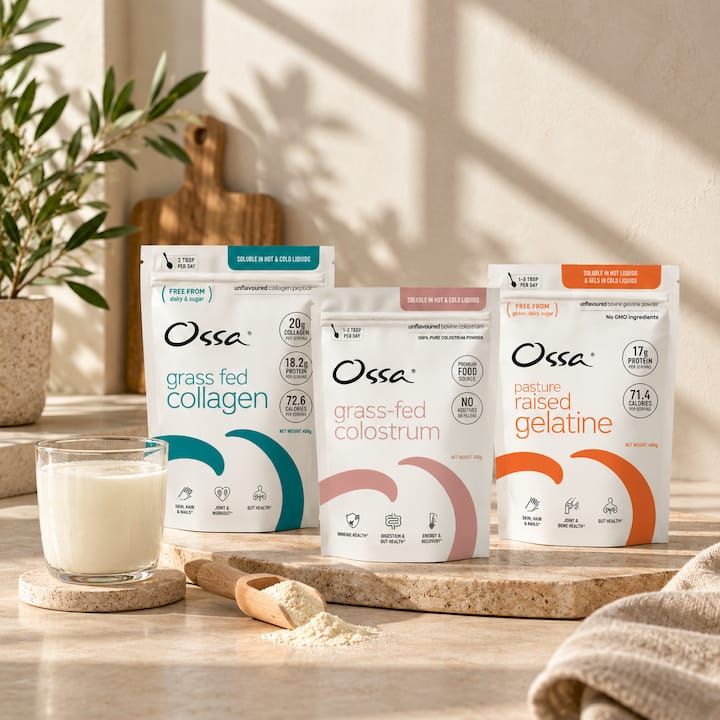
Bovine and marine collagen both deliver the same amino acids your body needs to rebuild skin, joints and gut lining, so neither is universally “better”. Choose bovine collagen for broader joint, gut and skin support at a lower cost per gram; choose marine collagen if you’re pescatarian, avoiding mammalian products, or focused specifically on skin. Whichever you pick, consistency matters more than source: 2.5g to 10g daily for at least 8 to 12 weeks. Fish allergies and religious dietary rules should decide the matter outright for some readers.
TL;DR:
Bovine collagen typically costs less per gram and offers broader Type I and III support for skin, joints, and gut health.
Marine collagen may absorb faster due to smaller peptides but is generally more expensive and suited for pescatarians and skin-focused goals.
Clinical evidence for bovine collagen shows measurable skin improvements at doses of 2.5g to 5g over 8 weeks, with higher doses for joint support.
Consistent daily intake of 2.5g to 10g for at least 8 to 12 weeks is necessary, regardless of the source, to see meaningful results.
Allergies, dietary restrictions, and budget should greatly influence collagen source choice since no collagen type is definitively superior.
Table of Contents
-
Bovine collagen: source, composition and the evidence behind it
-
What the clinical research actually shows for skin, joints and gut health
What is collagen and why does the source matter?
Collagen is the structural protein that holds skin, tendons, cartilage and gut lining together, and it’s the most abundant protein in the human body. There are at least 28 known types, but two matter for supplements: Type I, found in skin, bone and tendons, and Type III, found alongside Type I in skin and blood vessel walls. The type 1 vs type 3 collagen distinction explains why some products are marketed for skin firmness (Type I) and others for gut and vascular support (Type I and III combined).
Whole collagen molecules are too large to survive digestion intact, which is why every supplement worth buying uses hydrolysed collagen peptides. Hydrolysis breaks the protein into shorter chains that dissolve easily and absorb more readily than gelatine or raw collagen. This is where the type 1 vs type 2 collagen conversation sometimes causes confusion online: Type II collagen (found in cartilage) is a different molecule used in different supplements entirely, and it’s rarely what bovine or marine peptide products contain.
What actually varies between sources is peptide size and solubility, not the underlying amino acid content:
-
Molecular weight: smaller peptides generally dissolve faster and may appear in the bloodstream sooner in tracer studies.
-
Solubility: affects how easily a powder mixes into cold liquids without clumping.
-
Amino acid density: glycine, proline and hydroxyproline dominate both bovine and marine collagen, since these are what your body actually uses to rebuild its own collagen.
-
Processing method: enzymatic hydrolysis produces more consistent peptide sizes than acid hydrolysis, regardless of animal source.
None of this means one source is inherently defective. It means the label terms are worth understanding before you compare prices.
Bovine collagen: source, composition and the evidence behind it
Bovine collagen comes from cattle hide and bone, and it typically supplies a mix of Type I and Type III collagen, which is why it’s marketed for skin, joints and gut health simultaneously rather than one narrow use case. This broader composition is bovine collagen’s main practical advantage over single-type marine formulas.
The clinical evidence behind bovine collagen is also the deepest of the two categories. The Proksch VERISOL trials, among the most cited studies in this space, used daily doses of 2.5g to 5g of bovine collagen peptides over 8 weeks and reported measurable improvements in skin elasticity and wrinkle depth. Joint-focused trials have generally used higher doses, often around 10g daily, reflecting the larger amount needed to influence cartilage and connective tissue rather than skin alone.
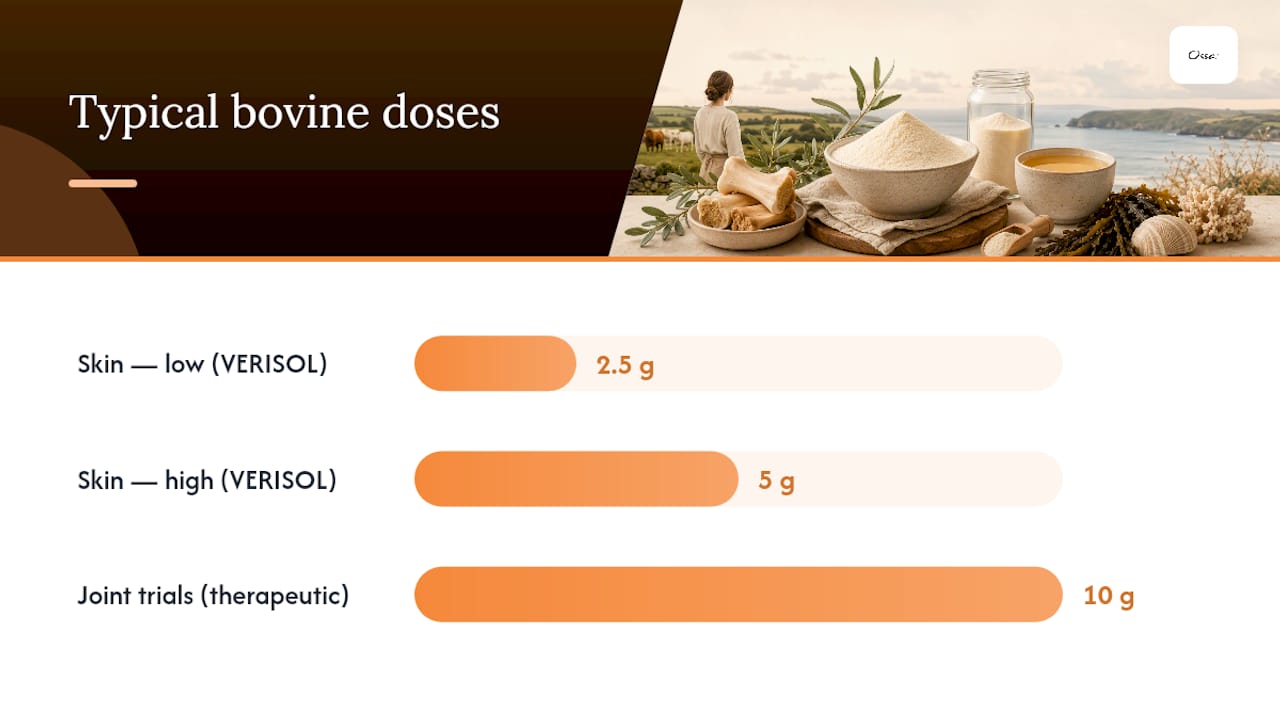
Statistic callout: Bovine collagen typically costs meaningfully less per gram than marine collagen, according to a BBC Good Food review of UK collagen supplements. At therapeutic doses of up to 10g a day, that price gap compounds fast over a month of consistent use.
Bovine collagen’s practical strengths and limitations:
-
Covers skin, joint and gut goals with one product rather than three.
-
Costs meaningfully less per gram, which matters at higher daily doses.
-
Some consumers prefer grass-fed labelling as it may indicate more consistent sourcing and fewer additives.
-
Not suitable for anyone following halal, kosher, Hindu or strict vegetarian dietary rules that exclude bovine-derived products.
-
Rare but real: some people carry an alpha-gal allergy to mammalian meat and collagen, which is worth checking if you’ve had unexplained reactions to red meat.
If you want a full explainer on how bovine and marine peptides compare on absorption and application, understanding collagen for skin, gut and joints covers the mechanics in more depth.
Marine collagen: source, composition and where it fits
Marine collagen is extracted from fish skin and scales, and it’s almost entirely Type I collagen, which is why it’s marketed heavily for skin firmness rather than joint or gut health. That narrower composition isn’t a flaw, it’s simply a different tool for a different goal.
The theoretical case for marine collagen rests on peptide size. Hydrolysed marine peptides tend to have a lower average molecular weight than bovine equivalents, and tracer studies suggest this can translate into faster appearance in the bloodstream. Whether that speed advantage produces meaningfully better skin, joint or gut outcomes in practice remains unproven. Human trials on marine collagen are also fewer in number and generally smaller than the bovine literature, so the dermal fit is more mechanistic reasoning than settled proof.
Pro Tip: If sustainability matters to you, check whether the product is made from wild-catch fish byproducts rather than farmed offcuts. “Marine” sounds automatically eco-friendly, but traceability varies enormously between brands, and a vague “sustainably sourced” claim without specifics is a label to question.
Marine collagen’s practical trade-offs:
-
Pescatarian-friendly and free of the religious dietary restrictions that rule out bovine sources.
-
Possible faster absorption based on smaller peptide size, though clinical relevance is still debated.
-
Costs more per gram in most UK retail comparisons, often noticeably higher per kilogram than bovine collagen.
-
Unsuitable for anyone with a fish or shellfish allergy, which is a hard exclusion rather than a caution.
-
Worth checking for heavy metal and contaminant testing, since fish can concentrate environmental toxins depending on catch location.
Bovine vs marine collagen: the practical trade-offs
The type coverage gap is the clearest difference: bovine collagen typically supplies Type I and Type III together, while marine collagen is almost purely Type I. That single fact answers most of the “which collagen is better, marine or bovine” question on its own, because it tells you what each is actually built to support.
Peptide size favours marine collagen on paper, but the evidence gap runs the other way. Far more human trials, including the VERISOL and Peptan protocols, have tested bovine hydrolysates, which means bovine dosing recommendations rest on a larger body of research. If you want your supplement choice to mirror what was actually tested in a clinical trial, bovine collagen currently gives you more to work from.
Cost tips the practical scale further towards bovine for anyone taking higher daily doses. A 20 to 40% per-gram saving barely registers at 2.5g a day, but at 10g a day across a month, it adds up to a genuine budget consideration.
Key comparison points at a glance:
-
Type coverage: bovine offers Type I and III; marine offers predominantly Type I.
-
Absorption evidence: marine peptides are smaller on average; clinical impact of that difference is unconfirmed.
-
Trial volume: bovine collagen has more, and larger, published human trials behind it.
-
Cost per gram: bovine collagen is consistently cheaper across UK retail comparisons.
-
Dietary fit: marine suits pescatarians and those avoiding mammalian products; bovine suits those without fish allergies wanting broader coverage.
No published trial has directly pitted bovine against marine collagen head to head on the same outcome measure, so any claim that one “wins” outright is reading further into the evidence than it currently supports.
How to choose between bovine and marine collagen
Work through this checklist before you buy, in order of importance:
-
Define your primary goal. Skin only points towards either source; joint, gut or general wellness goals point more strongly towards bovine’s broader type coverage.
-
Check dietary and allergy exclusions first. Fish allergy rules out marine immediately; halal, kosher or vegetarian requirements rule out standard bovine collagen.
-
Set a realistic budget. At 10g daily, marine collagen’s higher cost per gram becomes a genuine monthly expense difference, not a rounding error.
-
Look for third-party purity testing. Heavy metal testing matters more for marine sources; additive-free processing matters for both.
-
Read the origin claims critically. “Grass-fed” and “wild-caught” only mean something when the brand can substantiate them, not just print them.
-
Pick a starting dose within the trial range. 2.5g for a light skin-focused trial, up to 10g if joint or broader support is the goal.
-
Commit to 8 to 12 weeks before judging results. This mirrors the duration used in the clinical trials that back both sources.
Pro Tip: Keep a simple weekly note on skin texture, joint stiffness or digestion rather than relying on memory alone. Most people underestimate gradual change, and a written log makes the 8 to 12 week comparison far more honest.
Red flags worth avoiding regardless of source: vague “proprietary blend” labelling that hides the actual peptide content, missing allergen information, and unnecessary fillers, flavourings or sweeteners bulking out an otherwise simple product.
Safety, dosing and how long results actually take
Most clinical protocols use between 2.5g and 10g of collagen peptides daily, and measurable changes in skin elasticity or joint comfort tend to appear around the 8 to 12 week mark, not within days. Anyone expecting overnight results from either bovine or marine collagen is working from a false premise the marketing rarely corrects.
Statistic callout: Nutrition researchers note that consistency in daily intake, typically 2.5g to 10g sustained for at least 8 weeks, predicts results far more reliably than which animal the collagen came from.
A few safety points worth flagging before you start:
-
Fish or shellfish allergy is an absolute exclusion for marine collagen.
-
Alpha-gal syndrome, a rare allergy to mammalian products, can affect tolerance to bovine collagen.
-
Vitamin C supports the body’s own collagen synthesis process, so pairing it with either supplement is a sensible practical step.
-
If you’re pregnant or on prescription medication, check with a clinician before starting, particularly around dosing; our guidance on collagen during pregnancy covers the 5g to 10g range typically considered appropriate with plain hydrolysed products.
-
Mild bloating or digestive change is the most commonly reported side effect early on, and it usually settles; persistent symptoms warrant stopping and seeking medical advice. For a fuller breakdown, see collagen side effects over extended use.
When choosing collagen supplements, important factors include sourcing verification, additive-free hydrolysed peptides, clear allergen labelling, and transparency about processing methods, regardless of source.
Our blog on why collagen matters for skin, joints and gut health goes further into the practical evidence behind daily use.
What the clinical research actually shows for skin, joints and gut health
The strongest clinical signal for either collagen type comes from skin studies using bovine hydrolysates. The Proksch VERISOL trials reported improved skin elasticity and reduced wrinkle depth at doses of 2.5g to 5g daily over 8 weeks, and that protocol remains the most frequently cited benchmark in the entire collagen supplement category. Joint-focused research has generally leaned on higher bovine doses, closer to 10g daily, reflecting the larger structural demand of cartilage repair compared with skin.
Marine collagen’s evidence base is thinner by comparison. Review literature acknowledges that marine peptides show different absorption kinetics, appearing in bloodstream tracer studies somewhat faster due to smaller average molecular weight, but this hasn’t yet translated into a comparable volume of large human outcome trials. Gut health research for both sources remains the least developed area, with most support currently theoretical, resting on collagen’s role in supporting the gut lining rather than dedicated large-scale trials.
None of this means marine collagen doesn’t work. It means if you want your choice to be backed by the deepest pool of published human evidence specifically, bovine collagen currently gives you more of it, particularly for skin and joint outcomes.
A founder’s honest view on collagen and consistency
Bone broth changed how I think about food, and collagen supplements have taught me the same lesson twice over: patience beats novelty. Nobody sees results from a fortnight of sporadic use, and no source, bovine or marine, works around that. If you’re genuinely undecided, start with a grass-fed bovine peptide, commit to the full 8 to 12 weeks, and judge honestly.
— Ossa Organic
Which Ossa Organic collagen fits your goals?
If your goal spans skin, joints and gut health together, rather than skin alone, Ossa Grass Fed Collagen Peptides gives you the broader Type I and III coverage this article has walked through, sourced from grass-fed cattle and free from unnecessary additives. It’s the practical, better-value route compared with a marine-only, skin-focused product, particularly if you’re committing to the higher end of the 10g daily range for joint support.
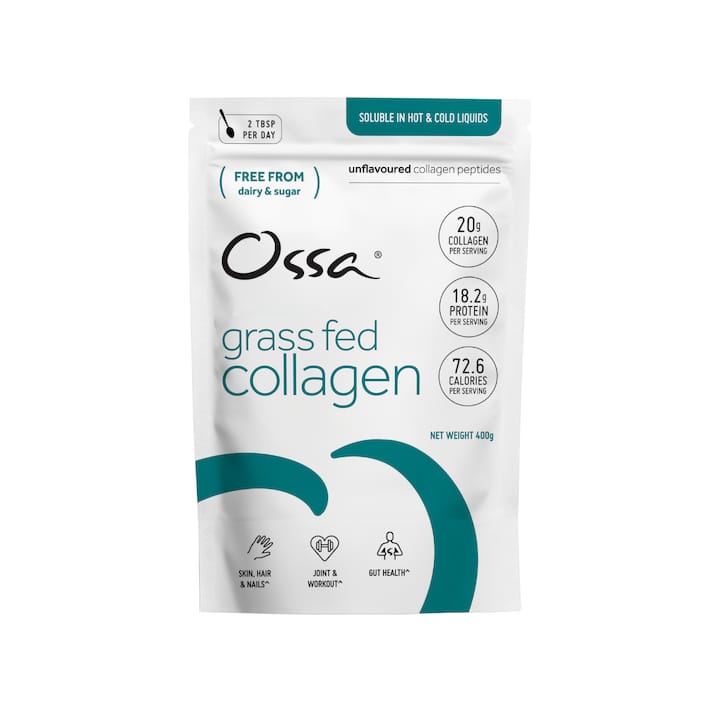
Want to trial both formats before settling on one? The Ossa Certified Grass Fed Collagen Peptides and Pasture Raised Gelatine bundle lets you compare peptides against gelatine side by side, which is genuinely useful if you’re unsure which texture and serving style you’ll actually stick with for 8 to 12 weeks. For a wider introduction to gut-focused nutrition alongside your collagen trial, the Ossa Functional Nutrition Ambient Bundle pairs collagen with complementary products from our range.
A quick buying tip: check pack size against your chosen daily dose before you order, since a 400g tub at 10g a day lasts 40 days, just short of the 12 week mark most trials use. Browse the full organic bone broths, collagen and grass-fed fats range to plan a full trial period, or explore our gut health bundles and healthy snacks if you want to support digestion alongside your collagen dose. Start your order today and give the 8 to 12 week protocol a proper, evidence-matched trial.
Sources and further reading
- PMC review on hydrolysed marine collagen — supports the point that peptide molecular weight differs by source but doesn’t clearly determine superior outcomes.
FAQ
Which is better, bovine or marine collagen?
Neither is universally better; bovine collagen offers broader Type I and Type III coverage for skin, joints and gut at a lower cost per gram, while marine collagen suits pescatarians and those prioritising a skin-only focus. The deciding factors are usually diet, allergies and budget rather than one source outperforming the other clinically.
What collagen did Jennifer Aniston use?
Marine collagen has been widely reported in celebrity skincare press coverage, including around Jennifer Aniston, though specific product endorsements aren’t independently verified through clinical trial data. The underlying evidence for skin benefits is actually stronger for bovine hydrolysates tested in the Proksch VERISOL trials.
Which form of collagen is most effective?
Hydrolysed collagen peptides are the most effective supplement form because the smaller peptide chains dissolve and absorb more readily than gelatine or whole collagen. Within hydrolysed peptides, bovine sources currently have the larger body of supporting human trial evidence, particularly for skin at 2.5g to 5g daily over 8 weeks.
Can I take a collagen supplement with citalopram?
There’s no established interaction between hydrolysed collagen peptides and citalopram or similar antidepressant medications in the current evidence. Anyone on prescription medication should still check with their GP or pharmacist before starting a new supplement, since individual circumstances vary.
How much does Ossa Organic’s collagen cost?
Current prices for Ossa Grass Fed Collagen Peptides and related bundles are available directly on the Ossa Organic product pages, where pack sizes and bundle options are listed. Checking pack size against your planned daily dose is worth doing before ordering to match the 8 to 12 week trial period this article recommends.