
Cart
0
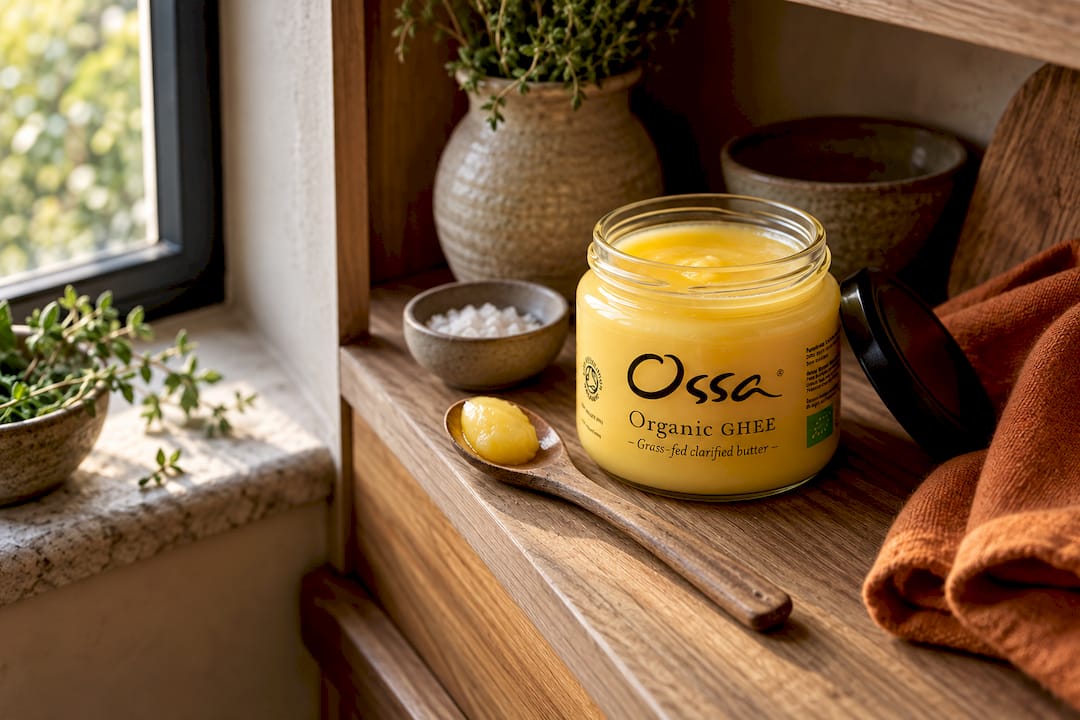
Unopened ghee keeps for around 9 to 12 months in a cool pantry, while an opened jar is best used within 3 to 6 months at room temperature. Refrigeration or freezing can extend the shelf life considerably beyond that. None of this matters much, though, if you skip the one habit that actually protects the jar: airtight lid, dry spoon, cool dark cupboard. Bulk jars, humid kitchens, or infrequent use are situations where refrigeration helps maintain ghee quality longer.
TL;DR:
Ghee stored in a cool, dark pantry lasts about 9 to 12 months unopened and 3 to 6 months after opening if kept properly sealed and dry.
Refrigeration extends shelf life beyond a year but causes the fat to firm and aroma to mute, making small daily portions preferable.
Freezing can preserve ghee indefinitely if stored airtight in small portions, but thaw at room temperature for best quality.
Oxidation, not bacteria, causes ghee to spoil, and signs include sour smell, bitter taste, discoloration, or rancid aroma, not mold or visible changes.
Buying traditional, minimally processed ghee with a single ingredient and avoiding added water or fillers helps ensure longer shelf stability.
Table of Contents
Ghee shelf life at a glance: pantry, fridge and freezer
Here’s the fast version for anyone matching their own jar against a timeline before deciding what to do with it.
-
Unopened, pantry: typically about 9 to 12 months in a cool, dark cupboard away from heat.
-
Opened, pantry: generally 3 to 6 months with an airtight lid and dry utensils.
-
Opened or unopened, fridge: storage usually extends shelf life significantly, often approaching or exceeding a year, though texture may firm.
-
Freezer: freezing effectively slows oxidation for long-term storage, potentially extending beyond a year if the jar is airtight.
Heat accelerates spoilage noticeably. A jar kept near a stove or in direct sunlight during warm periods will lose quality more rapidly than one stored in a cool, shaded cupboard, as higher temperatures speed oxidation that causes deterioration. Bulk jars bought to save money are the biggest risk here: the more ghee sitting in one container, the longer it takes to use, and the longer it sits exposed to air each time you open the lid. Splitting a large tub into two or three smaller jars solves this without any extra cost.
Why ghee lasts longer than butter
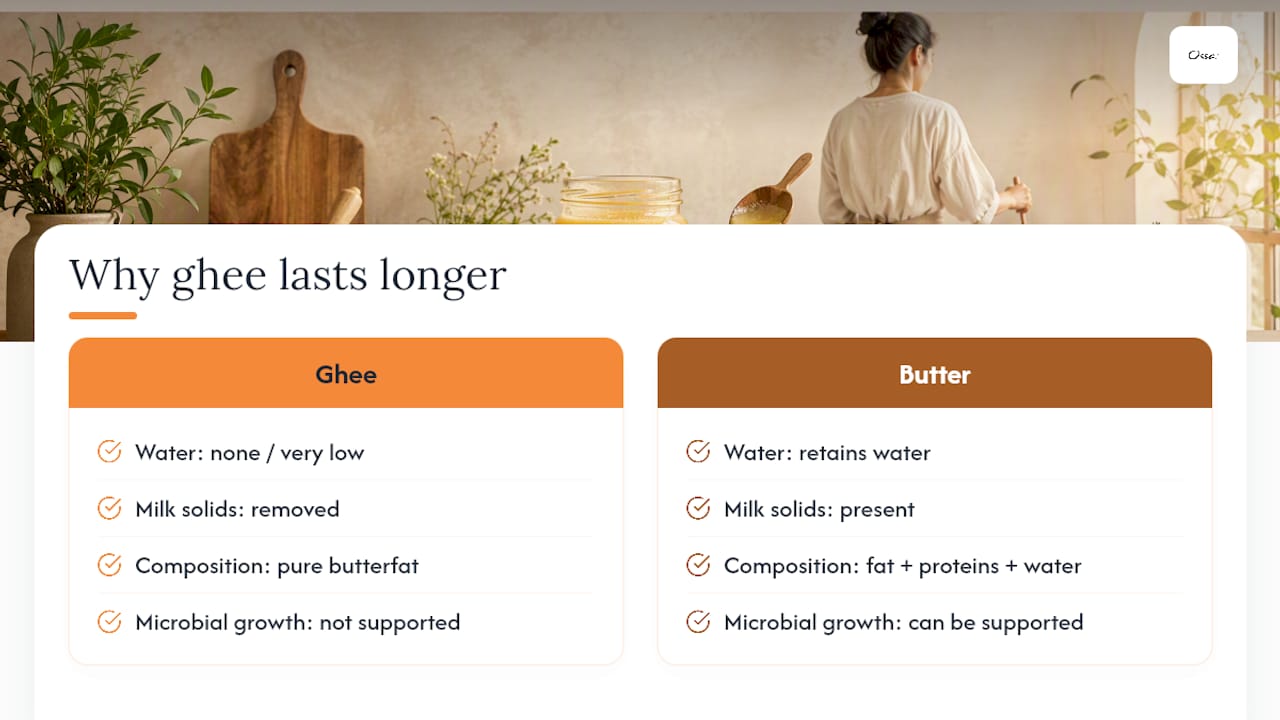
Ghee outlasts butter because it lacks water and milk solids, leaving pure butterfat with very low moisture. Butter retains water and proteins that can support microbial growth. Strip those out and you remove the conditions microbes need to establish themselves, which is why ghee is often described as shelf-stable in a way butter never can be.
That doesn’t mean ghee is indestructible. What eventually spoils a jar of ghee is oxidation, not bacteria. Food-science reviews describe this as auto-oxidation: a chemical chain reaction in the unsaturated fatty acids that, once triggered by oxygen, light, or heat, keeps propagating even with no microbial contamination present. The by-products of that reaction, hydroperoxides and compounds like malondialdehyde, are what give old ghee its rancid smell and bitter aftertaste. This is also why an old jar can look perfectly fine and still taste off. There’s nothing growing in it. The fat itself has chemically changed.
The quality of processing influences shelf life. Traditionally made ghee with lower residual moisture tends to resist oxidation longer than some mass-produced types, which may have higher moisture and oxidize sooner. You can read more about how ghee differs from butter nutritionally as well as structurally.
Pantry, fridge or freezer: choosing the right storage for your kitchen
The right storage method depends less on the calendar and more on how you actually cook.
-
Pantry suits anyone using ghee two or three times a week. Keep the jar in a cool, dark cupboard away from the stove, the window, and any other heat source. A jar used this often rarely sits long enough for oxidation to become a problem.
-
Fridge makes sense in three specific situations: a hot or humid kitchen, a bulk jar that will take months to finish, or a household that only reaches for ghee occasionally. Refrigeration slows the auto-oxidation reaction considerably, though it firms the fat and mutes the aroma slightly. If you go this route, decant a small jar for daily use rather than dipping into the cold main tub each time, since repeated warm-to-cold cycling does the fat no favours.
-
Freezer is worth considering only for genuinely long-term storage, such as a large batch made at home or a bulk-buy you won’t touch for months. Portion it into smaller containers before freezing so you’re not thawing the whole batch for a single tablespoon, and let portions thaw at room temperature rather than in a microwave, which can unevenly heat the fat.
Pro Tip: If your kitchen runs warm in summer, move ghee to the fridge for those months only, then back to the pantry once temperatures drop. Small seasonal adjustments beat leaving a jar in a hot cupboard year round.
Whichever method you choose, the same rules apply: airtight lids only, dry utensils every time, and no direct light or heat. Thermal cycling (repeatedly warming and cooling the same jar) does more damage than most people realise, because each cycle reintroduces condensation and oxygen exposure.
How to tell if ghee has gone bad
Trust your senses over the calendar. A best-by date reflects peak quality, not a safety cliff edge, so the real test is what the jar smells, tastes, and looks like.
-
Smell: fresh ghee has a warm, nutty aroma; rancid ghee smells sour, sharp, or faintly like old cooking oil.
-
Taste: a bitter or “off” aftertaste, distinct from the usual toasted flavour, is a clear sign it’s turned.
-
Visual and texture: watch for mould, an unusual film, or noticeable discolouration. Some natural graininess is normal in traditionally made ghee and isn’t a fault on its own.
-
When in doubt, discard it. A jar that fails any one of these checks isn’t worth the risk, however close to its date it sits.
Simple habits that keep ghee fresh for longer
Small changes in how you handle the jar do more for ghee longevity than any storage location alone.
-
Buy or decant into smaller jars if you go through ghee slowly. Less headspace and fewer open-close cycles mean less oxygen exposure over the jar’s life.
-
Use dry, clean utensils every single time. A wet spoon or stray breadcrumb introduces the exact moisture and organic matter that ghee’s processing was designed to eliminate.
-
For long-term storage, press a clean piece of kitchen parchment onto the surface of the ghee to reduce the air gap at the top of the jar.
-
Avoid repeated heating and cooling. If you refrigerate your main jar, keep a small daily-use portion at room temperature instead of returning to the cold jar several times a day.
-
Store in glass jars with tight metal lids or food-grade tins rather than plastic, which can allow more light and odour transfer over time.
Pro Tip: Keep a permanent marker near your storage cupboard and jot the opening date on the lid the moment you break the seal. It takes five seconds and removes all the guesswork later.
What to look for when buying ghee
Not all ghee is processed the same way, and that difference shows up directly in how long a jar stays good. Look for a single-ingredient product (milk fat, nothing else) with a transparent description of how it’s made. Labels mentioning slow-cooking or traditional methods are generally a good sign, since these processes tend to drive off more moisture than quick industrial rendering. Avoid anything listing added water or filler oils, which undermine the low-moisture stability that makes ghee reliable in the first place.

It’s also worth understanding that a best-by date signals peak flavour, not a hard safety line, so don’t panic over a jar that’s a few weeks past its printed date if it passes the sensory checks above. If you only use ghee occasionally, buy the smaller jar size rather than the bulk option. Ossa Organic makes its Organic Ghee from grass-fed British cows to organic standards, with no additives, which is exactly the kind of straightforward ingredient list worth looking for regardless of which brand ends up in your cupboard.
Our take on storage and product design
Ghee should be simple enough that you never need a laboratory to judge whether it’s still good.
A practical household routine includes using smaller jars so nothing sits open for months, a dry spoon kept specifically for the ghee cupboard, and deciding between pantry and fridge storage based on the season rather than the label. Trusting your nose and palate over a printed date is usually the best approach.
Where to find ghee built for these storage rules
Everything covered above, low moisture, minimal processing, honest ingredient lists, points to the same conclusion: the ghee that lasts longest is the ghee made simplest. Ossa Organic’s Organic Ghee is made from grass-fed British cows to organic standards, with nothing added and nothing to obscure how it was produced. That single-ingredient approach is precisely what supports the shelf-stability this article has walked through, and the available jar sizes make it straightforward to buy only as much as you’ll realistically use before opening a fresh one. If you’re ready to stock a jar that matches the storage habits above, visit the product page to check current sizing and place an order.
Selected sources for further reading
-
Recent innovations in functionality and shelf life enhancement of ghee, clarified butter fat (PMC)
-
Ghee, an overview (ScienceDirect Topics)
-
BBC Food: ghee
FAQ
Can I eat two year old ghee?
Ghee that old has likely passed peak quality and may show signs of oxidative rancidity, so check smell, taste, and appearance carefully before using it. If it smells sour or tastes bitter, discard it rather than risk the flavour or any digestive discomfort.
How do you know if ghee has gone bad?
Rancid ghee smells sour or sharp instead of nutty, tastes bitter rather than warm, and may show mould, an unusual film, or discolouration. Any one of these signs means it’s time to throw the jar away.
What happens if I use expired ghee?
Ghee past its best-by date is unlikely to be unsafe in the way spoiled dairy can be, since its low moisture limits microbial growth, but oxidised ghee tastes unpleasant and has reduced nutritional quality. Always run the sensory checks rather than relying on the date alone.
Is there an expiry date for ghee?
Ghee typically carries a best-by date reflecting peak flavour and quality rather than a strict safety cutoff, since its low moisture content makes it shelf-stable for extended periods. Unopened jars generally hold quality for 9 to 12 months in a cool pantry, with fridge or freezer storage extending that considerably.