
Cart
0
What are grass-fed fats and why do they matter?
Grass-fed fats come from ruminants — cattle, sheep, and goats — that eat predominantly grass and forage rather than grain-based feed. The distinction matters because what an animal eats directly shapes the fat it produces.
Key differences from grain-fed fats:
- Higher omega-3 fatty acids: Grass-based feeding raises alpha-linolenic acid (ALA) content significantly. Research shows milk fat contains 1.33 g/100g ALA in grass-fed systems versus 0.58 g/100g in grain-fed systems.
- Better n-6/n-3 ratio: Grass-fed fats carry a more balanced omega-6 to omega-3 ratio, which supports anti-inflammatory dietary patterns.
- Higher CLA levels: Conjugated linoleic acid (CLA) forms naturally in ruminants and concentrates in their fat. It has documented roles in reducing inflammation, supporting metabolic health, and may help reduce abdominal fat accumulation.
- Fat-soluble vitamins: Grass-fed fats contain more vitamins A, E, and K2 than grain-fed equivalents, along with beta-carotene as a natural antioxidant.
- Gut health support: These fats provide biologically appropriate energy sources that complement whole-food, anti-inflammatory diets.
- UK certification matters: The term “grass-fed” carries no strict legal definition in the UK, so certification is the only reliable way to verify authenticity.
Table of Contents
- How does the nutritional profile of grass-fed fats compare?
- Ossa Organic grass-fed fats for your family
- FAQ
- Key takeaways
How does the nutritional profile of grass-fed fats compare?
Fatty acids and CLA
The fatty acid composition of grass-fed fats sets them apart from grain-fed alternatives in practical, measurable ways. CLA — the compound most associated with grass-fed animal products — is synthesised naturally in the rumen of cattle and sheep. Its concentration in fat depends heavily on diet: animals grazing fresh pasture produce considerably more CLA than those fed conserved forage or grain. Research links CLA intake to reduced abdominal obesity, improved lean body mass, and anti-carcinogenic properties, with atherosclerosis prevention also noted in the literature.
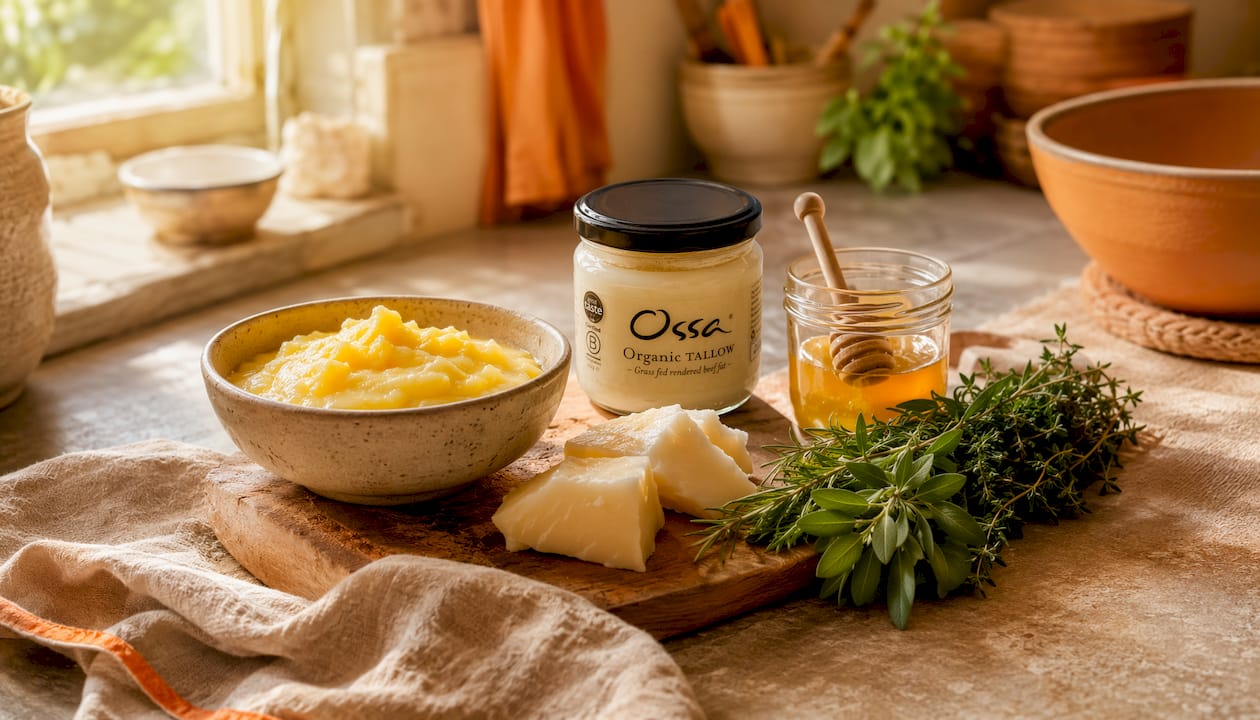
Seasonality adds another layer. Spring-grazed butter tends to be richer in both CLA and omega-3 fatty acids than butter produced from animals on autumn or indoor feeding regimes. If you buy grass-fed butter or ghee year-round, the nutritional profile will shift slightly with the seasons — a normal and expected variation, not a quality failure.
Vitamins, antioxidants, and gut health
Grass-fed butter and ghee contain more vitamin K2 than conventional dairy fats, a nutrient involved in calcium metabolism and bone and oral health. Vitamin A supports immune function, and vitamin E acts as a fat-soluble antioxidant. The yellow colour of genuine grass-fed butter comes from beta-carotene, a reliable visual indicator of pasture feeding.
For gut health specifically, these fats provide a clean, traditional energy source that fits naturally within whole-food and paleo-style diets. They carry none of the additives or processing residues found in refined vegetable oils, making them a straightforward choice for families moving away from ultra-processed foods.
Nutritional comparison: grass-fed vs grain-fed fats
| Nutrient | Grass-fed fats | Grain-fed fats |
|---|---|---|
| ALA (omega-3) | 1.33 g/100g fat in milk | 0.58 g/100g fat in milk |
| CLA content | Significantly higher | Lower |
| Vitamin K2 | Higher | Lower |
| Vitamin A | Higher | Lower |
| Beta-carotene | Higher (visible yellow colour) | Lower |
| n-6/n-3 ratio | More balanced | Less balanced |
UK certification and labelling
The UK has no legal definition for “grass-fed” on product labels. A product can carry the term without any requirement that the animal ate exclusively grass. The most reliable standard currently available is Certified Grassfed by A Greener World, which requires animals to consume a 100% grass and forage diet from birth. Without that certification, or equivalent verified sourcing, the label alone tells you little.
The terms “pasture-fed” and “outwintered” are also frequently confused. Pasture-fed describes diet; outwintered describes where the animal lives in winter. A product can be outwintered and still grain-supplemented, so the distinction matters when you are assessing nutritional quality.
Storage and cooking tips
Grass-fed fats are stable for cooking at moderate to high temperatures, particularly ghee and tallow, which have had milk solids removed and carry higher smoke points than butter. Store them in airtight containers away from direct light. Butter and ghee keep well refrigerated; tallow is shelf-stable at room temperature when kept sealed. Avoid repeated heating and cooling cycles, which degrade fatty acid quality over time.
For everyday cooking, grass-fed tallow and ghee are practical choices that preserve nutritional value better than most refined oils.
Ossa Organic grass-fed fats for your family
Ossa Organic sources its fats from British cows raised to organic standards on grass-based diets, giving you a direct route to verified nutritional quality without the label uncertainty described above. The range includes two core products built for everyday family cooking.
Organic grass-fed tallow is rendered from British beef fat and delivers a stable, nutrient-dense cooking fat rich in CLA and fat-soluble vitamins. Organic grass-fed ghee is clarified butter from the same British herds, with milk solids removed for a clean, high-smoke-point fat suited to daily use. Both products reflect Ossa Organic’s founding principle: traditional food, properly sourced, with no shortcuts.
For families wanting to build a broader whole-food nutrition base, the functional nutrition bundle brings these grass-fed fats together in a single order. Visit Ossa Organic to review the full range and sourcing details.
FAQ
What makes grass-fed fats healthier than grain-fed fats?
Grass-fed fats contain higher levels of omega-3 fatty acids, CLA, and fat-soluble vitamins A, E, and K2. In milk fat, ALA reaches 1.33 g/100g in grass-fed systems versus 0.58 g/100g in grain-fed systems.
Is “grass-fed” a legally protected term in the UK?
No. The UK has no strict legal definition for “grass-fed” on food labels. Look for third-party certification such as Certified Grassfed by A Greener World to verify that animals ate a 100% grass and forage diet.
Which grass-fed fats are best for cooking?
Ghee and tallow are the most practical for everyday cooking. Both have higher smoke points than butter and remain stable at moderate to high temperatures, preserving their nutritional profile during use.
Does CLA in grass-fed fats support weight management?
Research indicates CLA may reduce abdominal obesity and improve lean body mass through multiple biological mechanisms, though the effect depends on the specific CLA isomers present, which vary with the animal’s diet.
Where can I buy certified grass-fed fats in the UK?
Ossa Organic produces grass-fed ghee and tallow from British cows raised to organic standards, available directly through the Ossa Organic website.
Key takeaways
Grass-fed fats deliver a measurably richer fatty acid profile than grain-fed alternatives, with milk fat containing 1.33 g/100g ALA in grass-fed systems and 0.58 g/100g in grain-fed systems.
| Point | Details |
|---|---|
| Superior fatty acid profile | Milk fat contains 1.33 g/100g ALA in grass-fed systems and 0.58 g/100g in grain-fed systems. |
| CLA health benefits | CLA from grass-fed fats supports anti-inflammatory health, metabolic function, and may reduce abdominal fat. |
| Certification is essential | The UK has no legal definition for “grass-fed”; Certified Grassfed by A Greener World is the most reliable standard. |
| Seasonal variation is normal | Spring-grazed butter is richer in CLA and omega-3s; nutritional profiles shift naturally across the year. |
| Ossa Organic | Supplies certified grass-fed tallow and ghee from British cows raised to organic standards for verified quality. |