

Cart
0
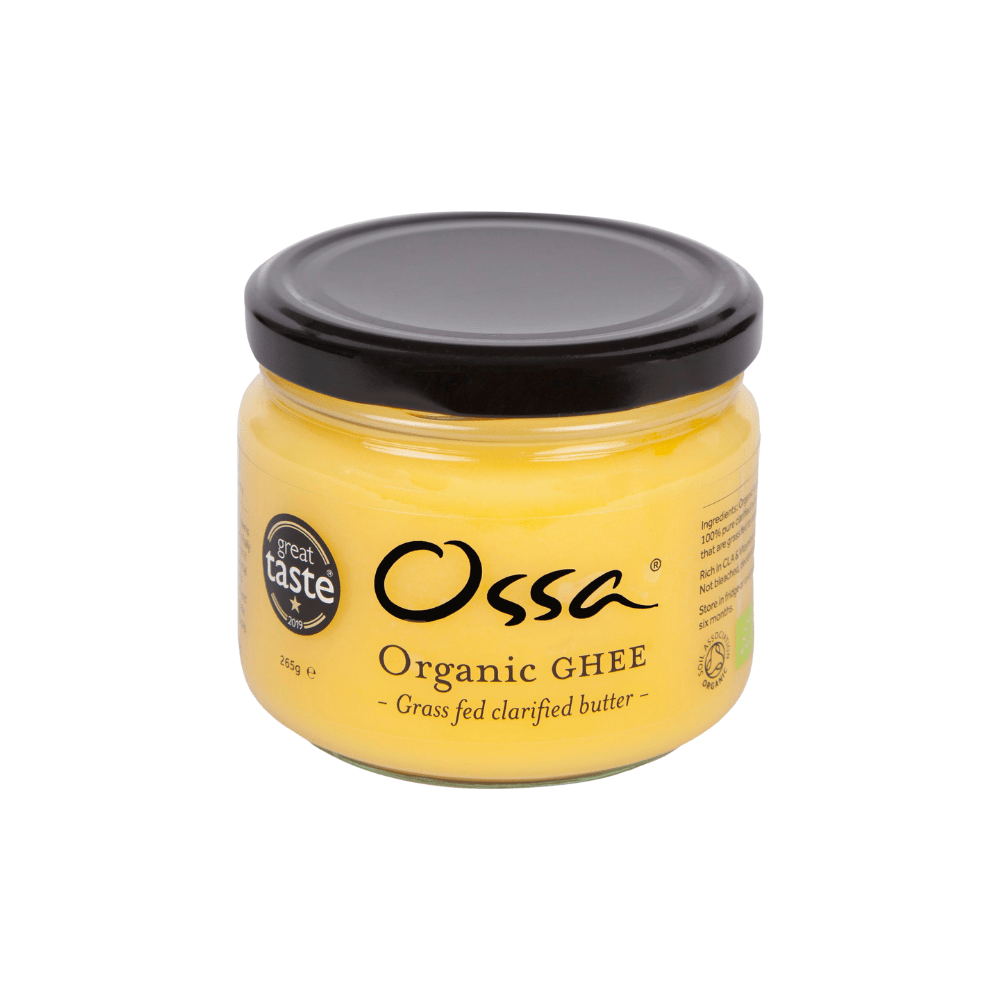
Grass-fed ghee offers meaningfully higher levels of CLA, omega-3s and vitamin K2 than regular grain-fed ghee, but the gap only matters if you use ghee often enough for those differences to accumulate. For occasional cooking, the nutritional edge is real yet marginal. For daily users replacing vegetable oils or butter across most meals, it becomes a genuinely useful source of fat-soluble nutrients that grain-fed dairy simply doesn’t match.
-
CLA and omega-3s run higher. Pasture-fed dairy shows roughly 2 to 5 times more omega-3s than grain-fed dairy, alongside more conjugated linoleic acid (CLA).
-
The difference compounds with frequency. Occasional use won’t move the needle much; daily cooking fat swaps might.
-
Buying implication. Colour and certification, not marketing copy, are your best clues to genuine grass-fed sourcing.
Statistic to anchor this: peer-reviewed dairy research puts grass-fed milk fat at significantly higher omega-3 content than grain-fed milk fat, with a more favourable omega-6 to omega-3 ratio throughout.
Key Takeaways
Grass-fed ghee delivers measurably higher CLA, omega-3s and vitamin K2 than regular ghee, and the benefit scales with how often you use it.
| Point | Details |
|---|---|
| Nutrient gap is real | Grass-fed dairy fat contains roughly 2 to 5 times more omega-3s and more CLA and vitamin K2 than grain-fed. |
| Frequency decides value | Daily cooking fat use makes the premium worthwhile; occasional use makes it a nice-to-have. |
| Evidence strength varies | Omega-3 and ratio benefits are well supported; butyrate and MCT claims in ghee are often overstated. |
| Buy on certification, not wording | Look for third-party grass-fed certification and a deeper golden colour, not vague label language. |
| Ossa Organic offers traceable sourcing | Ossa Organic’s grass-fed ghee and bone broths follow traditional, transparent production rather than industrial shortcuts. |
Selected evidence and further reading
-
PMC dairy fatty acid research — peer-reviewed basis for the omega-3 and CLA differences.
-
Healthline ghee comparison — balanced consumer summary of lactose, casein and calorie facts.
Table of Contents
Grass-fed ghee benefits at a glance
Here’s the headline picture before we get into the detail.
-
CLA: typically higher in grass-fed ghee, though exact multiples vary by study and season.
-
Omega-3s: around 2 to 5 times higher in pasture-fed dairy fat versus grain-fed.
-
Vitamin K2 and beta-carotene: both reported higher in grass-fed dairy fat, contributing to a deeper golden colour.
That colour difference isn’t cosmetic. Beta-carotene from fresh pasture grass gives grass-fed ghee its richer, more amber hue compared with the paler yellow of grain-fed versions. If you cook with ghee daily, the nutrient premium is worth paying for. If a jar sits at the back of your cupboard for occasional frying, regular ghee will do the job almost as well.
What does ‘grass-fed’ actually mean for dairy?
“Grass-fed” describes cows that graze on pasture rather than being fed primarily grain-based feed in a barn or feedlot. In practice, it’s a spectrum. Some cows have year-round pasture access; others get grass for part of the year and supplementary grain the rest. Labelling rules vary between markets, and “grass-fed” on a pack doesn’t always mean 100% grass-fed, which is why looking for third-party certification matters more than the word alone.
The mechanism behind the nutritional difference is straightforward. Cows that graze on fresh grass and legumes take in more alpha-linolenic acid (an omega-3 fatty acid) and more carotenoids than cows eating grain-heavy diets. Those compounds pass into the milk fat, then concentrate further once the milk becomes butter and the butter is clarified into ghee.
The nutritional shift happens in three stages:
-
Cow diet: fresh pasture forage supplies more omega-3 precursors and beta-carotene than grain.
-
Milk fat profile: these compounds accumulate in the butterfat, changing its fatty acid and vitamin makeup.
-
Ghee concentration: clarifying butter into ghee removes water and milk solids, concentrating the remaining fat-soluble nutrients.
Grass-fed ghee vs regular ghee: the nutrition comparison
The nutrient gap between grass-fed and grain-fed ghee is well documented for some compounds and only loosely quantified for others. Here’s the comparison, with hedged ranges rather than false precision.
| Nutrient | Grass-fed ghee | Regular (grain-fed) ghee | Confidence |
|---|---|---|---|
| CLA (conjugated linoleic acid) | Notably higher | Lower baseline | Moderate to strong |
| Omega-3 fatty acids | Roughly 2 to 5 times higher | Lower baseline | Strong |
| Omega-6 to omega-3 ratio | More favourable (lower ratio) | Less favourable (higher ratio) | Strong |
| Vitamin A | Higher | Lower | Moderate |
| Vitamin K2 | Higher | Lower | Moderate |
| Beta-carotene | Higher (visible in colour) | Lower | Moderate |
| Butyrate | Present in both, small amounts | Present in both, small amounts | Limited |
| MCTs (medium-chain triglycerides) | Present in both, small amounts | Present in both, small amounts | Limited |
| Vitamin D | Marginally higher in some studies | Lower baseline | Limited |
The omega-3 and omega-6:omega-3 differences are the ones backed by the most consistent research, and they’re also the ones most likely to matter if ghee is a regular part of your cooking. The CLA and vitamin K2 gaps are real but reported with more variability between studies, largely because pasture composition, season and breed all shift the numbers. Butyrate and MCT content, meanwhile, sit at low concentrations in ghee regardless of the cow’s diet, so don’t expect either type to meaningfully change based on grass-feeding alone.
What do CLA, omega-3s and vitamin K2 actually do?
Each of these nutrients has a plausible mechanism behind the health claims attached to ghee, but the evidence strength varies a lot from one to the next.
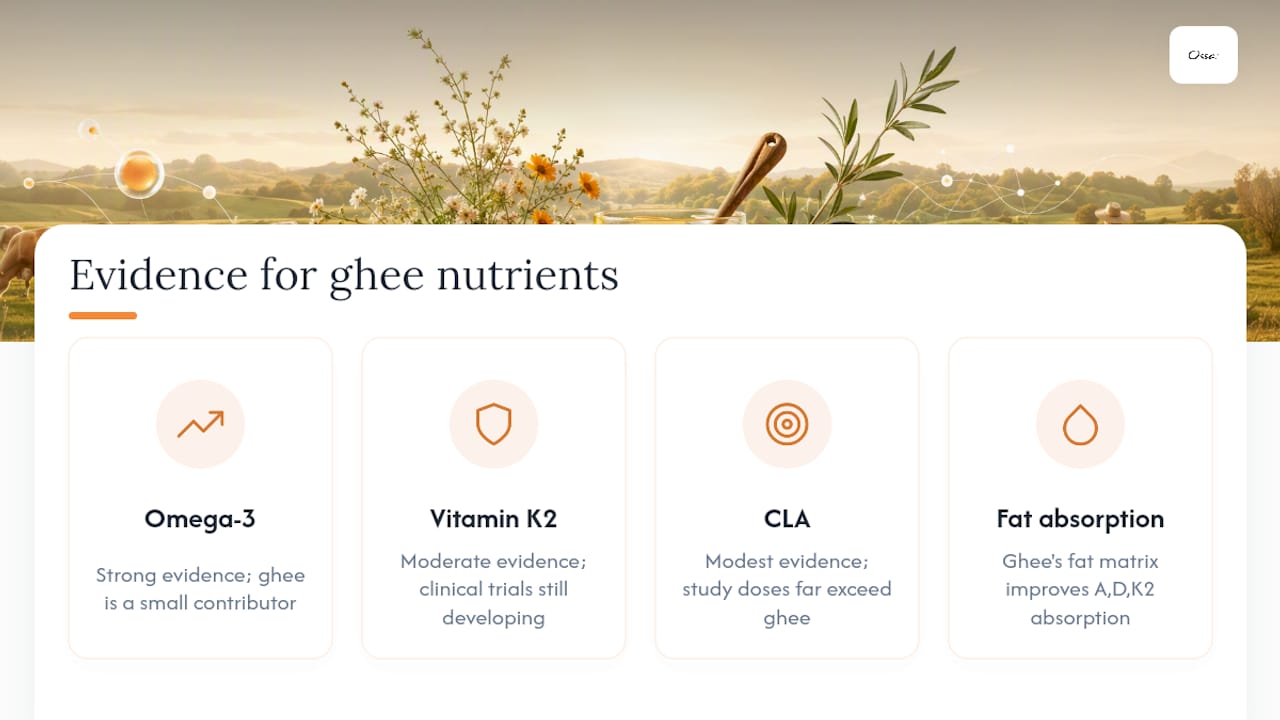
CLA (conjugated linoleic acid) is a fatty acid studied for anti-inflammatory and metabolic effects. Human trial evidence remains mixed and the doses used in most studies are far higher than what you’d get from cooking with ghee, so treat this as a modest, contributory benefit rather than a standalone reason to switch. Evidence strength: modest.
Omega-3 fatty acids support a healthier ratio against omega-6 fats, which most Western diets already overload on through vegetable oils and processed food. A better ratio is one of the more consistently supported dietary levers for lowering background inflammation. Evidence strength: strong, though ghee is a small contributor compared with fish or flaxseed.
Vitamin K2 plays a role in directing calcium toward bones and away from soft tissue and arteries. It’s one of the more interesting nutrients in grass-fed dairy fat because most diets are genuinely low in it. Evidence strength: moderate, with clinical trial data still developing.
Beta-carotene, the compound behind ghee’s golden colour, converts to vitamin A in the body and supports vision and immune function. Evidence strength: moderate for general vitamin A status, though ghee is a minor dietary source overall.
Butyrate, a short-chain fatty acid linked to colon health, is present in ghee in genuinely small quantities. The Cleveland Clinic’s summary on ghee is blunt about this: claims that ghee delivers meaningful butyrate for gut health are often exaggerated relative to what’s actually in a tablespoon. Evidence strength: limited.
MCTs (medium-chain triglycerides), sometimes credited with quick-energy or metabolic benefits, exist in ghee at low levels compared with dedicated MCT oil. Evidence strength: limited.
One point worth flagging on absorption: because vitamin A, D and K2 are fat-soluble, eating them within a fat matrix like ghee actually helps your body absorb them, rather than taking them as an isolated supplement on an empty stomach.
Does the science support real health benefits from grass-fed ghee?
Peer-reviewed evidence on ghee itself, as opposed to its individual nutrients, remains limited. Most of the health case rests on extrapolating from what we know about CLA, omega-3s and vitamin K2 in other food sources, then applying that to grass-fed ghee’s slightly richer profile.
-
Inflammation. A better omega-6 to omega-3 ratio is one of the more evidence-backed dietary changes for lowering chronic low-grade inflammation. Grass-fed ghee nudges that ratio in the right direction, though it’s one input among many, not a fix on its own.
-
Digestion and colon health. Butyrate is genuinely useful for colon cells, but the amount in ghee is too small to be the primary driver most marketing suggests. Ghee’s real digestive advantage is more mundane: it’s virtually free of lactose and casein once properly clarified, so many people who react to dairy tolerate it fine.
-
Cardiovascular health. The omega-3 boost and vitamin K2 content both plausibly support heart health, K2 through calcium regulation and omega-3s through the inflammation pathway. Neither replaces standard cardiovascular advice or medication.
-
Weight and body composition. CLA has been studied for fat metabolism effects, but the doses in research trials are well beyond what typical ghee consumption provides. Ghee remains calorie-dense at roughly 120 calories per tablespoon, so portion awareness matters more than nutrient content here.
-
Bone and eye health. Vitamin K2 and beta-carotene support bone mineralisation and vision respectively, giving grass-fed ghee a small but real edge for readers already watching these outcomes.
For someone eating ghee two or three times a week, none of these differences will be dramatic. For someone using it as their primary cooking fat every day, the cumulative vitamin K2 and omega-3 intake genuinely adds up over months.
How should you cook with grass-fed ghee?
Ghee’s high smoke point, generally cited around 250°C, makes it well suited to searing, roasting and pan-frying without the same risk of burning that affects regular butter. It’s a natural swap wherever a recipe calls for butter or a neutral cooking oil, from scrambled eggs to roasted vegetables to baking, where it adds a slightly nutty depth.
-
Storage: ghee is shelf-stable at room temperature for weeks because clarifying removes the water and milk solids that cause butter to spoil.
-
Reuse: you can safely reuse ghee for frying more than once, provided you strain out food particles between uses.
-
Baking: substitute it 1:1 for butter in most recipes, though very delicate pastries may need slight adjustment for ghee’s lower moisture content.
-
Portion: a tablespoon (roughly 14g) is a sensible single serving for cooking or finishing a dish.
Pro Tip: Pair ghee with vegetables high in beta-carotene, like carrots or sweet potato, since the fat in ghee helps your body absorb more of that vitamin A precursor than eating the vegetable alone.
For more ideas on working it into daily meals, using ghee for everyday cooking covers practical swaps beyond the basics.
Is it safe to eat ghee every day?
Ghee is calorie-dense and made from dairy fat, so daily use needs a bit of context rather than blanket reassurance.
-
Lactose and casein: properly clarified ghee removes almost all milk solids, so most people with lactose intolerance tolerate it well. People with a true casein allergy, rather than intolerance, should still be cautious, since trace protein can remain.
-
Calories: at roughly 120 calories per tablespoon, ghee adds up quickly if you’re not tracking total fat intake, particularly for anyone managing weight or cardiovascular risk factors.
-
Vitamin K2 and anticoagulants: anyone on warfarin or similar blood-thinning medication should talk to their doctor before significantly increasing vitamin K intake from any source, ghee included, since K vitamins interact with how these drugs work.
-
Existing hyperlipidaemia: if you have high cholesterol or a diagnosed lipid disorder, treat ghee as an occasional fat choice and discuss overall dietary fat intake with a clinician rather than assuming “grass-fed” makes it a free pass.
How do you spot genuinely grass-fed ghee?
Labelling around “grass-fed” isn’t tightly regulated in most markets, so the word on the front of the jar isn’t proof of anything on its own.
-
Look for certification, not just the phrase “grass-fed” or “pasture-raised” without a named certifying body behind it.
-
Check the ingredient list: genuine ghee should list only butter, or cream, with nothing else added.
-
Judge the colour: a deeper golden-yellow hue is a reasonable, though not definitive, indicator of higher beta-carotene from real pasture feeding.
-
Watch for vague sourcing language like “natural” or “farm fresh” that implies grass-feeding without stating it.
-
Weigh the premium against your usage: if you cook with ghee daily, the extra cost per jar is easier to justify than if it’s an occasional ingredient.
Our guide on identifying genuinely grass-fed ghee goes deeper into taste and sourcing cues if you want a fuller checklist before you buy.
Why we back grass-fed sourcing at Ossa Organic
Ossa Organic was built on the belief that traditional, slow production methods produce better food than shortcuts do, and that applies as much to ghee as it does to bone broth. Our ghee comes from grass-fed sources, made using traditional clarifying methods rather than industrial shortcuts that strip flavour and nutrients alike.
That same philosophy runs through the rest of the range. Our 1x Organic Beef Bone Broth Ambient 515ml and Organic Free Range Chicken Bone Broth 500ml are slow-simmered from organic, free-range animals, and the 1 x Organic Chicken Bone Broth Ambient 515ml offers the same ambient convenience without compromising on ingredients.
-
No preservatives or artificial additives in any product.
-
Sourcing built around organic, pasture-based farming, not marketing claims.
-
Evidence on ghee’s specific health effects is still developing; we present it honestly rather than overselling it.
What people underestimate about grass-fed ghee
The conventional pitch for grass-fed ghee tends to oversell butyrate and MCTs as if a tablespoon works like a supplement. It doesn’t. Both compounds sit in ghee at concentrations too low to drive the digestive or metabolic transformations often claimed for them, and the Cleveland Clinic’s own assessment makes that point plainly. The more defensible case for grass-fed ghee rests on the omega-3 ratio and vitamin K2, both of which have a stronger evidentiary basis and both of which genuinely differ from grain-fed versions.
What most buying guides skip is the frequency question. A jar of grass-fed ghee used twice a month won’t shift your nutrient intake meaningfully, no matter how impressive the comparison table looks. The people who actually benefit are those using it as a default cooking fat, replacing vegetable oils across most meals, where the vitamin K2 and omega-3 differences compound over months rather than staying theoretical. Buy grass-fed if ghee is a daily habit. If it’s occasional, don’t feel pressured to pay the premium.
Bring grass-fed ghee into your everyday cooking
Beyond ghee, building a genuinely gut-friendly kitchen usually means stacking a few whole-food staples that do more than one job. Ossa Organic’s grass-fed ghee sits alongside our organic bone broths as part of that same approach: traditional production, no preservatives, and ingredients you can actually pronounce. If you’re already convinced the daily-use case makes sense, the next logical step is pairing your cooking fat with a nutrient-dense base like broth, rather than treating them as separate purchases.
A structured way to try both together is the 14 Day Gut Reset, which walks you through practical, whole-food swaps including how ghee and bone broth fit into daily meals. If you’d rather start smaller, browse the ghee recipe library for ideas that use it beyond the frying pan.
This article is general information, not a substitute for advice from a qualified doctor. Consult a qualified healthcare professional about your own circumstances before acting on anything here.
FAQ
Is grass-fed ghee healthier than regular ghee?
It’s higher in CLA, omega-3s and vitamin K2, so for regular users it offers a real, if modest, nutritional edge over grain-fed ghee. For occasional cooking, the practical difference is small.
What happens if you eat ghee every day?
Daily ghee is generally well tolerated and can supply useful fat-soluble vitamins, but its calorie density (around 120 calories per tablespoon) means portion size matters, and anyone on blood-thinning medication should discuss vitamin K2 intake with a doctor first.
What are the main benefits of grass-fed ghee?
The clearest benefits are a better omega-6 to omega-3 ratio, higher vitamin K2 for bone-related calcium regulation, and more beta-carotene, alongside ghee’s general advantage of being virtually lactose and casein-free.
Is ghee rich in collagen?
No, ghee contains no meaningful collagen since it’s a dairy fat product, not a connective-tissue extract. If collagen is your goal, a bone broth like Organic Free Range Chicken Bone Broth is a more direct source.