

Cart
0
TL;DR:
- Shopping at an organic farmers market requires understanding USDA certification tiers and verifying vendor credentials. Vendors should be asked for proof of certification, especially if labels are unclear or absent. SNAP benefits are processed centrally, with tokens used at the market, and market walk-throughs help prevent leftover scrip or shortfalls.
Shopping at an organic farmers market means selecting fresh, locally grown produce certified to recognised standards, using the right payment methods, and knowing which vendors to trust. The term “organic farmers market” is widely used, but the formal industry term is a certified organic direct market, where producers sell goods that meet National Organic Programme standards. Whether you are buying organic produce for the first time or refining your weekly routine, understanding USDA certification tiers, SNAP payment systems, and market selection strategies gives you a real advantage.
How to shop organic farmers market produce with confidence
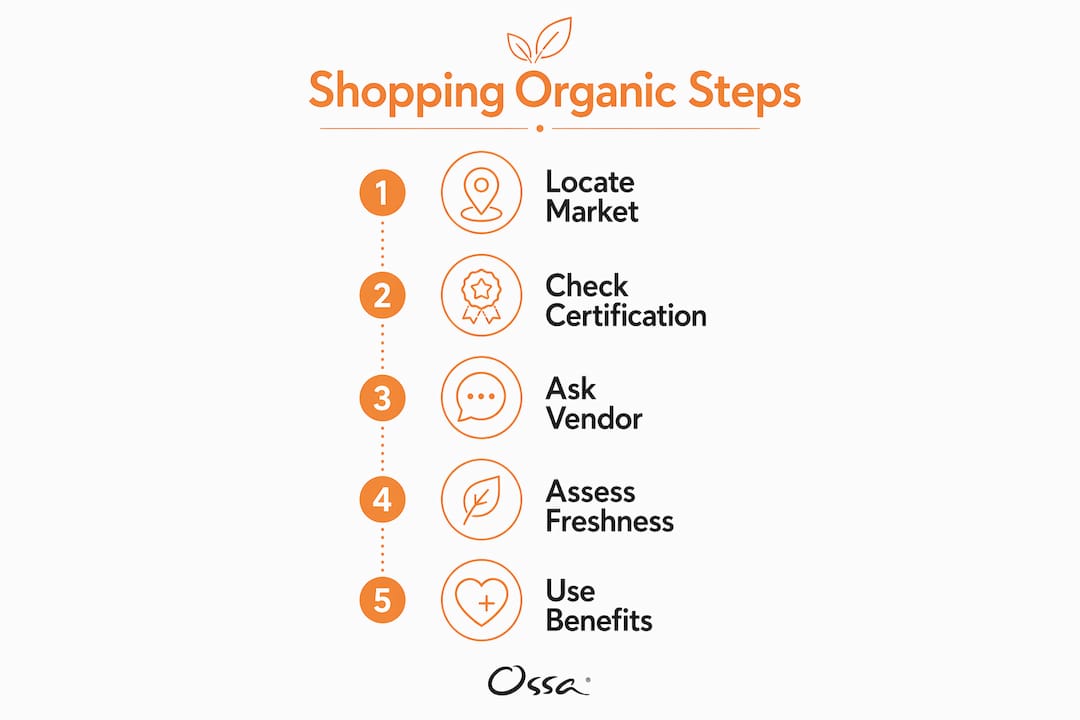
The single most important skill when you shop at an organic farmers market is reading certification labels correctly. Misreading those labels is the most common shopper mistake, and it costs you money and trust. The USDA operates a tiered system that determines exactly what “organic” means on any given product.
USDA organic certification works across four distinct tiers:
- 100% Organic: every ingredient is certified organic. This is the highest standard.
- Organic: at least 95% of ingredients are certified organic. Products at this level may display the USDA Organic seal.
- Made with organic: contains 70–94.9% organic ingredients. No USDA seal is permitted on these products.
- Specific organic ingredients: less than 70% organic content. The word “organic” may only appear in the ingredient list, not on the front label.
Only products with at least 95% organic content can carry the USDA Organic seal. That distinction matters enormously when you are comparing two products at a market stall.
What does “natural” actually mean on a label?

“Natural” does not mean organic. The label “natural” carries no USDA certification and does not guarantee that a product was grown without synthetic pesticides or fertilisers. Harvard Health confirms that “natural” labelling is frequently misunderstood as equivalent to organic, but the two terms have no regulatory overlap. If a vendor’s sign says “natural” without displaying a USDA Organic seal, the product is not certified organic.
Certified organic farming prohibits synthetic fertilisers, pesticides, and genetic engineering. It also requires organic feed and outdoor access for animals, with no antibiotics or growth hormones permitted. That is the standard behind the seal.
Should you ask vendors for proof of certification?
Yes, always. Vendors at farmers markets should be asked to show proof of organic certification when labelling is unclear or absent. Experts advise treating organic claims as a matter of verification, not trust in signage alone. A legitimate certified producer will have documentation and will not hesitate to show it.
Pro Tip: Walk the market before you buy. Note which stalls display a USDA Organic seal or have certification paperwork visible. That first pass takes five minutes and saves you from buying mislabelled goods.
| Label | Organic content | USDA seal permitted |
|---|---|---|
| 100% Organic | 100% | Yes |
| Organic | ≥95% | Yes |
| Made with organic | 70–94.9% | No |
| Specific organic ingredients | Below 70% | No |
How do SNAP and EBT payments work at farmers markets?
SNAP benefits are accepted at a growing number of organic farmers markets, but the process differs from a standard supermarket checkout. Most markets use a centralised system rather than allowing individual vendors to process EBT cards directly. Understanding this system before you arrive prevents confusion and wasted time.
Markets accepting SNAP benefits typically operate a central point of sale. N.C. Cooperative Extension explains that shoppers exchange their EBT balance for market scrip or tokens at a welcome booth, then use those tokens to pay vendors throughout the market. The process works as follows:
- Locate the market’s central welcome booth or information point. Look for SNAP or EBT signage at the entrance.
- Swipe your EBT card at the centralised point of sale device. The market operator, not individual vendors, authorises the transaction.
- Receive market scrip or tokens in exchange for your EBT balance.
- Use the scrip or tokens to pay any participating vendor at the market.
- Return unused tokens to the welcome booth if your market permits refunds. Policies vary by location.
The Ecology Center’s EBT Toolkit confirms that market operators handle all SNAP authorisation centrally. Individual vendors do not need their own EBT terminals. This simplifies vendor participation but means shoppers must follow the centralised procedure every visit.
How to avoid leftover scrip or shortfalls
Overbuying or underbuying scrip is the most frequent SNAP mistake at farmers markets. N.C. Cooperative Extension recommends doing a quick walk-through of the market first to estimate your total spend before exchanging your EBT balance for tokens. That single step prevents you from ending the visit with unused scrip or running short mid-shop.
“Locate the central EBT point before you start shopping. Markets with clear signage and well-communicated payment protocols make the process straightforward. If you cannot find the booth, ask any vendor.” — Ecology Center Farmers’ Market EBT Toolkit
Pro Tip: Check whether your local market offers Double Bucks or Triple Bucks programmes. These schemes match your SNAP spend with bonus tokens, effectively doubling your purchasing power on fresh organic produce.
What organic products can you find at farmers markets?
Farmers markets offer a broader range of certified organic products than many shoppers expect. The variety extends well beyond fruit and vegetables, making the local farm fresh market a genuine alternative to a weekly supermarket shop.
Common organic product categories at farmers markets include:
- Fresh produce: seasonal vegetables, salad leaves, herbs, and fruit. Seasonality is the key advantage here. Produce sold at the market was typically harvested within 24–48 hours, compared to days or weeks for supermarket stock.
- Meat and poultry: grass-fed beef, free-range chicken, and heritage breed pork from farms operating under USDA Organic or equivalent standards.
- Dairy: organic milk, cheese, butter, and eggs from certified producers.
- Packaged goods: fermented foods, bone broths, condiments, and baked goods made with certified organic ingredients.
- Artisan products: organic coffee, teas, and preserves from small-batch producers.
USDA Economic Research Service data shows that organic food sales have grown substantially across all retail channels, with farmers markets remaining a meaningful part of the organic food marketplace alongside e-commerce and mass retail. That growth reflects rising consumer demand for verified, traceable food sources.
Farmers markets vs other organic sales channels
| Channel | Key advantage | Key limitation |
|---|---|---|
| Farmers market | Direct producer contact, peak freshness | Seasonal and location dependent |
| Online organic retailers | Year-round availability, home delivery | Cannot inspect produce before purchase |
| Supermarket organic range | Convenience, consistent stock | Less traceability, longer supply chain |
The farmers market advantage is traceability. You can speak directly to the person who grew or produced the food. That conversation is not available in a supermarket aisle or on an e-commerce product page.
How to assess freshness and seasonality
Fresh organic produce shows specific signs of quality. Leaves should be firm and bright, not wilted or yellowing. Root vegetables should feel dense and heavy. Fruit should smell ripe at room temperature. Vendors who grow their own produce will know exactly when each item was harvested. Ask them. A grower who cannot answer that question is likely a reseller, not a producer.
How to find the best organic farmers markets near you
Finding a reputable local organic market requires more than a quick internet search. The quality of markets varies considerably, and not every market labelled “organic” enforces certification standards at the vendor level.
Reliable methods for locating certified organic markets include:
- Soil Association market listings: the Soil Association maintains directories of certified organic producers and markets across the United Kingdom. Their listings confirm which vendors hold active certification.
- Local authority websites: many councils publish seasonal market schedules with vendor information.
- USDA’s Agricultural Marketing Service: for markets in the United States, the AMS maintains a searchable national farmers market directory.
- Community boards and local food networks: neighbourhood groups and food co-operatives often share verified market recommendations that online directories miss.
Once you have located a market, evaluate it before committing to a regular visit. Check whether vendors display certification documents or USDA Organic seals. A market that enforces certification standards will make that information easy to find. If certification is absent or vendors are vague about their growing practices, treat the market as a conventional market, not a certified organic one.
For guidance on finding certified organic produce with confidence, Ossa Organic’s blog covers the practical steps in detail, including how to read ingredient percentages and identify genuine seals.
Questions to ask vendors at the market
Engaging directly with producers is the most reliable verification method available to shoppers. Ask vendors:
- Are you USDA Organic certified, or do you use organic practices without certification?
- Which certification body audits your farm?
- What is the harvest date for this produce?
- Do you grow everything you sell, or do you source from other farms?
These questions take under two minutes and give you more reliable information than any label. Producers who grow and sell their own certified organic food answer them without hesitation.
Pro Tip: Build a relationship with two or three trusted vendors over several visits. Regular customers often get first access to limited seasonal produce and honest advice about what is worth buying that week.
Key takeaways
Shopping at a certified organic direct market requires knowing USDA certification tiers, understanding centralised SNAP payment systems, and verifying vendor credentials directly.
| Point | Details |
|---|---|
| Know the USDA tiers | Only products with ≥95% organic content may display the USDA Organic seal. |
| Verify, do not assume | Ask vendors for certification proof rather than relying on signage or the word “natural”. |
| Use SNAP centrally | Exchange your EBT balance for market scrip at the welcome booth before shopping. |
| Walk the market first | A pre-shop walk-through helps you estimate spend and avoid leftover scrip or shortfalls. |
| Choose markets carefully | Use Soil Association listings or the USDA AMS directory to find verified certified organic markets. |
What shopping organic at farmers markets has taught us at Ossa Organic
The most consistent mistake we see shoppers make is assuming that a market stall selling “natural” or “farm-fresh” produce is automatically organic. It is not. The word “natural” has no legal weight in the context of organic certification. We learned this early, and it changed how we source ingredients entirely.
Building direct relationships with certified producers is not a nice extra. It is the only reliable way to know what is in your food. When we source ingredients for Ossa Organic products, we ask the same questions we recommend you ask at any market stall: who certified you, when was this harvested, and do you grow everything you sell? Those three questions filter out most of the ambiguity.
The vendors worth returning to are the ones who welcome those questions. They know their certification status, their harvest dates, and their growing practices without hesitation. The ones who deflect or give vague answers are telling you something important.
One practical observation: prioritise organic staples that carry the highest pesticide residue risk when grown conventionally. Leafy greens, strawberries, and apples consistently appear on residue monitoring lists. Spending your organic budget on those categories first delivers the clearest benefit. For a deeper look at what makes food truly organic, the distinctions between certification levels matter more than most shoppers realise.
— Ossa Organic
Ossa Organic and the organic food marketplace
Ossa Organic was founded on the same principles that drive a good farmers market visit: certified ingredients, traditional preparation methods, and no shortcuts on quality. Our organic beef bone broth is made from certified organic grass-fed beef bones, slow-cooked using traditional methods with no additives or preservatives. For those who prefer poultry, our organic chicken bone broth follows the same standard. Both products carry full organic certification, making them a natural complement to the fresh produce you bring home from your local market. Ossa Organic is B Corp certified, reflecting a commitment to sustainability that goes beyond the product itself.
FAQ
What does the USDA Organic seal mean at a farmers market?
The USDA Organic seal confirms that a product contains at least 95% certified organic ingredients, produced without synthetic pesticides, fertilisers, or genetic engineering. Only vendors with active USDA certification may display the seal.
Can I use SNAP benefits to buy organic produce at farmers markets?
Yes. Many farmers markets accept SNAP via a centralised EBT system where you exchange your card balance for market scrip at a welcome booth, then use the scrip with individual vendors.
How is “natural” different from “organic” on a market label?
“Natural” carries no USDA certification and does not indicate organic growing practices. Harvard Health clarifies that the two terms have no regulatory overlap, and “natural” products may still contain synthetic inputs.
How do I find a certified organic farmers market near me?
Use the Soil Association’s producer directory in the United Kingdom or the USDA Agricultural Marketing Service’s national farmers market directory in the United States. Both list markets and vendors with verified certification status.
Is produce at farmers markets fresher than supermarket organic produce?
Farmers market produce is typically harvested within 24–48 hours of sale, compared to days or weeks for supermarket stock. That shorter supply chain preserves nutritional quality and flavour more reliably than centralised retail distribution.