
Cart
0
TL;DR:
- Microwaving bone broth is safe when using a glass or ceramic container and reheating in short bursts.
- It preserves minerals effectively but overheating can damage delicate flavors built during slow cooking.
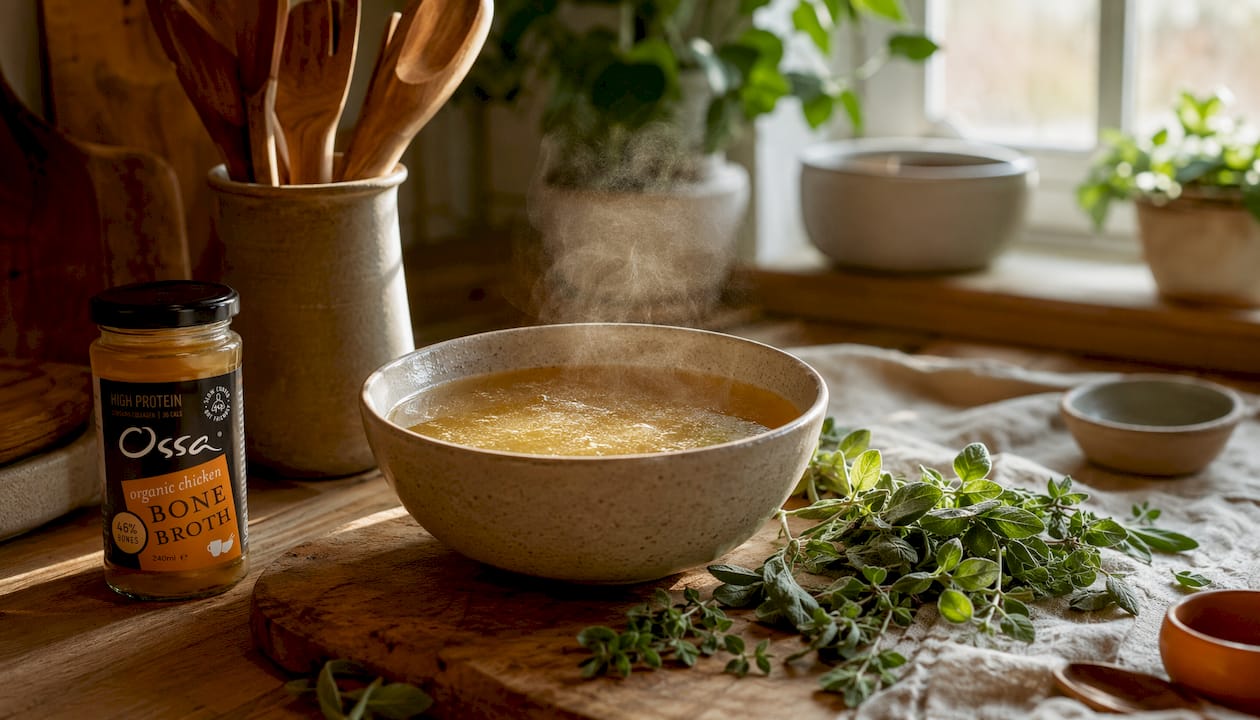
Yes, you can microwave bone broth safely. Use a microwave-safe glass or ceramic container; heat in short bursts of 30–60 seconds, stir between each interval, and stop when the broth is steaming rather than boiling.
- Container: glass or ceramic only; avoid plastic even if labelled microwave-safe.
- Technique: start-stop-stir in 30–60 second bursts; never one long continuous blast.
- Target temperature: steaming throughout, approximately 74°C (165°F) as recommended by the Food Standards Agency (FSA) for safe reheating.
- Ossa Organic’s ambient 240 ml portions are sized precisely for single-serving microwave reheating.
Table of Contents
- Safety checklist before you microwave any bone broth
- How to microwave bone broth without losing flavour or safety
- What microwaving actually does to minerals and flavour
- How to thaw and reheat bone broth from frozen safely
- Common mistakes when microwaving bone broth
- UK food-safety timelines and reheating guidance
- Why Ossa Organic’s guidance is worth following
- Key takeaways
- Tradition and convenience can work together
- Ready-to-use organic bone broth from Ossa Organic
- Further reading and official guidance
- FAQ
Safety checklist before you microwave any bone broth
Run through these points before heating.
- Container: use high-quality glass or ceramic. Even plastics labelled “microwave-safe” can leach trace compounds into hot, protein-rich liquids like bone broth; glass and ceramic avoid that risk entirely and preserve flavour.
- Cover loosely: place a microwave-safe lid or a sheet of kitchen paper over the container. This contains splatter from the fat and protein content while still allowing steam to escape.
- Portion size: reheat single servings (around 240 ml) rather than large quantities. Smaller volumes heat more evenly and reduce food-safety risk.
- Timing mindset: commit to short intervals and check temperature between each one. A probe thermometer is useful if food safety is a priority; FSA guidance recommends reheating food until it is steaming hot throughout.
- Superheating risk: liquids can superheat in a microwave without visibly boiling. After heating, let the container sit for about one minute before removing the cover to avoid sudden steam release.
Pro Tip: If your broth has gelled in the fridge, let it sit at room temperature for five minutes before microwaving. This reduces the time needed and prevents the outer liquid from boiling while the gel centre is still cold, which cuts both splatter and clean-up.
How to microwave bone broth without losing flavour or safety
Follow this sequence for a 240 ml (1 cup) portion.
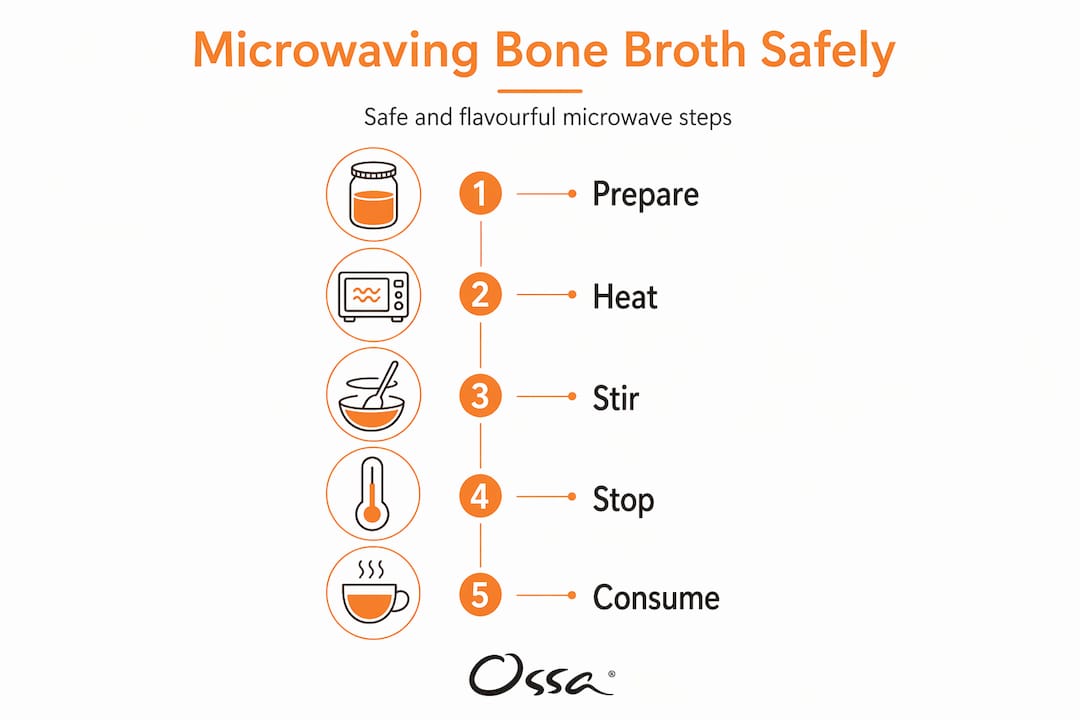
- Pour into a glass or ceramic mug or bowl. Leave at least 2–3 cm of headspace to allow for expansion and reduce splatter.
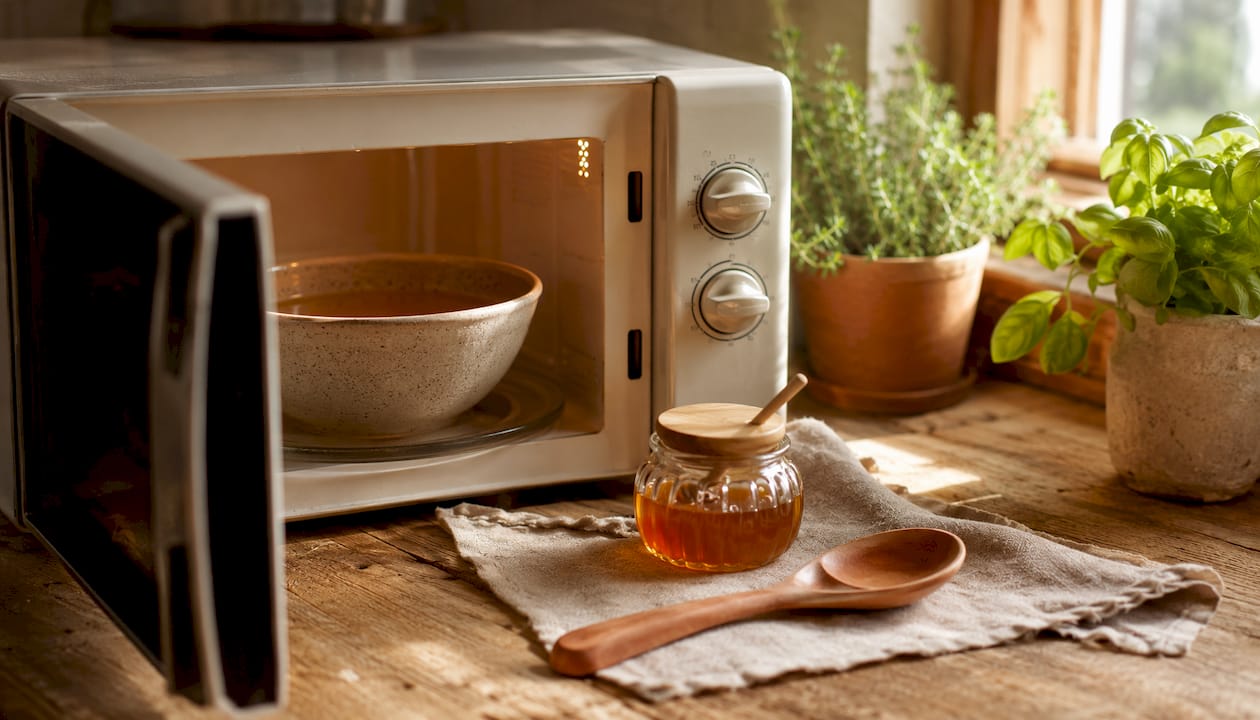
- Cover loosely with a microwave-safe lid or a piece of kitchen paper.
- Set power to 70–80% (medium-high). Full power increases the chance of localised boiling and flavour loss.
- Heat for 30–60 seconds, then remove and stir thoroughly, reaching the bottom of the container.
- Check the temperature. If it is not yet steaming, return for another 30–60 second burst and stir again.
-
Repeat until steaming throughout. For most UK microwaves, total time is roughly:
- 700 W: 2–2.5 minutes across 3–4 intervals
- 900 W: 1.5–2 minutes across 2–3 intervals
- 1200 W: 1–1.5 minutes across 2 intervals
- Rest for one minute before removing the cover. Use oven gloves; the container will be hot.
- Season after heating. Salt, herbs, and spices added before microwaving can overcook and blunt the clean flavour of slow-simmered broth.
For larger portions (480 ml or more), add 30–60 seconds per additional 240 ml and increase stirring frequency. Portioning into separate containers before heating gives more even results than heating one large batch.
Pro Tip: Place a wooden skewer or a non-metallic stirring stick in the container during heating. It provides a nucleation point that reduces the risk of superheating and makes the broth safer to handle.
What microwaving actually does to minerals and flavour
Microwaving generally retains key minerals such as calcium and potassium well. Nutrition practitioners note that the short heat exposure in a microwave does not significantly degrade these minerals compared with stovetop reheating.
Flavour is a different matter. Slow-cooked bone broth contains delicate volatile compounds built up over hours of simmering. Overheating, which microwaves make easier to do accidentally, can alter those compounds and flatten the depth of flavour. The risk is not the microwave itself but the boiling point: once broth rolls to a full boil, texture changes and some of those restorative qualities shift.
Stovetop reheating on medium heat (roughly 5–10 minutes) gives more precise control and is the preferred method when flavour is the priority, particularly for artisan or traditionally slow-cooked broths. The microwave is the practical choice for speed and convenience. Understanding the slow simmer difference helps explain why keeping heat gentle at the reheating stage matters.
For gut-health consumers, the practical takeaway is straightforward: stop at steaming, season afterwards, and the restorative qualities of a quality broth remain largely intact.
How to thaw and reheat bone broth from frozen safely
- Preferred method: overnight fridge thaw. Transfer frozen broth to the fridge the evening before. This is the safest and most flavour-preserving approach.
- Cold-water bath alternative. Submerge the sealed container in cold water, changing the water every 30 minutes, until thawed. Do not use warm water.
- Avoid microwaving directly from frozen where possible. Ice pockets heat unevenly, creating localised boiling while other areas remain frozen.
- If you must defrost in the microwave: use the defrost setting (usually 30% power), heat in 2-minute intervals, and pause to break up ice pockets and stir after each interval.
- Once fully thawed, reheat using the start-stop-stir method described above. Never reheat from frozen in one continuous cycle.
- Portion before freezing. Freezing broth in 240 ml portions means each serving thaws and reheats faster and more evenly. This is also safer: you only thaw what you need.
Common mistakes when microwaving bone broth
- One long blast. A single 3-minute cycle produces uneven hot spots, risks boiling, and can scorch the bottom of the container. Short intervals are the fix.
- Sealed or tightly covered container. Steam pressure builds rapidly. Always vent the cover or use kitchen paper rather than cling film.
- Boiled-off flavour. Broth that has reached a rolling boil tastes flat and thin. If this happens, a small addition of fresh herbs or a squeeze of lemon after cooling slightly can partially restore brightness.
- Separated fat. Bone broth fat rises and can pool at the surface during reheating. Stir well after each interval to reincorporate, or skim the fat before heating if you prefer a leaner cup.
- Wrong container. Plastic containers, even microwave-safe ones, are best avoided for bone broth. Glass or ceramic preserves both safety and flavour.
- Large batch in one container. For quantities above 480 ml, split into separate containers or switch to the stovetop. A water bath (placing the container in a pan of simmering water) is a good option when flavour is paramount and you have a few extra minutes.
UK food-safety timelines and reheating guidance
| Storage method | Safe window | Notes |
|---|---|---|
| Refrigerator (below 5°C) | Up to 4 days | Store in a sealed container; cool completely before refrigerating |
| Freezer (below freezing) | Up to 6 months | Best quality within 3 months; label with date |
| Room temperature | 2 hours maximum | FSA guidance: do not leave cooked food out longer |
| Reheating limit | Once only | Reheat only the portion you will consume; do not reheat the same batch twice |
| Target reheat temperature | 74°C (165°F) | Steaming hot throughout; use a probe thermometer to confirm |
Portioning broth before storage is the single most practical step for both safety and convenience. It means you reheat only what you need, stay within the single-reheat rule, and reduce waste.
This article provides general food-safety information. For your specific situation, consult the Food Standards Agency (food.gov.uk) or a qualified food-safety professional.
Why Ossa Organic’s guidance is worth following
Ossa Organic was founded after the founder discovered the benefits of bone broth during pregnancy and built a family business around slow-cooked, organic ingredients. The brand has been in the market for five years, with a focus on traditional preparation methods and gut health. That background is directly relevant here: the guidance on reheating comes from practical experience with the products, not theory.
The ambient 240 ml format, available in both organic chicken and organic beef varieties, was developed with convenience in mind. A single 240 ml portion fits a standard mug, heats evenly in a microwave using the method above, and requires no preparation beyond opening the carton. The bone broth on the go resource on the Ossa Organic site covers further usage ideas for portioned ambient products.
Pro Tip: The 240 ml ambient carton requires no refrigeration until opened, making it straightforward to keep at work or in a bag and microwave when needed, without any thawing step.
Key takeaways
Microwaving bone broth is safe and practical when you use a glass or ceramic container, apply the start-stop-stir technique, and stop at steaming rather than boiling.
| Point | Details |
|---|---|
| Container choice | Use glass or ceramic; avoid plastic even if labelled microwave-safe. |
| Start-stop-stir | Heat in 30–60 second bursts, stirring between each, until steaming throughout. |
| Target state | Aim for steaming (around 74°C), not a rolling boil, to preserve flavour and restorative qualities. |
| Thaw first | Defrost frozen broth in the fridge overnight before microwaving for even, safe reheating. |
| Ossa Organic portions | The ambient 240 ml chicken and beef options are sized for single-serving microwave reheating with no prep needed. |
Tradition and convenience can work together
The slow-cooking process that makes bone broth genuinely restorative takes many hours. Reheating it should take two minutes. There is no contradiction in that. The work was done at the simmering stage; the microwave is simply returning the broth to the temperature at which it is most useful.
What matters is not abandoning the care that went into making the broth at the reheating stage. Boiling it hard, using the wrong container, or reheating a large batch unevenly all undermine what slow cooking built. The start-stop-stir method, the right container, and stopping at steaming are small habits that protect a quality product. Busy days and nourishing food are not in conflict.
Ready-to-use organic bone broth from Ossa Organic
Ossa Organic’s ambient 240 ml portions are slow-cooked from organic ingredients and require no refrigeration until opened, making them a practical option for microwave reheating at home or at work.
- Organic Chicken Bone Broth 240ml — single-serving chicken broth, ready to heat in a mug.
- Organic Chicken Bone Broth multipack — multi-pack for regular use; each 240 ml carton is a single microwave-ready portion.
- Organic Beef Bone Broth 240ml — beef option for a richer flavour profile, same convenient format.
Each carton heats in under two minutes using the method above. Use as a gut-soothing drink or as a base for bone broth recipes. Visit the Ossa Organic product pages to order.
Further reading and official guidance
- Food Standards Agency (FSA): food.gov.uk — primary UK source for safe reheating temperatures and food storage guidance.
- NHS food safety guidance: nhs.uk — practical advice on storing and reheating cooked food safely at home.
- Ossa Organic how-to and usage pages: how to use bone broth and 50 ways to use bone broth.
- For busy home cooks, holiday meal prep tips from Wild Foodz covers practical batch-cooking and reheating strategies.
Consult the FSA directly for the most current temperature and storage standards applicable to your situation.
FAQ
Can you microwave bone broth without losing nutrients?
Yes. Microwaving generally retains key minerals such as calcium and potassium. Use short bursts and stop at steaming to minimise any impact on delicate flavour compounds.
What container should you use for microwaving bone broth?
Use glass or ceramic. Avoid plastic containers, even those labelled microwave-safe, as they carry a risk of chemical leaching into hot, protein-rich liquids.
How long does it take to microwave a 240 ml portion of bone broth?
On a 900 W microwave, roughly 1.5–2 minutes across 2–3 intervals of 30–60 seconds each, stirring between each burst.
Can you microwave bone broth straight from frozen?
It is not recommended. Thaw overnight in the fridge first. If you must use the microwave, use the defrost setting at low power and stir frequently to break up ice pockets before reheating fully.
How many times can you reheat bone broth?
Once only. Reheat only the portion you will consume and do not return leftover reheated broth to the fridge for a second reheating cycle.