
Cart
0
TL;DR:
- Proline is a vital amino acid that supports collagen’s structural stability and tissue integrity. Its hydroxylation by vitamin C-dependent enzymes produces hydroxyproline, essential for maintaining collagen at body temperature. Adequate dietary intake from sources like bone broth and collagen supplements, combined with vitamin C, promotes healthy skin, joints, and connective tissues.
Proline is defined as the amino acid most responsible for collagen’s structural integrity, comprising 15–17% of collagen’s total amino acid content and second in abundance only to glycine. The role of proline in collagen synthesis goes far beyond simple building-block provision. Proline’s unique cyclic structure forces the collagen chain into the rigid triple-helix formation that gives skin its elasticity, joints their resilience, and connective tissue its tensile strength. Without sufficient proline, and without the cofactors that chemically modify it, collagen production slows and tissue integrity suffers. Understanding how this single amino acid works gives you a precise framework for supporting your body through food, supplementation, and lifestyle choices.
What is the role of proline in collagen synthesis?
Proline’s contribution to collagen formation begins at the molecular level. Its cyclic, ring-shaped side chain is unlike any other amino acid. That rigid geometry forces a kink into the polypeptide chain, which is exactly what the collagen triple helix requires to fold and lock into shape. Without that structural constraint, the three collagen strands cannot wind tightly together.
A single type I procollagen molecule requires over 200 proline residues alongside 338 glycine residues and more than 30 lysine residues for full assembly. That scale of demand makes proline one of the most metabolically significant amino acids in connective tissue biology. Shortfalls in supply do not just slow collagen production; they impair wound healing and tissue repair at a measurable level.
Proline also undergoes a critical chemical transformation after it is incorporated into the collagen chain. The enzyme prolyl 4-hydroxylase converts proline into hydroxyproline, a modified form that forms hydrogen bonds between the three collagen strands. Those bonds are what stabilise the triple helix at human body temperature. Without this conversion, collagen would denature and lose function at 37°C.
How does proline’s chemistry stabilise collagen?
The biochemistry of proline in collagen is built around one central modification: hydroxylation. Once proline residues are incorporated into the procollagen chain inside fibroblast cells, prolyl 4-hydroxylase acts on them to produce hydroxyproline. This is the most prevalent post-translational modification in humans, and it is entirely dependent on three cofactors: vitamin C (ascorbate), iron, and alpha-ketoglutarate.
The functional consequence of this modification is significant. Hydroxylation raises collagen’s melting temperature by 16°C, bringing it from an unstable threshold to a stable 37°C. That single biochemical step is the difference between functional connective tissue and collagen that cannot hold its shape at body temperature.
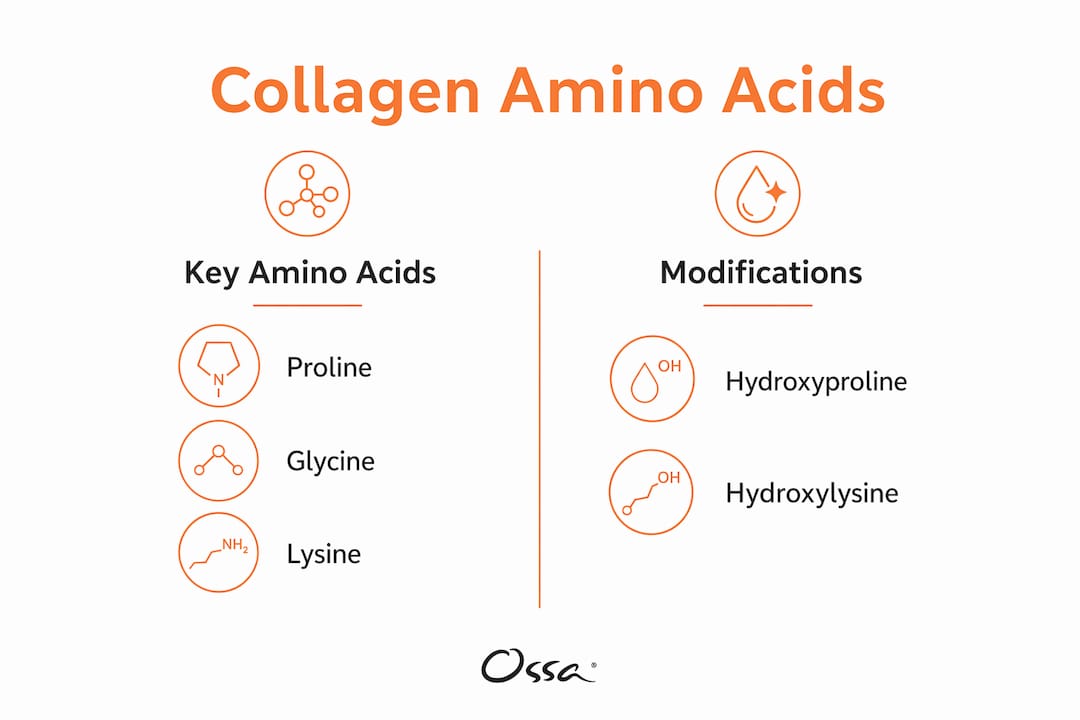
Vitamin C’s role here is non-negotiable. Prolyl hydroxylase and lysyl hydroxylase both require vitamin C to hydroxylate proline and lysine residues. When ascorbate is absent, the enzymes stall. The historical consequence of this failure is scurvy, a condition characterised by collapsing connective tissue, bleeding gums, and poor wound healing. Scurvy is not a relic of maritime history; it is a biochemical demonstration of what happens when proline cannot be properly modified.
Key cofactors required for proline hydroxylation in collagen synthesis:
-
Vitamin C (ascorbate): Regenerates the iron centre of prolyl hydroxylase, keeping the enzyme active
-
Iron (Fe²⁺): Sits at the catalytic core of prolyl 4-hydroxylase; oxidised iron must be reduced by vitamin C to restart the reaction
-
Alpha-ketoglutarate: Acts as a co-substrate, consumed during each hydroxylation reaction alongside oxygen
-
Prolyl 4-hydroxylase: The enzyme that performs the conversion of proline to hydroxyproline within the endoplasmic reticulum
Pro Tip: If you supplement collagen or eat collagen-rich foods, consume them alongside a source of vitamin C. Without ascorbate, the proline in your diet cannot be fully converted to hydroxyproline, and your collagen’s structural stability is compromised.
Why does proline availability affect collagen production rates?
Proline is classified as a conditionally non-essential amino acid. The body synthesises it from glutamine and glutamate, but that endogenous production has limits. Under normal conditions, synthesis is adequate. During injury, surgery, intense physical training, or chronic stress, demand rises sharply and the body’s own production cannot keep pace.
When proline availability is limited, the body prioritises it for other essential functions, diverting supply away from collagen synthesis. This creates a bottleneck that slows tissue repair even when total protein intake appears sufficient. Eating adequate protein does not guarantee adequate proline for collagen production; the amino acid profile of what you eat matters as much as the quantity.
Dietary sources that provide concentrated, bioavailable proline include:
-
Bone broth: Slow-cooked from animal bones and connective tissue, bone broth delivers proline, hydroxyproline, and glycine in a pre-formed, readily absorbed state. Ossa Organic’s organic beef bone broth is produced using traditional slow-cooking methods that preserve these amino acids.
-
Collagen peptides: Hydrolysed collagen supplements provide collagen-derived amino acids including proline and hydroxyproline directly. Grass-fed sources are preferable for amino acid quality.
-
Gelatin: Derived from the same connective tissue as bone broth, gelatin is a concentrated source of proline-rich collagen protein.
-
Egg whites: Contain proline alongside other amino acids, though at lower concentrations than connective tissue sources.
-
Meat and fish: Provide proline as part of their protein content, with cuts containing more connective tissue delivering higher concentrations.
Demand for collagen amino acids rises during recovery, making dietary proline intake particularly relevant after injury, surgery, or periods of high physical stress. This is when food-based sources of collagen precursors offer the most direct benefit.
Maintaining proline at an appropriate physiological level also has a regulatory effect. A proline concentration of approximately 0.9 mmol/L stimulates collagen content by upregulating prolyl 4-hydroxylase enzyme activity in fibroblasts. This means proline does not just supply raw material; it actively signals cells to produce more of the enzyme needed to stabilise collagen. The relationship between dietary proline and collagen output is therefore both structural and regulatory.
Proline vs. glycine, lysine, and hydroxyproline in collagen
Collagen is not a single-amino-acid protein. Its assembly requires several amino acids, each with a distinct structural role. Understanding how proline compares to glycine, lysine, and hydroxyproline clarifies why proline’s specific contribution cannot be substituted.
| Amino Acid | Approximate Abundance in Collagen | Primary Role | Key Modification |
|---|---|---|---|
| Glycine | ~33% of residues | Occupies every third position; smallest amino acid allows tight helix packing | None required |
| Proline | ~15–17% of residues | Provides rigidity; forces triple-helix folding | Hydroxylated to hydroxyproline |
| Hydroxyproline | Derived from proline | Stabilises triple helix via hydrogen bonding at 37°C | Post-translational product of proline |
| Lysine | ~30+ residues per molecule | Cross-links collagen fibrils for tensile strength | Hydroxylated to hydroxylysine |
Glycine is the most abundant amino acid in collagen at roughly 33% of all residues. Its small size is structurally necessary; glycine must occupy every third position in the collagen chain because only the smallest amino acid fits into the tight core of the triple helix. Proline, by contrast, contributes rigidity rather than compactness. Its cyclic structure actively shapes the helix rather than simply fitting within it.
Lysine contributes fewer residues than proline but performs a different structural function. Hydroxylysine, formed from lysine by lysyl hydroxylase (another vitamin C-dependent enzyme), creates cross-links between collagen fibrils. Those cross-links determine tensile strength. Proline determines helix stability; lysine determines fibril strength. Both are necessary, and both depend on vitamin C for their modifications.
Hydroxyproline is not a separate dietary amino acid in the conventional sense. The body produces it from proline after incorporation into the collagen chain. Its presence in blood and urine is used clinically as a marker of collagen turnover. When you consume bone broth or collagen peptides, some hydroxyproline is absorbed directly, which may offer a signalling benefit beyond simple amino acid provision.
How does proline affect skin, joint, and overall health?
The biochemical role of proline in collagen formation translates directly into measurable health outcomes across several tissues. Skin, cartilage, tendons, and bone all depend on collagen quality, and collagen quality depends substantially on proline availability and modification.

Skin elasticity and appearance. Dermal collagen, primarily type I and type III, gives skin its firmness and resistance to wrinkling. As proline availability declines with age or poor diet, collagen fibres become less stable and skin loses structural support. Supporting collagen production and proline intake through diet and supplementation is one of the most evidence-grounded approaches to maintaining skin quality from within.
Joint cartilage and mobility. Articular cartilage is composed largely of type II collagen. Proline’s role in stabilising this collagen type is directly relevant to joint function and comfort. Reduced collagen integrity in cartilage contributes to the joint stiffness and discomfort associated with ageing and overuse. Dietary strategies that support proline availability are therefore relevant to long-term joint health, not just skin appearance.
Wound healing and tissue repair. Collagen is the primary structural protein deposited during wound healing. The fibroblasts that produce this repair collagen require adequate proline, vitamin C, and iron to complete hydroxylation. Deficiencies in any of these slow the healing process. This is why clinical nutrition protocols for surgical recovery and wound management increasingly focus on targeted amino acid and micronutrient provision.
Broader connective tissue health. Tendons, ligaments, bone matrix, and the gut lining all contain collagen. Collagen synthesis requires mechanical stress and signalling molecules like GHK-Cu in addition to amino acid supply. This means physical activity, alongside adequate proline intake, creates the conditions for collagen production across multiple tissue types.
-
Consume proline-rich foods consistently, not just during recovery periods
-
Pair collagen sources with vitamin C-rich foods at the same meal
-
Include weight-bearing or resistance exercise to provide the mechanical stimulus collagen synthesis requires
-
Consider grass-fed collagen peptides as a targeted supplement when dietary sources are insufficient
Pro Tip: Bone broth consumed in the evening provides proline and glycine, both of which support overnight tissue repair when the body’s natural regenerative processes are most active.
Key takeaways
Proline is the amino acid that determines collagen’s structural stability, and its hydroxylation by vitamin C-dependent enzymes is the single most critical step in producing functional connective tissue.
| Point | Details |
|---|---|
| Proline abundance in collagen | Proline comprises 15–17% of collagen’s amino acids, making it the second most abundant after glycine. |
| Hydroxylation is non-negotiable | Prolyl 4-hydroxylase converts proline to hydroxyproline, raising collagen’s melting point by 16°C to ensure stability at body temperature. |
| Vitamin C is a required cofactor | Without ascorbate, prolyl hydroxylase stalls and collagen cannot be properly stabilised, causing scurvy-like tissue breakdown. |
| Dietary sources matter during stress | Proline demand rises during injury and recovery; bone broth, gelatin, and collagen peptides provide bioavailable collagen amino acids. |
| Proline regulates enzyme production | A physiological proline level of approximately 0.9 mmol/L upregulates prolyl 4-hydroxylase in fibroblasts, actively stimulating collagen output. |
What ossa organic has learnt about proline and collagen
Most conversations about collagen focus on the protein itself. Fewer focus on the specific amino acids that make collagen functional. Having spent years working with bone broth and observing its effects on gut health, skin, and joint comfort, the clearest lesson is this: the quality of collagen support depends on the completeness of the nutritional picture, not just the quantity of protein consumed.
The common misconception is that eating more protein automatically supports collagen production. It does not. Collagen synthesis is tightly regulated; sufficient proline alone does not guarantee synthesis without cofactors like vitamin C. Someone eating a high-protein diet but low in fresh produce may have adequate proline but insufficient ascorbate to hydroxylate it. The collagen produced under those conditions is structurally compromised.
Bone broth made from organic, grass-fed bones is one of the few foods that delivers proline, hydroxyproline, and glycine together in a pre-formed, bioavailable state. That is not a marketing claim. It is a reflection of what slow cooking extracts from connective tissue. Pairing that broth with vegetables rich in vitamin C is not a wellness trend. It is the nutritional logic that the biochemistry demands.
The other underappreciated point is that collagen production depends on mechanical and biochemical signals beyond amino acid supply. Sedentary individuals who supplement collagen without providing the mechanical stimulus of exercise are missing a key regulatory input. Food and movement work together. Neither substitutes for the other.
— Ossa Organic
Support your collagen with ossa organic bone broth
Ossa Organic bone broths are made using traditional slow-cooking methods from organic, grass-fed and free-range bones. Each batch delivers a natural concentration of proline, hydroxyproline, and glycine, the amino acids your body uses directly in collagen synthesis pathways. The organic beef bone broth and organic chicken bone broth are ready to use straight from the pack, making consistent daily intake straightforward. For recipe ideas that incorporate bone broth into your collagen-supporting diet, visit the Ossa Organic collagen recipes collection. Tradition, not trend, is the principle behind every product.
FAQ
What percentage of collagen is made up of proline?
Proline comprises approximately 15–17% of collagen’s total amino acid content, making it the second most abundant amino acid in collagen after glycine.
Why is vitamin c necessary for collagen synthesis?
Vitamin C is required for prolyl hydroxylase and lysyl hydroxylase to function. Without it, proline cannot be converted to hydroxyproline, and collagen loses its structural stability at body temperature.
What foods are highest in proline for collagen support?
Bone broth, gelatin, and collagen peptides from grass-fed or free-range sources provide the highest concentrations of proline and hydroxyproline in a bioavailable form.
Does eating more protein increase collagen production?
Not directly. Collagen synthesis requires specific amino acids including proline, plus cofactors such as vitamin C and iron. Total protein intake alone does not guarantee adequate proline or the enzymatic conditions needed for collagen stabilisation.
How does proline differ from hydroxyproline in collagen?
Proline is the dietary amino acid incorporated into the collagen chain during synthesis. Hydroxyproline is produced from proline after incorporation, via a vitamin C-dependent enzymatic reaction, and is the form that stabilises the triple helix at 37°C.