
Cart
0
Neither tallow nor butter wins outright on health grounds: the right choice depends on the dish and your priorities. Use tallow for high-heat searing, frying and roasting. Use butter for baking, pan sauces and finishing touches. If lowering LDL cholesterol matters to you, lean on unsaturated plant oils most days and treat animal fats as an occasional ingredient rather than a daily staple.
TL;DR:
Tallow withstands higher cooking temperatures than butter, making it ideal for searing, frying, and roasting, while butter is better suited for baking and finishing sauces.
The composition of tallow and butter varies based on rendering method and animal diet, affecting flavor, smoke point, and performance in the kitchen.
Both fats have similar saturated fat content, but replacing them with unsaturated oils like rapeseed or olive oil has a more significant impact on heart health.
Tallow is generally dairy-free and more stable at room temperature, whereas butter requires refrigeration and is unsuitable for dairy allergies.
Portion control and choosing the right fat for each dish are more important for health than switching from one animal fat to another.
Table of Contents
-
Composition differences: what butter and tallow actually are and why that matters
-
Smoke point and heat techniques: searing, frying and finishing
-
Flavour and culinary uses: where tallow wins and where butter remains essential
-
Nutrition and health: evidence-based guidance on saturated fat and LDL
-
Ossa Organic: why our products follow the guidance in this article
Composition differences: what butter and tallow actually are and why that matters
Tallow is rendered beef fat, almost always free of dairy, and closer to pure fat in structure. That difference explains most of what happens in the pan.
Milk solids in butter brown quickly and burn at moderate heat, which is why butter left alone in a hot pan turns bitter and dark before your food is cooked through. The water content also causes butter to spit and foam, changing how it behaves in pastry and how evenly it coats a surface. Tallow, being nearly pure fat, melts cleanly, crisps food well and behaves consistently across batches, though not identically: rendering method, the cut of beef used and the animal’s diet all shift the final texture and flavour.
When buying either fat, a few label details tell you what you’re actually getting:
-
Grass-fed or organic claims indicate how the animal was raised, which affects fatty-acid composition and flavour.
-
Rendering method (wet versus dry rendering) changes clarity, shelf life and taste.
-
Ingredient list length matters: pure tallow or butter should have one ingredient, not fillers or added oils.
-
Batch notes or best-before dates help you judge freshness, since natural fats vary more than processed alternatives.
Home cooks weighing up rendering choices and how they affect tallow smoke points and storage will find that the method used to render the fat has a bigger effect on performance than most people expect.
Smoke point and heat techniques: searing, frying and finishing
Smoke point is the temperature at which a fat starts to break down and visibly smoke, and it’s measured under laboratory conditions that don’t always match a home kitchen. Published smoke-point figures for tallow and butter vary between sources because tallow’s composition changes with the breed of cattle, the tissue it comes from and how it was rendered, so treat any single number as a rough guide rather than a fixed fact.
In practice, tallow tolerates higher, more sustained heat than butter, which makes it the better choice for searing, deep frying and roasting. Butter’s milk solids mean it scorches faster, so it performs best when you want flavour rather than raw heat tolerance. If you want a buttery taste at higher temperatures, ghee or clarified butter solves that problem: removing the milk solids leaves a fat that behaves much more like tallow while keeping butter’s aroma.
A simple searing technique used widely by chefs combines both fats in sequence:
-
Preheat the pan until it’s properly hot before adding any fat.
-
Add a thin layer of tallow and let it heat until it shimmers, not smokes.
-
Sear the food undisturbed to build a proper crust.
-
Lower the heat once the crust forms, then add a knob of butter.
-
Tilt the pan and baste continuously, letting the butter’s milk solids add colour and aroma without burning.
-
Rest the food off the heat before serving.
Pro Tip: Watch the fat, not the clock: a faint haze and a nutty smell mean it’s ready, while sharp, acrid smoke means it’s already breaking down and should be removed from the heat.
If a fat starts smoking heavily, discolours suddenly or smells sharp rather than savoury, take the pan off the heat and start again with fresh fat. Continuing to cook in fat that has broken down affects both flavour and food safety.
Flavour and culinary uses: where tallow wins and where butter remains essential
Tallow brings a savoury, slightly beefy depth that suits hearty, high-heat cooking. It’s the fat behind properly crisp roast potatoes, deep-fried chicken with a shattering crust, and steaks seared hard before resting. Traditional beef dripping in pastry, particularly for savoury pies, is another use where tallow’s structure and flavour genuinely improve the result.

Butter, by contrast, is close to essential in baking. Its water content creates steam that helps pastry rise and flake, and its flavour is what makes shortbread, sponge cakes and buttercream taste the way they do. It’s also the standard finishing fat for pan sauces, where a knob of cold butter whisked in at the end adds gloss and body, and it pairs naturally with delicate proteins like fish, where tallow’s stronger flavour would overpower the dish.
Some practical swaps to try:
-
Roast potatoes: swap vegetable oil for tallow to get a crisper, more savoury crust.
-
Steak searing: use tallow for the initial sear, then finish with butter for aroma.
-
Shortcrust pastry: tallow can replace some or all of the fat for a firmer, more savoury pastry, useful in meat pies.
-
Cakes and delicate sauces: stick with butter, since tallow’s flavour and lack of water will change both texture and taste in ways that don’t suit sweet or subtle dishes.
For more detailed recipe ideas built around these principles, tallow recipes for everyday cooking offer a useful starting point, as does a step-by-step guide to using beef tallow for anyone new to cooking with it.
Nutrition and health: evidence-based guidance on saturated fat and LDL
Both tallow and butter are concentrated sources of saturated fat, and neither is a unique outlier compared with the other. The NHS recommends cutting down on saturated fat generally and replacing some of it with unsaturated fat, rather than singling out any one animal fat as uniquely problematic.
A typical tablespoon of either butter or tallow contains a significant amount of saturated fat, which matters because NHS guidance sets a daily limit of no more than 30g of saturated fat for men and 20g for women, with lower limits for children. That means two or three tablespoons of either fat across a day’s cooking can use up most of your saturated-fat allowance before you’ve accounted for meat, cheese or pastry.
HEART UK and the American Heart Association’s evidence summaries both point to the same conclusion: the real benefit comes from replacing saturated fat with unsaturated fat, not from swapping one saturated animal fat for another. Switching from butter to tallow, or the reverse, doesn’t meaningfully change your cardiovascular risk profile on its own.
Practical ways to apply this:
-
Use unsaturated oils such as rapeseed or olive oil for everyday cooking where high heat isn’t essential.
-
Reserve tallow and butter for dishes where their texture or flavour genuinely improves the result.
-
Measure fat with a spoon rather than pouring freely, since it’s easy to underestimate how much you’re using.
-
Choose grilling or roasting over deep frying where practical, to reduce overall fat intake.
If you have high LDL cholesterol or existing heart disease, saturated fat intake is worth discussing directly with a GP or dietitian rather than relying on general guidance, since individual targets can differ. For a broader look at how Ossa Organic frames animal fats against processed alternatives, see this piece on replacing seed oils with tallow, though the saturated-fat guidance above still applies regardless of which fat you choose.
Allergies, religious and labelling considerations
Tallow is rendered beef fat and is generally dairy-free, which makes it a useful option for people avoiding milk proteins, though cross-contamination is possible if it’s processed in a facility that also handles dairy, so checking the label matters. Butter, by definition, contains milk proteins and is unsuitable for anyone with a milk allergy or a strict dairy-free diet.
For religious dietary requirements, tallow’s suitability depends on how the animal was slaughtered and processed, so kosher or halal certification should be checked directly on the packaging rather than assumed. Those following keto or paleo diets often choose tallow and butter deliberately for their fat content, but that dietary preference is separate from general public-health advice on saturated fat, and the two shouldn’t be confused when making health decisions.
Shelf life, storage and sourcing tips
Butter keeps for a few weeks in the fridge and can be frozen for longer storage, but it picks up odours easily and should be well wrapped. Tallow is more stable at room temperature than butter thanks to its low water content, though a cool, dark cupboard or the fridge extends its life further, and freezing keeps it usable for months.
Rancidity in either fat shows up as a sharp, sour or crayon-like smell, and any fat showing that should be discarded rather than cooked with. Salt in butter and airtight packaging in both fats slow oxidation and extend shelf life noticeably.
When buying, a few checks help:
-
Look for grass-fed or organic labelling, which affects both flavour and fatty-acid profile.
-
Check the rendering method where listed, since wet-rendered tallow tends to have a milder flavour than dry-rendered.
-
Expect some batch variation, particularly with tallow, since the source animal and tissue affect the final product.
-
Reuse frying fat only if strained and stored properly, and discard it once it smells off or has been reheated several times.
Quick how-to: choosing the right fat for your goal
Work through this checklist when you’re not sure which fat to reach for:
-
Identify the cooking method first: high heat (searing, frying, roasting) points towards tallow or ghee; baking, sauces or finishing point towards butter.
-
Check your health priority: if lowering LDL cholesterol is the goal, default to unsaturated oils like rapeseed or olive oil for most cooking, and use tallow or butter sparingly.
-
Rule out allergies or religious requirements: dairy allergy rules out butter; certification requirements mean checking tallow’s processing and slaughter method.
-
Consider storage and availability: tallow’s stability at room temperature suits batch cooking, while butter is better bought in smaller quantities more often.
-
Measure rather than estimate: a tablespoon of any fat adds up quickly against daily saturated-fat limits, so portion control matters more than which fat you choose.
Ossa Organic: why our products follow the guidance in this article
Ossa Organic began five years ago as a family project built around bone broth and traditional, slow-cooked nourishment, and that same approach shapes how we produce fat for cooking. Our Organic Tallow is produced to provide high-heat stability suitable for searing, frying and roasting, with batch care consistent with traditional rendering methods. Our Organic Ghee is clarified to offer butter’s flavour with improved heat tolerance for cooking methods between high-heat searing and delicate finishing. We check labels and sourcing thoroughly, so claims on our packaging reflect the rendering and farming practices behind the products rather than being marketing language alone.
Short closing recommendation and checklist
Use tallow where high heat and crisp texture matter, butter where flavour and structure in baking and sauces matter, and unsaturated oils where lowering saturated fat is the priority. A quick reminder: high-heat cooking favours tallow or ghee, pastry and finishing favour butter, and everyday cooking benefits from unsaturated oils. Read labels for rendering method and sourcing, and measure portions rather than pouring freely.
Editorial take on cooking fats and public-health advice
The most overrated question in this debate is “which fat is healthier”, because it assumes one animal fat can be meaningfully better than another when the real lever is what you’re comparing them against. Swapping butter for tallow, or the reverse, barely moves the needle on cardiovascular risk. Swapping either for rapeseed or olive oil in your everyday cooking moves it considerably more, according to the evidence HEART UK and the NHS both point to.
What gets underestimated is portion size. A tablespoon here and there across a day’s cooking adds up to a meaningful share of the recommended saturated-fat limit, and most people don’t track it that closely. The practical fix isn’t choosing the “right” animal fat: it’s using tallow and butter deliberately, for the dishes where they earn their place, and defaulting to unsaturated oils the rest of the time. That’s a less satisfying answer than a clean verdict, but it’s the one the evidence actually supports.
— Ossa Organic
Ossa Organic product options that match these uses
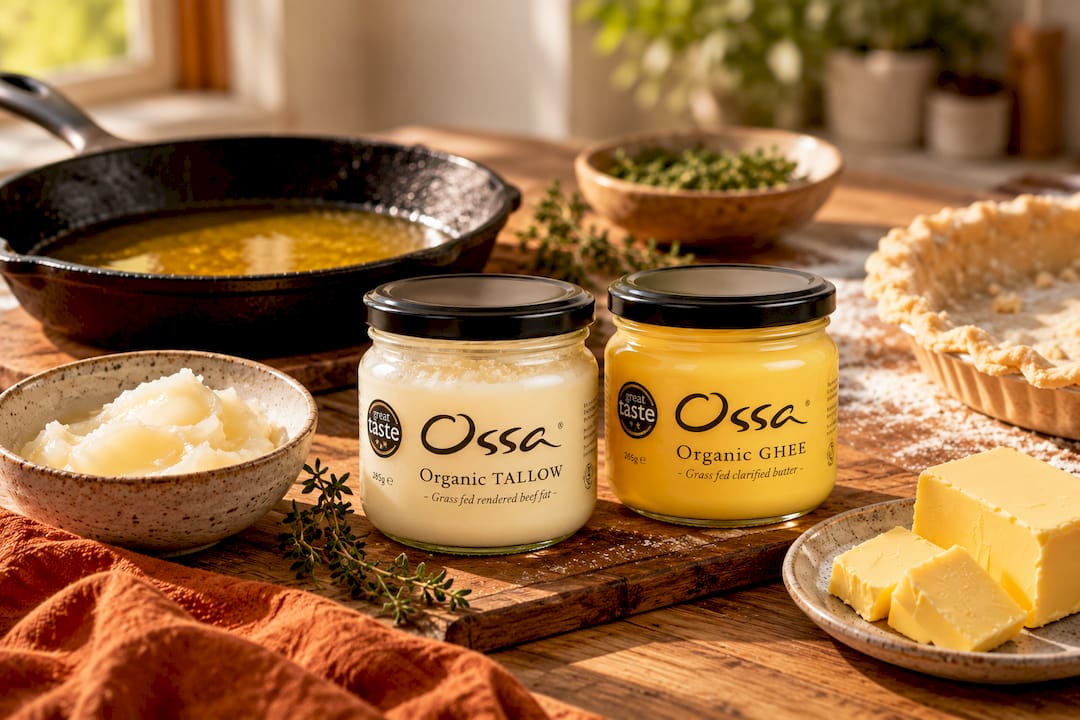
If you’ve settled on tallow for high-heat cooking, Organic Tallow is rendered from grass-fed British beef to organic standards, suited to searing, roasting and deep frying exactly as described above. For a butter-flavoured fat with better heat tolerance, Organic Ghee works well for pan-frying and finishing dishes where you want richness without burning milk solids. If you’re after a savoury snack made with the same approach to fat, Tallow Potato Crisps are cooked in tallow rather than seed oil, offering a distinct flavour compared to standard crisps.

Whichever product you choose, check the label for rendering method and sourcing before you buy, since that detail affects flavour and performance as much as the fat itself. Browse the full range on the Ossa Organic shop to compare tallow, ghee and other grass-fed fats side by side.
Authoritative sources and further reading
This article draws on NHS guidance on reducing saturated fat intake and daily limits, and on HEART UK’s evidence summaries on replacing saturated fat with unsaturated fat to manage cardiovascular risk. Cooking technique guidance reflects widely used chef practice around searing with heat-stable fats and finishing with butter. For product browsing and further reading on tallow and ghee, visit the Ossa Organic homepage.
This article is general information, not a substitute for advice from a qualified doctor. Consult a qualified healthcare professional about your own circumstances before acting on anything here.
FAQ
Is butter healthier than tallow?
Neither is categorically healthier: both are concentrated sources of saturated fat, and the NHS and HEART UK both focus on replacing saturated fat with unsaturated fat rather than favouring one animal fat over another. Your choice should depend on the dish and your overall dietary pattern rather than a single health verdict.
Why do some health professionals raise concerns about tallow in skincare?
Concerns about tallow used on skin relate to comedogenicity and individual skin reactions rather than the cooking use covered in this article, and specific dermatological guidance sits outside general dietary advice. For any skin-related use, a dermatologist’s assessment of your individual skin type is more reliable than general commentary.
What do cardiology bodies recommend instead of butter for heart health?
HEART UK and cardiology-focused guidance recommend replacing saturated fats, including butter, with unsaturated fats such as rapeseed or olive oil, since this has a stronger effect on lowering LDL cholesterol than swapping one saturated fat for another. Butter can still feature occasionally in a varied diet, but it shouldn’t be the default cooking fat if lowering cardiovascular risk is a priority.
Why might someone choose to limit beef tallow in their diet?
Tallow is high in saturated fat, and the NHS recommends keeping saturated fat intake within daily limits as part of general cardiovascular health. The concern isn’t that tallow is uniquely harmful, but that it contributes to overall saturated-fat intake alongside other foods like meat, cheese and pastry.