

Cart
0
TL;DR:
- Grass fed organic meat comes from animals raised solely on organic pastures without grain, pesticides, hormones, or antibiotics. The combination of both certifications ensures the meat has a natural diet and chemical-free environment, offering significant nutritional benefits like higher omega-3s and antioxidants. Verifying trusted third-party labels and “grass-finished” claims guarantees authentic product sourcing and quality.
Grass fed organic meat is meat from animals raised exclusively on organic pastures, without grain supplementation, synthetic pesticides, hormones, or routine antibiotics at any stage of their lives. The term combines two distinct standards: “grass-fed,” which governs what the animal eats, and “organic,” which governs how the animal is raised and what enters its environment. Together, they represent the most rigorous category of meat available to health-conscious consumers. Understanding what each label actually guarantees is the first step to buying with confidence.
What is grass fed organic meat and how does it differ from standard labels?
Grass fed organic meat sits at the intersection of two separate certification systems. Most shoppers assume the terms are interchangeable. They are not, and the difference matters significantly for both nutrition and food safety.
USDA Organic certification guarantees that animals are raised without synthetic pesticides, hormones, or routine antibiotics, and that all feed is certified organic. What it does not guarantee is a grass-only diet. An animal can be certified organic and still be finished on organic grain before slaughter. That distinction changes the nutritional profile of the meat considerably.
The “grass-fed” label, by contrast, focuses entirely on diet. It specifies that the animal’s primary feed source is forage: grass, hay, and other pasture plants. However, the USDA withdrew its federal definition for grass-fed in 2016, leaving the label without a uniform federal standard. A producer can print “grass-fed” on packaging without third-party verification. That regulatory gap is why certification bodies like the American Grassfed Association (AGA) exist.
True grass fed organic meat carries both certifications. The animal eats only organic forage, lives on certified organic pasture, and is never treated with synthetic chemicals or growth promoters. This combination closes the loopholes that each individual label leaves open.
Grass-fed vs organic: certification comparison
| Criterion | Grass-fed (AGA certified) | USDA Organic |
|---|---|---|
| Diet | Forage only, no grain | Organic feed, grain permitted |
| Synthetic pesticides | Not addressed | Prohibited |
| Hormones | Prohibited | Prohibited |
| Routine antibiotics | Prohibited | Prohibited |
| Pasture access | Required | Required |
| Third-party verification | Yes (AGA) | Yes (USDA accredited certifier) |
| GMO feed | Not addressed | Prohibited |
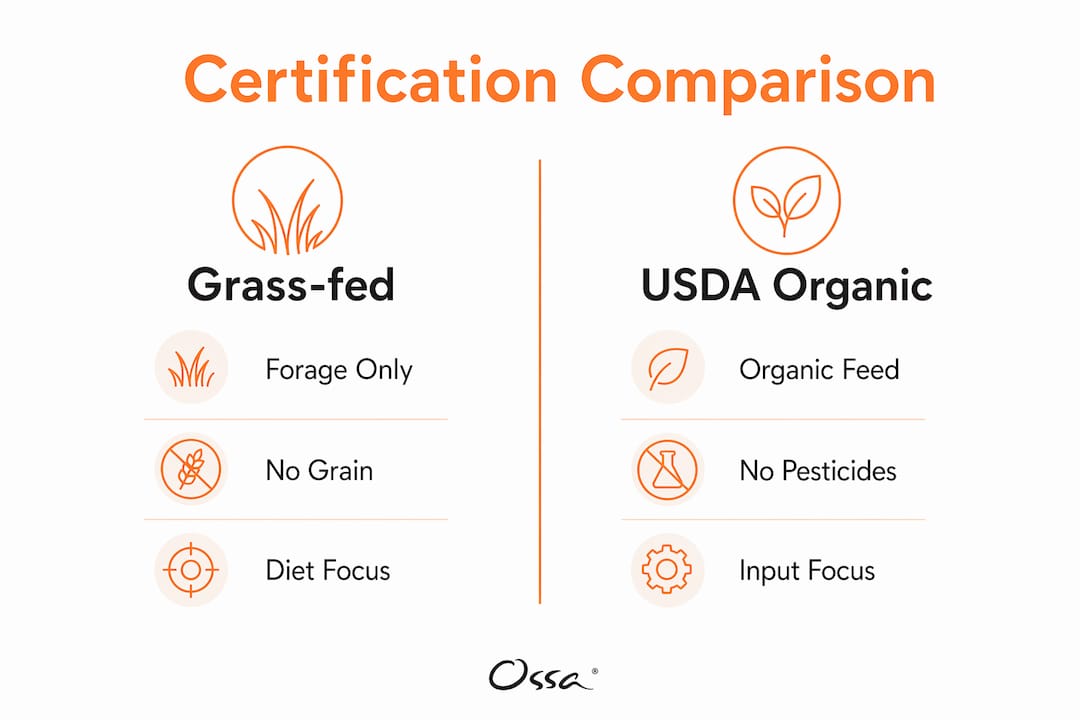
The table shows clearly that neither label alone covers every concern. Grass-fed addresses diet but not chemical inputs. Organic addresses inputs but not diet composition. Only the combination of both standards covers the full picture.
What are the nutritional benefits of grass fed organic meat?
Grass fed organic beef delivers a measurably different nutritional profile compared to conventional grain-fed beef. The differences are not marginal. Research shows grass-fed beef contains 3.1-fold higher phytochemical antioxidants, 2.9-fold higher Vitamin A, and 4.2-fold higher Vitamin E than grain-fed beef. Those are substantial gaps, not minor variations.
The fatty acid profile is equally significant. Grass-fed beef contains 2 to 5 times more omega-3 fatty acids than grain-fed beef, with an omega-6 to omega-3 ratio of roughly 2:1 to 3:1. Grain-fed beef sits at 6:1 to 10:1. A lower ratio is associated with reduced inflammation and better cardiovascular health. That shift in ratio is one of the most clinically relevant differences between the two production systems.
Grass fed organic meat also carries lower chemical residue risk. Because organic certification prohibits synthetic pesticides, hormones, and routine antibiotic use, the animal’s tissue is not exposed to those inputs throughout its life. For people who eat red meat regularly, that reduction in cumulative chemical exposure is meaningful.
Does pasture quality affect the nutritional value?
Pasture quality is a major variable that most labels do not capture. Nutrient content in grass-fed meat varies significantly based on soil health and pasture diversity. An animal grazing on a biodiverse meadow with mineral-rich soil produces meat with a different nutrient density than one grazing on a monoculture ryegrass field. This is why farm practices matter as much as certification status.
The practical implication is that two products both labelled “grass fed organic” can differ in nutritional quality depending on where and how the animal was raised. Sourcing from farms that actively manage soil health and pasture diversity produces the most nutrient-dense results. Future nutritional labelling may move towards specific constituent data, such as omega-3 content per 100g, rather than relying on broad production claims alone.
Pro Tip: Choose cuts from the shoulder, shank, or brisket when buying grass fed organic beef. These working muscles have higher concentrations of omega-3s and connective tissue nutrients compared to lean loin cuts.
Nutritional comparison: grass fed organic vs grain-fed conventional
| Nutrient | Grass fed organic | Grain-fed conventional |
|---|---|---|
| Omega-3 fatty acids | Significantly higher (2–5x) | Lower |
| Omega-6:omega-3 ratio | ~2:1 to 3:1 | ~6:1 to 10:1 |
| Vitamin A | ~2.9x higher | Baseline |
| Vitamin E | ~4.2x higher | Baseline |
| Phytochemical antioxidants | ~3.1x higher | Baseline |
| Synthetic residues | Absent (organic certified) | Potentially present |
One important caveat: grass-fed beef still contains saturated fat, and the Mayo Clinic recommends lean cuts and moderation regardless of how the animal was raised. The nutritional advantages of grass fed organic meat are real, but they do not make unlimited consumption advisable. Overall diet quality remains the dominant factor in long-term health outcomes.
How to identify authentic grass fed organic meat
Label reading is the single most important skill when buying grass fed organic meat. The market contains a wide range of claims, and not all of them are backed by independent verification. Knowing which marks to trust saves both money and disappointment.
The two most reliable certifications in the UK and US markets are USDA Organic and the American Grassfed Association (AGA) seal. In the UK, the Soil Association certification is the gold standard for organic status, covering feed, welfare, and environmental standards. Look for these marks on the packaging rather than relying on front-of-pack marketing language.
The phrase “100% grass-fed and grass-finished” is the most specific claim to seek out. “Grass-finished” means the animal ate only forage in its final months before slaughter, not just during early life. A product labelled simply “grass-fed” can still be grain-finished, which alters the fatty acid profile significantly. The word “finished” is the key distinction.
Questions to ask before you buy
-
Does the product carry a recognised third-party certification (Soil Association, AGA, USDA Organic)?
-
Does the label state “100% grass-fed and grass-finished” or only “grass-fed”?
-
Can the retailer or producer confirm the farm of origin?
-
Is the organic certification current and verifiable on the certifying body’s website?
-
Does the producer describe their pasture management practices?
Understanding how to find certified organic produce with confidence is a practical skill worth developing. Farmers’ markets and direct-from-farm box schemes often provide the most transparent sourcing information, because you can ask the producer directly.
Pro Tip: Scan the certifying body’s public register online before purchasing from a new supplier. Both the Soil Association and USDA maintain searchable databases of certified producers. A quick search confirms whether a claim is current.
What does grass fed organic meat cost, and is it worth it?
Grass fed organic meat costs more than conventional meat, and the reasons are structural rather than arbitrary. Grass-fed cattle take roughly 24–28 months to reach market weight, compared to approximately half that time for grain-fed animals. Longer production cycles mean higher land, labour, and feed costs per animal. Those costs pass through to the retail price.
Retail prices for grass fed organic meat typically run 20–50% higher than grain-fed conventional equivalents. That premium reflects not just the longer production time but also the cost of organic certification, pasture management, and lower stocking densities. Understanding why organic food costs more helps frame the price as a reflection of genuine production differences rather than marketing.
How grass fed organic compares to other sustainable options
| Meat type | Diet | Certification | Relative price |
|---|---|---|---|
| Grass fed organic | Organic forage only | Soil Association / AGA + Organic | Highest |
| Pasture-raised organic | Mixed forage and organic grain | Organic certified | High |
| Free-range conventional | Mixed, outdoor access | Welfare standard only | Moderate |
| Grain-fed conventional | Grain-based | None required | Lowest |
Availability varies by season and geography. Grass-fed animals depend on living pasture, so supply can tighten in winter months when pasture growth slows. Many producers supplement with certified organic hay during these periods, which maintains the grass-fed standard without compromising the animal’s diet. Buying directly from a farm or through a specialist butcher often provides more consistent year-round access than supermarket channels.
The ethical and environmental case for the premium is also measurable. Ethically raised grass-fed organic meat supports environmental sustainability and animal welfare, and well-managed pasture systems can contribute to soil carbon sequestration. For consumers who factor environmental impact into purchasing decisions, the price difference carries additional weight beyond personal health.
Key takeaways
Grass fed organic meat delivers the strongest nutritional and safety profile available because it combines a forage-only diet with certified organic rearing standards, eliminating both grain finishing and synthetic chemical exposure.
| Point | Details |
|---|---|
| Two certifications, not one | “Grass-fed” governs diet; “organic” governs inputs. Both are needed for full assurance. |
| Nutritional advantage is measurable | Grass-fed organic beef contains up to 4.2x more Vitamin E and 2–5x more omega-3s than grain-fed. |
| “Grass-finished” is the key phrase | Look for “100% grass-fed and grass-finished” to avoid products grain-finished before slaughter. |
| Third-party verification is non-negotiable | The USDA withdrew its grass-fed definition in 2016; rely on AGA or Soil Association certification. |
| Premium price reflects real costs | Longer production cycles of 24–28 months explain the 20–50% retail price premium. |
Ossa Organic’s view on choosing grass fed organic meat
Label confusion is the biggest barrier between consumers and genuinely better food. After years of working with certified organic ingredients at Ossa Organic, the pattern is consistent: shoppers read “grass-fed” on a package and assume it covers everything. It does not. The organic certification is the part that protects you from synthetic residues. The grass-fed certification is the part that changes the nutritional profile. You need both, and you need them verified by a body that carries out physical farm inspections.
The budget question comes up constantly. Grass fed organic meat is more expensive, and that is a real constraint for many households. The practical answer is not to eat less quality meat, but to use the whole animal more efficiently. Bone broth, slow-cooked cuts, and offal from grass fed organic animals deliver exceptional nutritional density at a lower cost per serving than prime cuts. Tradition-based cooking methods extract far more value from the animal than modern convenience cooking does.
The future of this category will move towards greater specificity. Broad labels will give way to nutrient-specific data: omega-3 content per 100g, antioxidant profiles, and farm-level soil health scores. Until that transparency arrives, the most reliable shortcut is a direct relationship with a producer whose practices you can verify. Ask where the animal grazed, what the pasture management looks like, and whether the certification is current. Those three questions filter out most of the noise.
— Ossa Organic
Discover Ossa Organic’s grass fed organic bone broth
Bone broth is one of the most practical ways to incorporate the benefits of grass fed organic meat into daily life. Ossa Organic’s organic beef bone broth is made from certified organic, pasture-raised beef bones, slow-cooked to preserve collagen, minerals, and amino acids. The same standards that define quality grass fed organic meat apply directly to the source ingredients. For those exploring the gut health benefits of organic bone broth, Ossa Organic’s range offers a straightforward entry point. Each batch is traceable, certified, and free from preservatives or synthetic additives.
FAQ
What does “grass-fed and grass-finished” mean?
“Grass-finished” means the animal ate only forage in its final months before slaughter, not just during early life. A product labelled only “grass-fed” may have been grain-finished, which lowers its omega-3 content.
Is organic meat always grass-fed?
No. USDA Organic certification permits grain finishing using certified organic grain. Organic meat is not automatically grass-fed unless the label explicitly states it.
Why was the USDA grass-fed standard withdrawn?
The USDA withdrew its marketing claim definition for grass-fed in 2016, leaving no uniform federal standard. Third-party certifiers like the American Grassfed Association now provide the most reliable verification of grass-fed claims.
Does grass fed organic meat taste different?
Grass fed organic beef typically has a leaner texture and a more pronounced, slightly mineral flavour compared to grain-fed beef. The lower fat content means it benefits from slower cooking methods or careful temperature control when grilling.
How should I store grass fed organic meat?
Grass fed organic meat stores the same way as conventional meat: refrigerate and use within 2–3 days, or freeze for up to 6 months. Its lower fat content means it can dry out faster during cooking, so resting the meat after cooking is particularly important.