

Cart
0
TL;DR:
- Single origin organic food comes from one clear, identifiable source, produced without synthetic pesticides under organic standards. Verifying claims requires checking for a named farm or region, the organic certifier logo, and a batch or lot number linked to certification documentation. For gut health, selecting products with both single origin and organic certification ensures higher traceability, consistent nutrients, and lower contamination risks.
Single origin organic food comes from one named, identifiable source — a specific farm, cooperative, or defined region — and is produced without synthetic pesticides or fertilisers under a regulated organic certification scheme. For gut-health and paleo shoppers in the UK, the most useful first step is to check for both a named origin and a recognised organic certifier logo before anything else.
Three trust signals worth spotting immediately on any label or product page:
- A named farm, cooperative, or region (not just a country)
- A Soil Association logo or equivalent UK-recognised organic certification mark
- A batch or lot number that links to a Certificate of Analysis or provenance record
Table of Contents
- What does ‘single origin’ actually mean for UK shoppers?
- How does ‘single origin’ differ from ‘organic’, ‘single-estate’, and blends?
- What are the real benefits and limits of single-origin organic?
- How can UK shoppers verify single-origin organic claims?
- Your practical shopping checklist for single-origin organic foods
- How Ossa Organic applies single-origin organic principles to bone broth
- Should you prioritise single-origin organic?
- Key takeaways
- Why single-origin organic sourcing matters to Ossa Organic
- Ossa Organic bone broths for gut-health and paleo shoppers
- Further reading and useful UK sources
- FAQ
What does ‘single origin’ actually mean for UK shoppers?
The term operates on a spectrum of specificity. At its broadest, it means a single country. At its most meaningful, it identifies a named cooperative or estate, with a documented harvest season and post-harvest protocol attached to every lot. Sourcing from a named cooperative or estate is the highest level of traceability and the most commercially significant use of the term.
In practice, a UK shopper might encounter:
- Country-level: “Sourced from Sri Lanka” — useful context, limited traceability
- Region-level: “From the Kalamata valley, Greece” — more specific, better for polyphenol-sensitive products like olive oil
- Cooperative/estate-level: “From Cooperativa X, harvest season 2024” — the gold standard, with lot-level documentation available on request
When ‘single origin’ pairs with organic certification, the combination means the named source has also been independently audited for compliance with organic farming standards. A single-origin organic bone broth, for example, should be traceable to a named farm or cooperative that holds a current organic certificate covering both the rearing of animals and the processing facility.
Pro Tip: Ask the supplier which cooperative or farm the product comes from. A genuine single-origin claim should be answerable in one sentence, not a paragraph of marketing copy.
Labels worth recognising in the UK context include the Soil Association logo, the EU organic leaf (still accepted on many products sold in the UK), and the OF&G (Organic Farmers & Growers) mark. Each indicates third-party auditing, but none automatically confirms single-origin sourcing. That detail lives in the provenance statement, not the certification logo alone.
How does ‘single origin’ differ from ‘organic’, ‘single-estate’, and blends?
These labels overlap but are not interchangeable. Understanding the distinctions prevents a common buying mistake: assuming that any one label covers what the others promise.
| Label | What it guarantees | What it does not guarantee |
|---|---|---|
| Organic (certified) | No synthetic pesticides or fertilisers; audited chain-of-custody | Named geographic origin; nutrient consistency |
| Single origin | Identifiable geographic source (country to estate level) | Organic farming methods; regulated definition |
| Single-estate / single-farm | One specific property; highest geographic precision | Organic certification; lot-level documentation |
| Blend | Consistent flavour profile across batches | Traceability; origin transparency |
For gut-health and paleo buying decisions, the practical implication is straightforward. Organic certification tells you how the food was grown. Single origin tells you where. Neither automatically implies the other. A blended organic product may carry full organic certification but offer no traceability to a specific source. Conversely, a single-estate product may have excellent provenance documentation but no organic audit.
| Buyer priority | Best label combination | Minimum acceptable |
|---|---|---|
| Traceability and safety | Single-estate + certified organic | Named region + certified organic |
| Nutrient consistency | Single-estate + certified organic | Single origin + certified organic |
| Budget-conscious paleo | Certified organic (any origin) | Certified organic |
| Gut-health supplements | Single-estate + certified organic + COA | Single origin + certified organic |
What are the real benefits and limits of single-origin organic?
For gut-health and paleo shoppers, the strongest case for single-origin organic rests on traceability and nutrient consistency, not marketing language.
Key benefits:
- Traceability: A shorter, transparent supply chain reduces contamination and adulteration risk. This matters most for concentrated products such as finishing oils, bone broths, and fermented ingredients.
- Consistent nutrient profile: Polyphenol concentration in olive oil, for instance, depends on cultivar, environment, and harvest timing. Single-origin lots give a more reliable indication of what you are actually consuming.
- Lower contamination risk: Identity-preserved lots with documented post-harvest protocols reduce the chance of cross-contamination from non-organic sources.
- Terroir-related differences: Soil mineral content, climate, and farming practice at a specific site can affect the nutritional character of the food produced there.
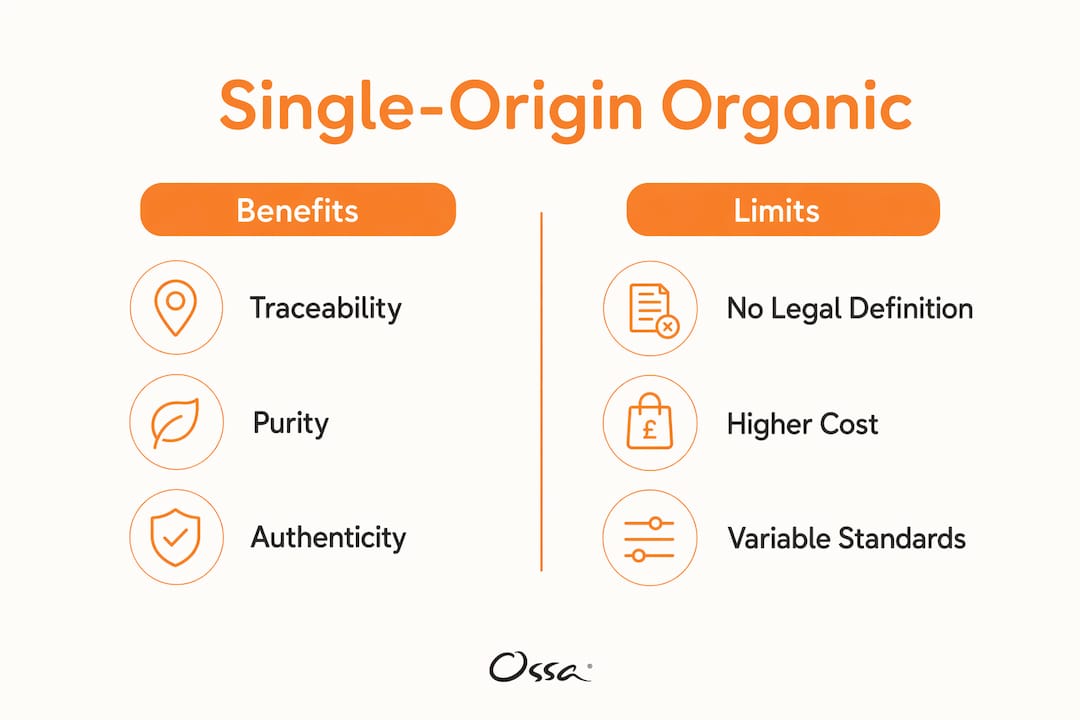
The limits are equally worth stating. ‘Single origin’ is not a legally regulated term in the UK or most other markets. Any producer can use it without independent verification. Experts note that the phrase is often used as a marketing term and does not automatically guarantee higher quality or better sustainability outcomes. The phrase earns its meaning only when supported by named provenance, current organic certification, and lot-level documentation.
Pro Tip: For products where polyphenol content or contaminant sensitivity matters most — finishing oils, bone broths, concentrated extracts — single-origin organic with a lot-level Certificate of Analysis is worth the premium. For bulk staples used in high-heat cooking, certified organic without named origin is usually sufficient.
How can UK shoppers verify single-origin organic claims?
Verification follows a short, practical sequence.
- Check the organic certification logo. The Soil Association, OF&G, and the EU organic leaf are the most common UK-recognised marks. Each certifier publishes a public database where you can confirm a producer’s current certificate status.
- Locate the named origin. The label or product page should state a farm, cooperative, or defined region — not just a country. If it does not, the single-origin claim is country-level at best.
- Find the batch or lot number. This is the link between the product in your hand and the documentation behind it. Reputable producers print it on the packaging.
- Request or download the Certificate of Analysis (COA). An accredited laboratory COA confirms the product’s composition and, for organic claims, the absence of prohibited substances. Some producers publish these on their website; others supply them on request.
- Scan any QR traceability link. An increasing number of UK producers use QR codes to connect consumers directly to harvest records, farm details, and certification documents.
- Confirm the processing facility is also certified. Organic chain-of-custody requires that the certificate names both the farm or cooperative and the processing facility. A farm-only certificate is incomplete evidence.
| Trust signal | Where to find it | What it confirms |
|---|---|---|
| Soil Association logo | Label / product page | UK organic standard compliance |
| Named cooperative or farm | Label / product description | Geographic traceability |
| Batch / lot number | Packaging | Links product to documentation |
| COA from accredited lab | Website or on request | Composition and purity |
| QR provenance link | Packaging | Harvest and farm records |
| Processing facility cert | Certifier database | Full chain-of-custody |
Understanding food quality standards helps put these signals in context alongside broader certification frameworks.
Organic certification in the UK is backed by Defra-approved bodies. Combining that regulatory rigour with named geographic origin creates one of the most traceable food options available to UK consumers.
Your practical shopping checklist for single-origin organic foods
Before purchasing, run through these points on the label or product page:
- Named farm, cooperative, or defined region stated explicitly
- Recognised organic certifier logo (Soil Association, OF&G, or equivalent)
- Harvest date or season visible
- Batch or lot number printed on packaging
- Processing facility included in the organic certificate
- COA or lab testing available (published or on request)
- Storage and packaging notes consistent with the product’s quality claims
Single-origin organic products typically cost more because they rely on direct origin relationships, documented post-harvest protocols, and smaller, identity-preserved lots. That premium is most justified for products where minor compositional differences affect gut-health outcomes: high-polyphenol oils, concentrated bone broths, fermented ingredients, and collagen-rich extracts.
Pro Tip: Prioritise single-origin organic for any product you consume daily in meaningful quantities — the cumulative difference in nutrient consistency and contaminant exposure is where the premium pays off.
How Ossa Organic applies single-origin organic principles to bone broth
Ossa Organic sources ingredients for its bone broths from named organic farms, maintaining organic chain-of-custody from rearing through to processing. The brand’s certification details are published on its certification page, where shoppers can confirm current credentials rather than taking label claims at face value.
Three products that demonstrate these principles in practice:
- Organic Beef Bone Broth Ambient 515ml — sourced from certified organic grass-fed cattle, slow-cooked without preservatives or artificial additives
- Organic Free Range Chicken Bone Broth 500ml — made from certified organic free-range chickens, with full organic certification covering both sourcing and processing
- Organic Chicken Bone Broth Ambient 515ml — ambient-stable format, same organic sourcing standards, batch information available for verification
Ossa Organic holds B Corp certification alongside its organic credentials, reflecting a commitment to verified social and environmental standards that goes beyond ingredient sourcing alone.
Shoppers can verify Ossa Organic’s credentials directly through the certification page, which covers both the organic standard and the B Corp status. Batch information is available on packaging, and the brand’s supply chain is built around the principle that traceability should be demonstrable, not assumed.
Should you prioritise single-origin organic?
The decision depends on what you are buying and how you are using it.
Single-origin organic matters most for:
- Finishing oils, bone broths, and concentrated extracts consumed regularly
- Products where polyphenol content, mineral density, or contaminant sensitivity affects your health goals
- Any ingredient where you want to understand terroir and harvest practice, not just farming method
Standard certified organic is sufficient for:
- Bulk staples used in high-heat cooking, where polyphenol content is largely destroyed
- Products where origin consistency has no material effect on your gut-health outcomes
- Budget-conscious purchasing where the organic standard itself is the primary safety requirement
For gut-health and paleo shoppers in the UK, the practical recommendation is to apply single-origin organic standards to the products you consume most frequently and in the most concentrated form, and to use standard certified organic for everything else.
Key takeaways
Single-origin organic food delivers its greatest value when named provenance, current organic certification, and lot-level documentation are all present together.
| Point | Details |
|---|---|
| Definition | Single origin means one named farm, cooperative, or region; organic means certified free from synthetic inputs. |
| Verification steps | Check certifier logo, named origin, batch number, and COA before purchasing. |
| When the premium is justified | Prioritise for daily-use concentrates: bone broths, finishing oils, fermented ingredients. |
| ‘Single origin’ is not regulated | The term has no legal definition in the UK; named provenance plus independent certification is the only reliable evidence. |
| Ossa Organic | Publishes organic and B Corp credentials; batch information is on packaging for direct verification. |
Why single-origin organic sourcing matters to Ossa Organic
Ossa Organic was founded on the conviction that knowing where your food comes from is not a luxury — it is the baseline for making genuinely informed choices about what you put into your body. The brand’s sourcing decisions reflect that: organic certification at every link in the supply chain, named farm origins, and credentials that are published and verifiable rather than stated and forgotten.
For gut-health and paleo shoppers, that transparency is the point. The benefits of organic food extend beyond the absence of pesticides; they include the consistency and integrity that come from knowing exactly where an ingredient originated and how it was handled. Ossa Organic’s commitment is to make that information accessible, not buried.
Ossa Organic bone broths for gut-health and paleo shoppers
Ossa Organic’s bone broths are produced to certified organic standards, sourced from named farms, and free from preservatives and artificial ingredients. For shoppers following a paleo or gut-health protocol, they represent a straightforward way to add a traceable, certified organic collagen source to a daily routine without compromising on provenance. Visit the how to use page for guidance on incorporating bone broth into your diet, or explore the 14-day gut reset programme for a structured approach. Check the certification page before purchasing to confirm current credentials and batch details.
Further reading and useful UK sources
- What makes food truly organic — Ossa Organic’s guide to organic certification requirements and chain-of-custody
- How to find certified organic produce — practical verification guidance for UK shoppers
- Why organic ingredients matter for gut health — links organic sourcing directly to gut-health outcomes
- What is local sourcing: benefits, challenges, and impact — broader context on local and traceable sourcing trade-offs
- Ossa Organic certification page — current organic and B Corp credentials for direct verification
FAQ
What does single origin organic food mean?
Single origin organic food comes from one named, identifiable source — a farm, cooperative, or defined region — and is produced under a regulated organic certification scheme free from synthetic pesticides and fertilisers.
Is ‘single origin’ a legally regulated term in the UK?
No. ‘Single origin’ has no legal definition in the UK or most other markets, so the term can be used without independent verification. Named provenance combined with a recognised organic certification is the only reliable evidence.
How do I verify a single-origin organic claim before buying?
Check for a named farm or cooperative, a recognised certifier logo such as the Soil Association mark, a batch or lot number on the packaging, and a Certificate of Analysis available on the product page or on request.
Why does single-origin organic matter for gut health?
A shorter, transparent supply chain reduces contamination risk, and known terroir and harvest timing give a more consistent nutrient profile — particularly relevant for polyphenol-rich products such as bone broths and finishing oils consumed regularly.
Does Ossa Organic publish its organic certification details?
Yes. Ossa Organic publishes its organic and B Corp credentials on its certification page, and batch information is printed on packaging so shoppers can verify provenance directly.