

Cart
0
TL;DR:
- Certified organic food is produced according to strict standards that exclude synthetic chemicals, GMOs, and industrial inputs, verified by third-party organizations. Advanced certifications like Regenerative Organic Certified and the Real Organic Project demand higher animal welfare, soil health, and social fairness standards than the basic USDA Organic label. To ensure genuine organic purchases, consumers should verify recognized certification seals and understand label tiers and common misconceptions about organic food.
Organic food is defined by its certified production method, not its appearance, taste, or marketing claims. What makes food truly organic is a legally verified set of farming and processing standards that exclude synthetic chemicals, genetically modified organisms, and industrial inputs at every stage of production. The USDA, the Soil Association in the UK, and advanced bodies like Regenerative Organic Certified each set the rules that determine whether a product earns that label. Understanding those rules separates genuine organic food from the growing noise of misleading claims on supermarket shelves.
What makes food truly organic by official standards?
Organic food standards are not voluntary guidelines. They are enforceable legal requirements backed by third-party verification. In the United States, a product must contain at least 95% organic ingredients to display the USDA Organic seal. That threshold means the remaining 5% must come from an approved list of non-organic substances, not a free pass for synthetic additives.

The core prohibitions are clear and non-negotiable. Certified organic food cannot be produced using synthetic fertilisers, synthetic pesticides, irradiation, or genetically modified organisms. These exclusions apply to both crop production and food processing. Organic food processing also prohibits industrial solvents, synthetic food additives, and irradiation, aligning the finished product with the same ecological principles applied on the farm.
For animal products, the standards go further. Organic animal products require a 100% organic diet for the animals, no antibiotics, no growth hormones, and outdoor access when weather permits. This matters because conventional animal farming routinely uses prophylactic antibiotics, a practice linked to antimicrobial resistance. Organic standards close that door entirely.
The regulatory framework that governs all of this in the US is the National Organic Program, established in the 1990s. The National Organic Program replaced a fragmented patchwork of state-level rules with consistent third-party verification, giving consumers a reliable baseline of trust. In the UK, the Soil Association operates a comparable role, certifying farms and processors against its own rigorous standards.
Here is a summary of what the USDA Organic label requires across product categories:
| Category | Key Requirement |
|---|---|
| Crop production | No synthetic fertilisers, pesticides, GMOs, or irradiation |
| Livestock and poultry | 100% organic feed, no antibiotics or hormones, outdoor access |
| Processed food | 95% organic ingredients, no synthetic additives or industrial solvents |
| Multi-ingredient products | Ingredients listed as organic must meet full certification criteria |
The key prohibitions at a glance:
-
No synthetic pesticides or herbicides at any stage
-
No genetically modified seeds or organisms
-
No irradiation of food or feed
-
No synthetic growth promoters in animal farming
-
No industrial solvents in processing
How do advanced certifications go beyond the baseline?
The USDA Organic seal is a floor, not a ceiling. Discerning consumers seeking soil regeneration and stronger animal welfare look for labels that go further. Regenerative Organic Certified (ROC) and the Real Organic Project both prohibit hydroponics and large-scale confinement operations, two practices that are technically permissible under standard USDA organic rules.
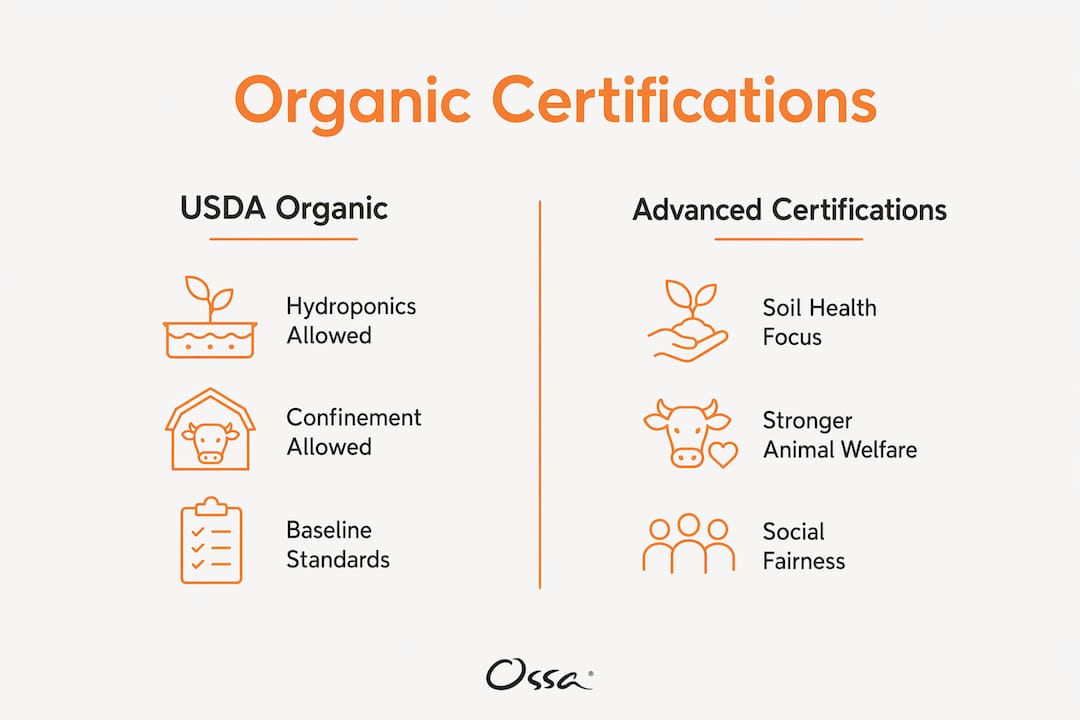
This distinction matters more than most shoppers realise. A hydroponic tomato grown in a nutrient solution inside a warehouse can carry the USDA Organic seal if the inputs meet the standard. ROC and Real Organic Project reject this entirely. Their certifications require crops to grow in living soil, because organic farming rooted in agroecology treats the farm as a complex adaptive system where soil health, biodiversity, and nutrient cycling are inseparable from food quality.
Advanced certifications also address social fairness and worker welfare, areas the USDA baseline does not cover. ROC includes a Fairtrade-aligned social equity pillar. The Real Organic Project focuses specifically on farm-scale integrity, verifying that soil and animal welfare standards are genuinely met rather than technically satisfied on paper.
Here is how the main certification tiers compare:
| Certification | Hydroponics Allowed | Confinement Allowed | Soil Health Focus | Social Fairness |
|---|---|---|---|---|
| USDA Organic | Yes | Partially | Baseline | No |
| Real Organic Project | No | No | High | No |
| Regenerative Organic Certified | No | No | Very High | Yes |
| Savory Institute Land to Market | N/A | N/A | Outcome-based | No |
The Savory Institute’s Land to Market label takes a different approach. It focuses on ecosystem health outcomes rather than input restrictions, and may permit some synthetic inputs. This makes it distinct from strict organic standards, though it shares a commitment to ecological regeneration.
Pro Tip: When shopping for the most ecologically sound products, look for the ROC or Real Organic Project seal alongside the USDA Organic seal. The combination confirms both baseline compliance and a higher standard of soil and animal stewardship.
You can find a detailed breakdown of how to navigate these labels in this guide to certified organic produce.
What are the common misconceptions about organic food?
The most widespread misconception is that organic automatically means more nutritious. Organic refers to a production method focused on ecological integrity, not a guaranteed improvement in nutrient density. A certified organic biscuit is still a biscuit. The label tells you how it was made, not whether it is good for you.
A second major source of confusion is the word “natural.” The term “natural” on food labels is unregulated and does not guarantee the absence of GMOs or synthetic pesticides. Any manufacturer can print “natural” on a product without meeting any farming standard whatsoever. Organic certification, by contrast, requires documented third-party verification at every stage.
On pesticide residues, the picture is nuanced. Organic foods typically carry fewer pesticide residues than conventionally grown produce, but both can fall below safe consumption thresholds. Choosing organic reduces your exposure, but it does not eliminate all risk, and conventional produce is not automatically dangerous.
Common myths worth correcting:
-
Myth: Organic food is always more nutritious. Fact: Certification governs production method, not nutrient content.
-
Myth: “Natural” means organic. Fact: “Natural” is an unregulated marketing term with no legal farming standard attached.
-
Myth: Organic produce is pesticide-free. Fact: Approved natural pesticides may still be used; the prohibition is on synthetic ones.
-
Myth: All organic food is worth the premium. Fact: Some produce carries minimal pesticide risk even when conventionally grown.
For budget-conscious shoppers, prioritising organic for the “Dirty Dozen” produce list is a practical strategy. The Dirty Dozen, published annually by the Environmental Working Group, identifies the twelve crops most likely to carry pesticide residues. Strawberries, spinach, and peaches consistently appear on it. Buying organic for these specific items delivers the greatest risk reduction per pound spent.
Pro Tip: Cross-reference the Environmental Working Group’s Clean 15 list before your weekly shop. The Clean 15 identifies produce with consistently low pesticide residues, so you can buy conventional versions without meaningful risk and save your organic budget for higher-priority items.
How can you identify truly organic food in the marketplace?
Identifying genuine organic food requires more than glancing at a label. The certification seal is your primary tool, but knowing which seals carry real weight separates confident shoppers from those who get misled. Here is a practical process for verifying organic claims before you buy:
-
Check for a recognised certification seal. In the UK, look for the Soil Association logo. In the US, look for the USDA Organic seal. These are legally backed and require third-party verification. The Soil Association certification is one of the most rigorous in the world, covering farming, processing, and animal welfare.
-
Look for advanced seals on high-value purchases. For meat, dairy, and eggs, check for ROC or Real Organic Project labels alongside the baseline organic seal. These confirm soil-grown crops and genuine animal welfare standards beyond the minimum.
-
Read the ingredient list, not just the front of pack. A product labelled “made with organic ingredients” in the US contains only 70% organic content and cannot display the USDA seal. The front-of-pack claim is legal but weaker than full certification. Full ingredient transparency is the mark of a producer with nothing to hide.
-
Be sceptical of vague claims. Words like “natural,” “eco-friendly,” “farm-fresh,” and “wholesome” carry no legal definition in food labelling. They are marketing language, not certification claims. If a product does not name a certifying body, treat the claim with caution.
-
Verify through the certifier’s database. Both the USDA and the Soil Association publish searchable databases of certified operators. If a brand claims organic status, you can confirm it takes less than two minutes. Legitimate producers welcome this scrutiny.
-
Understand labelling loopholes. In the US, products with 95–99% organic content display the USDA seal. Products with 70–94% organic content can say “made with organic [ingredient]” but cannot use the seal. Products below 70% can only list organic ingredients in the ingredient panel. Knowing these tiers prevents you from overpaying for partial compliance.
For a deeper look at what certification credentials actually mean, the Ossa Organic certification page explains the standards behind the products clearly.
Key takeaways
Truly organic food is defined by certified production methods that exclude synthetic inputs, GMOs, and industrial processing, verified by recognised third-party bodies at every stage of the supply chain.
| Point | Details |
|---|---|
| Certification is the definition | A product is organic only when a recognised body has verified its production method against legal standards. |
| The 95% threshold matters | USDA Organic requires 95% certified organic ingredients; anything less uses weaker label claims. |
| Advanced seals raise the bar | ROC and Real Organic Project prohibit hydroponics and confinement, going beyond the USDA baseline. |
| “Natural” is not organic | The natural label is unregulated and carries no farming standard; only certified organic claims are legally verified. |
| Prioritise the Dirty Dozen | Buying organic for high-residue produce like strawberries and spinach delivers the greatest health benefit per pound spent. |
Ossa organic’s view on what certification really means
At Ossa Organic, we have spent years sourcing ingredients that meet genuine organic standards, not just the minimum required to print a seal on a box. What we have found is that the gap between baseline certification and advanced certification is wider than most consumers expect.
The USDA Organic seal is a credible starting point. But when you look at what it permits, including hydroponic production and partial confinement of animals, it becomes clear that the seal alone does not tell the full story. The farms we trust are the ones that treat soil as a living system, not a growing medium. That distinction shows up in the quality of the ingredients and, we believe, in the quality of the food made from them.
We are also direct about what organic does not guarantee. It does not guarantee superior nutrition in every case. It does not mean zero pesticide exposure. What it does guarantee is a production method that prioritises ecological integrity over industrial convenience. For us, that is the right foundation for food that genuinely supports health.
The labelling environment is genuinely confusing, and that confusion benefits producers who want to imply organic credentials without earning them. Our advice is simple: look for the certifying body’s name, not just the word “organic.” Check the Soil Association standards if you are buying in the UK. Ask whether the producer publishes its sourcing practices. Transparency is not difficult for producers who have nothing to hide.
— Ossa Organic
Explore ossa organic’s certified organic range
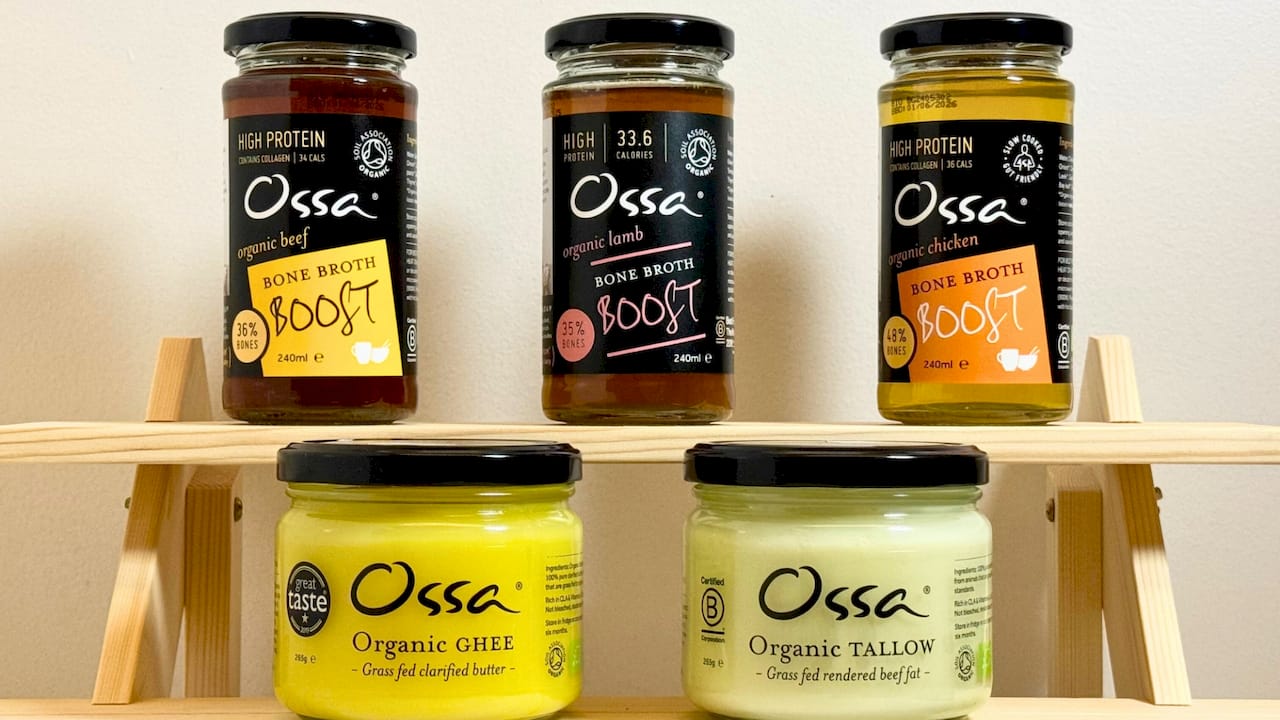
If you are ready to put these standards into practice, Ossa Organic’s product range is built on certified organic sourcing and traditional slow-cooking methods. The organic beef bone broth is made from grass-fed, certified organic bones and contains no synthetic additives, preservatives, or flavour enhancers. For those who prefer poultry, the organic chicken bone broth uses free-range, certified organic birds. Both products reflect the same commitment to ingredient integrity that this article describes. If gut health is your focus, the 14 Day Gut Reset programme offers a structured way to incorporate organic bone broth into your daily routine.
FAQ
What percentage of ingredients must be organic for a product to be labelled organic?
In the US, a product must contain at least 95% organic ingredients to display the USDA Organic seal. Products with 70–94% organic content can state “made with organic ingredients” but cannot use the seal.
Is “natural” food the same as organic food?
No. The term “natural” is unregulated and carries no legal farming standard. Organic certification requires documented third-party verification; “natural” requires nothing beyond the manufacturer’s own claim.
Do organic foods contain pesticides?
Organic farming prohibits synthetic pesticides but permits some approved natural ones. Organic produce typically carries fewer pesticide residues than conventional produce, though both can fall within safe consumption limits.
What is the difference between USDA organic and regenerative organic certified?
USDA Organic is the legal baseline, permitting hydroponics and some confinement practices. Regenerative Organic Certified requires soil-grown crops, genuine animal welfare, and includes a social fairness standard, making it a significantly stricter certification.
How do i know if an organic claim is genuine?
Look for a named certifying body such as the Soil Association, USDA, or Regenerative Organic Certified on the label. Both the USDA and Soil Association publish searchable databases of certified producers, allowing you to verify any claim directly.