

Cart
0
TL;DR:
- Organic food is more expensive because it involves higher production costs, including labor, lower yields, certification fees, and limited government subsidies. These factors reflect the true cost of farming without synthetic chemicals, making the organic premium a transparent record of genuine farming expenses. Consumers should prioritize organic for produce with thin skins and high pesticide absorption to maximize value.
Organic food costs more because producing it is genuinely more expensive at every stage, from field to shelf. Labour-intensive methods, lower crop yields, certification requirements, and a significant subsidy gap between organic and conventional farming all push prices upward. Consumers pay an average 59% price premium for organic fresh produce compared to conventional options in 2026. That figure is not arbitrary. It reflects the real cost of farming without synthetic chemicals, with full certification compliance, and with fewer government supports. This article breaks down each factor so you can understand exactly what you are paying for when you choose organic.
Why organic food costs more: the core reasons
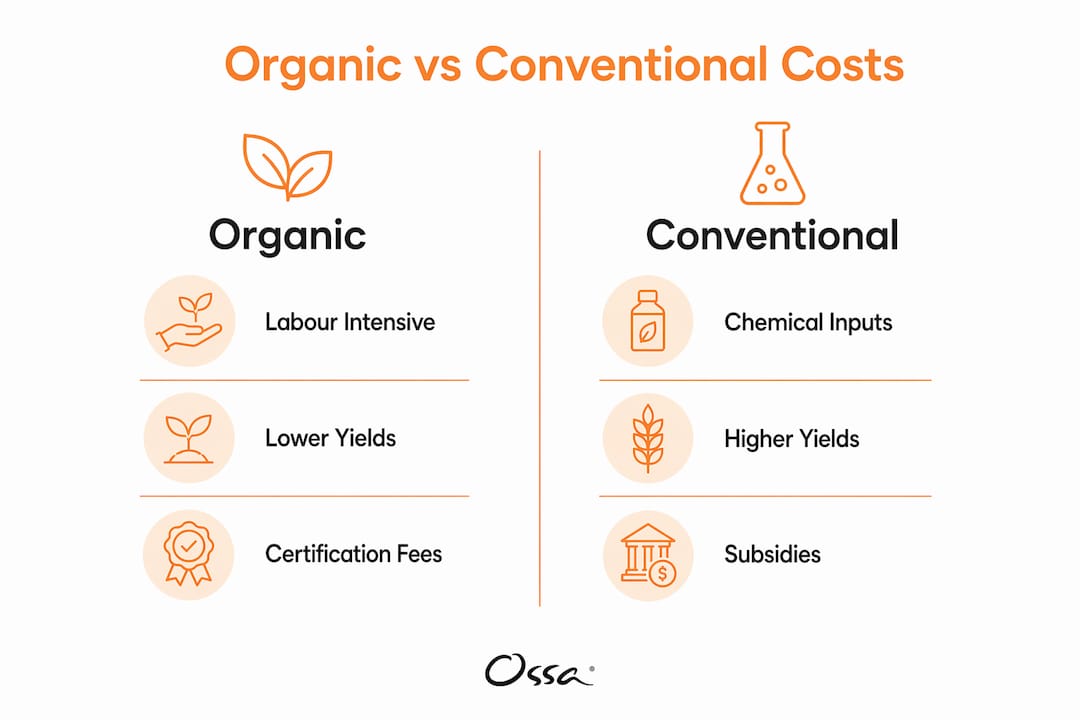
The price disparity between organic and conventional food comes down to four structural factors: labour, yield, certification, and subsidies. Each one adds cost at a different point in the supply chain. Together, they explain why organic food pricing is not a marketing premium but a reflection of production reality.
Conventional farming relies on synthetic herbicides, pesticides, and fertilisers to produce high volumes at low cost per unit. Organic farming prohibits all of these inputs. That single difference cascades into higher costs across the entire operation. The price disparity is rooted in labour-intensive organic production methods versus synthetic chemical reliance in conventional farming. Understanding this distinction is the foundation for everything that follows.
Consumers also need to distinguish between certified organic food and products labelled simply as “natural.” The term “natural” carries no verified regulatory standard in the UK or the US. Certified organic, by contrast, is governed by bodies such as the Soil Association in the UK and the USDA in the United States. You can learn more about what those standards actually require by reading about certified organic produce before making purchasing decisions.
How labour-intensive practices drive up organic food prices
Labour is the single largest cost driver in organic farming. Conventional farms apply a herbicide to an entire field in one pass. Organic farms must manage weeds through hand-weeding, mechanical cultivation, or cover cropping, all of which require significantly more time and human effort. Manual weed control replaces synthetic herbicides entirely, increasing labour input compared to conventional methods. That difference in hours worked per acre translates directly into higher costs per unit of food produced.
Pest management follows the same pattern. Conventional farms spray broad-spectrum insecticides. Organic farms use biological controls, such as introducing beneficial insects, alongside physical barriers and regular crop monitoring. Each of these methods requires skilled labour and more frequent field visits. The result is a higher wage bill per harvest cycle.
Here is a summary of where labour costs diverge most sharply between the two systems:
- Weed management: Hand-weeding or mechanical cultivation versus a single herbicide application per season
- Pest control: Biological monitoring and intervention versus one or two pesticide treatments
- Harvesting: Selective hand-picking for many organic crops versus mechanised bulk harvesting
- Soil management: Regular composting, cover cropping, and rotation planning versus synthetic fertiliser application
- Record-keeping: Detailed logs required for certification compliance versus minimal documentation
Each of these tasks adds hours. Those hours add wages. Those wages add to the price you see on the shelf.
Pro Tip: When comparing organic versus conventional prices at the supermarket, check whether the organic item is also hand-harvested. Soft fruits like strawberries and raspberries are almost always hand-picked in organic systems, which explains a significant portion of their premium.
What lower yields mean for the cost of organic produce
Yield is the second major cost driver. Organic farms yield 19–25% less than conventional farms per acre. That gap means the same fixed costs, land rent, machinery, insurance, and labour, are spread across fewer units of produce. The per-unit cost rises even before a single additional expense is added.
Natural fertilisers compound this problem. Organic fertilisers, including compost, manure, and bone meal, cost 20–50% more than synthetic equivalents. They also release nutrients more slowly, which can limit peak growth rates. Organic farmers must apply larger volumes to achieve comparable soil nutrition, adding both material and labour costs.
The three-year transition period is a cost that most consumers never consider. When a conventional farm converts to organic, it must follow organic practices for three full years before it can label and sell its produce as certified organic. During that period, the farm incurs higher labour and input costs but cannot charge organic prices. That financial gap is a genuine barrier, and the costs incurred during transition are ultimately recovered through higher prices once certification is achieved.
| Cost Factor | Organic Farming | Conventional Farming |
|---|---|---|
| Crop yield per acre | 19–25% lower | Baseline |
| Fertiliser cost | 20–50% higher | Baseline |
| Transition period | 3 years at full cost, no premium | No equivalent period |
| Weed control method | Manual or mechanical | Single herbicide application |
| Pest control method | Biological and physical | Chemical spray |
Pro Tip: If you want to reduce your organic spend without sacrificing quality, prioritise buying organic for produce with thin skins, such as strawberries, spinach, and apples. These absorb more pesticide residue in conventional farming, making the organic premium most worthwhile for them.
Do certification costs explain why organic is expensive?
Certification is a real and ongoing cost that sits on top of production expenses. Certification and compliance costs add 2–5% to the landed cost of organic products. That percentage sounds modest, but it applies to every product, every year, with no reduction for farms that have been certified for decades.
The certification process involves annual inspections, detailed record-keeping, and documentation of every input used on the farm. Inspectors verify that no prohibited substances have been applied, that records match field activity, and that the farm’s practices align with the relevant standard, whether that is the Soil Association in the UK or the USDA National Organic Programme in the United States.
Smaller farms carry this burden disproportionately. A large operation can spread certification fees across a high volume of produce, reducing the per-unit impact. A small family farm pays similar fees but sells far fewer units, meaning certification adds a larger percentage to each item’s cost. This is one reason why small organic producers often charge more than large organic brands, not because of inefficiency, but because of scale.
The certification process also creates a pricing floor. No certified organic product can be priced below the cost of production plus certification overhead. That floor is structural, not speculative. You can review what organic certification standards actually require to understand why this overhead is unavoidable.
Key certification cost factors include:
- Annual inspection fees paid to the certifying body
- Internal record-keeping systems and staff time for documentation
- Input verification, confirming every fertiliser, spray, and seed meets organic standards
- Re-certification costs if any non-compliant input is detected
- Labelling compliance, ensuring packaging meets regulated organic claims
Subsidies, retail margins, and the true organic vs conventional pricing gap
Government subsidies are the least visible but most significant factor in the price gap between organic and conventional food. Between 1995 and 2010, over £260 billion in subsidies supported large conventional commodity operations in the United States alone. Organic farming received approximately 2% of federal agricultural research funding since 2018. That imbalance means conventional food prices are artificially low, supported by public money that organic producers do not receive.
Organic farms cover their full production costs through the price of their products. Conventional farms do not, because subsidies absorb a portion of those costs on their behalf. The result is that the price gap you see at the checkout is not purely a reflection of organic being expensive. It is partly a reflection of conventional food being subsidised to appear cheap.
Retail margins widen the gap further. Organic retail margins run at 25–40% due to slower inventory turnover and specialised market placement. Conventional products move faster through retail channels, allowing retailers to operate on thinner margins. Organic products sit longer on shelves, require more careful storage in some cases, and are positioned as premium items, all of which justify higher retail markups.
| Pricing Factor | Organic | Conventional |
|---|---|---|
| Government subsidy support | Minimal | Substantial |
| Retail margin | 25–40% | Lower, faster turnover |
| Production cost coverage | Full, via consumer price | Partial, subsidies absorb remainder |
| Environmental cost inclusion | Internalised in price | Largely externalised |
Organic food pricing also internalises environmental and social costs that conventional farming externalises. Fair wages, soil health preservation, and reduced chemical runoff all have real costs. Conventional pricing models pass those costs to the environment and to public health systems. Organic pricing includes them in the product price. This makes organic food more expensive at the point of purchase, but more honest about what food production actually costs.
Key takeaways
Organic food costs more because every stage of production, from soil management to retail shelf, carries higher costs than conventional farming, with no subsidy support to offset them.
| Point | Details |
|---|---|
| Labour is the primary cost driver | Manual weed and pest control replaces chemicals, adding significant hours per harvest cycle. |
| Lower yields raise per-unit costs | Organic farms produce 19–25% less per acre, spreading fixed costs across fewer units. |
| Certification adds a structural floor | Annual inspections and compliance add 2–5% to product costs, with smaller farms hit hardest. |
| Subsidies distort the price comparison | Conventional food benefits from substantial public subsidies; organic prices reflect full production costs. |
| Retail margins compound the gap | Organic products carry 25–40% retail margins due to slower turnover and specialist positioning. |
What organic pricing actually tells you
At Ossa Organic, we have spent years working directly with certified organic suppliers, and the pricing question comes up constantly. Our honest view is this: the premium is not a mark-up for its own sake. It is a record of what it actually costs to grow food without shortcuts.
The farms we work with do not use synthetic inputs. They manage their land with the long view in mind, building soil health over seasons rather than extracting maximum yield in a single cycle. That approach costs more in the short term. It produces food that is more expensive to buy. But it also produces food that reflects true production costs rather than costs that have been shifted onto the environment or onto future generations.
What we find most telling is the subsidy comparison. Conventional food is not cheap because it is efficient. It is cheap because public money makes it appear cheap. Organic food prices are simply more transparent about what farming costs when done without that support.
We also think the “natural” label conversation matters. Many products charge a premium for being “natural” without any verified standard behind the claim. Certified organic is different. The Soil Association certification and equivalent bodies set enforceable standards. When you pay the organic premium, you are paying for something that has been independently verified, not just marketed.
The practical implication for consumers is straightforward. If budget is a constraint, prioritise organic for the produce where it matters most, thin-skinned fruits, leafy greens, and animal products where feed quality directly affects nutritional output. Spend conventionally on items with thick skins or lower pesticide absorption. That is not a compromise. It is an informed choice.
— Ossa Organic
Certified organic products worth the price
Understanding why organic food costs more makes it easier to assess whether a specific product justifies its premium. At Ossa Organic, every product in our range is certified organic, slow-cooked using traditional methods, and free from preservatives and artificial ingredients. Our organic beef bone broth is made from grass-fed, certified organic bones, slow-simmered to preserve collagen and nutrients. Our organic chicken bone broth uses free-range birds raised to certified organic standards. Both products carry full certification, transparent sourcing, and no hidden inputs. If you are building an organic food routine, our ambient broth range is a practical starting point.
FAQ
Why does organic food cost more than conventional food?
Organic food costs more because it requires more labour, produces lower yields, and carries certification costs that conventional farming does not. Government subsidies also support conventional farming far more heavily, making conventional prices artificially low by comparison.
Is the organic price premium worth paying?
The premium reflects genuine production costs including fair wages, soil health practices, and certification compliance. For produce with high pesticide absorption in conventional farming, such as strawberries and spinach, the organic premium is most justified.
What does the organic certification process involve?
Certification requires annual inspections, detailed record-keeping, and verification of every input used on the farm. Bodies such as the Soil Association in the UK and the USDA in the United States enforce these standards, and certification costs add 2–5% to the landed cost of each product.
Why is organic produce sometimes twice the price of conventional?
Specific items can carry premiums well above the average. Roma tomatoes, for example, have shown price differences of up to 134% compared to conventional versions. Labour-intensive harvesting, lower yields, and retail margin stacking all contribute to these higher premiums on individual items.
Does “natural” food cost more for the same reasons as organic?
No. “Natural” is an unregulated label with no verified standard behind it. Products labelled natural may charge a premium without any of the certification, inspection, or farming practice requirements that certified organic products must meet. The cost drivers for certified organic are structural and verified. The cost drivers for “natural” products are not.