

Cart
0
Organic sourcing is complex because certification rules, a mandatory three-year land conversion period, international supply chains and multi-layer verification requirements combine to raise costs, limit supply and create variable trust signals for UK consumers. Defra sets the governing standards; bodies such as the Soil Association and OF&G implement them through inspections, paperwork and batch audits. For buyers like Ossa Organic, that means managing everything from soil records to residue testing before a single product reaches a shelf. The result for shoppers: higher prices, seasonal gaps and a wide range of label claims that do not all carry the same weight.
Table of Contents
-
Why does UK organic certification take so long and cost so much?
-
How do international supply chains make organic sourcing harder?
-
Why are certificates no longer enough to verify organic claims?
-
How do production risks and lower yields drive up organic prices?
Why does UK organic certification take so long and cost so much?
The three-year conversion rule sits at the heart of organic sourcing difficulties. Land must be free of all prohibited substances, including synthetic pesticides and fertilisers, for at least three years before any harvest can be sold as organic. During that window, farmers carry the full cost of organic practices — more labour, lower yields, detailed soil and input records — without access to organic price premiums. The cash-flow pressure is real and it deters many producers from starting the process at all.
Defra sets the legal standards, but day-to-day implementation falls to approved certification bodies. The Soil Association is the most widely recognised in the UK; OF&G (Organic Farmers & Growers) is the other major body, particularly strong in arable and livestock sectors. Both conduct scheduled annual inspections and unannounced spot checks, reviewing soil history, input logs and storage records. A single documentation gap can delay certification or trigger a re-inspection, pushing market entry back further.
Unannounced inspections and paper trails are the infrastructure of trust in organic supply chains. Without them, a certificate is just a piece of paper.
Pro Tip: When checking a product’s organic credentials, look for the certification body’s logo and its registration number on the label or the brand’s website. The Soil Association’s certification details are publicly searchable, so you can verify a licence number in seconds.
How do international supply chains make organic sourcing harder?
Many ingredients central to UK food products simply cannot be grown here. Nuts, seeds and spices require climates the UK cannot provide, so buyers must source them internationally while maintaining organic status across every border crossing and processing step. Each handover — from overseas farm to exporter, consolidator, importer and UK processor — adds a documentation requirement and a potential point of failure.
The scale of cross-border organic trade illustrates why this matters. The EU imported a large quantity of organic agricultural products from outside the EU. UK buyers operate within a similarly complex import environment post-Brexit, with their own border-check obligations. A single rejected or blocked shipment triggers immediate extra costs: storage, relabelling and laboratory retests. That risk shifts upstream and is ultimately priced into the product.
Value-chain frictions compound the problem. Limited processing capacity, fragmented logistics and weak coordination between producers and processors can force organic produce to be downgraded to conventional markets, wiping out the price premium that made conversion worthwhile in the first place. Poor forecasting and volume mismatches are common causes.
| Supply chain stage | Key complexity | Risk if it fails |
|---|---|---|
| Overseas farm | Soil records, input logs, local certification | Organic status void at source |
| Export / consolidation | Documentation coherence, mass-balance records | Shipment blocked at border |
| UK import | Border checks, re-certification under UK rules | Storage costs, relabelling |
| Processing (mixed facility) | Clean-down protocols, dual traceability | Cross-contamination, downgrade |
| Retail / brand | Batch codes, residue testing, label accuracy | Consumer trust loss |
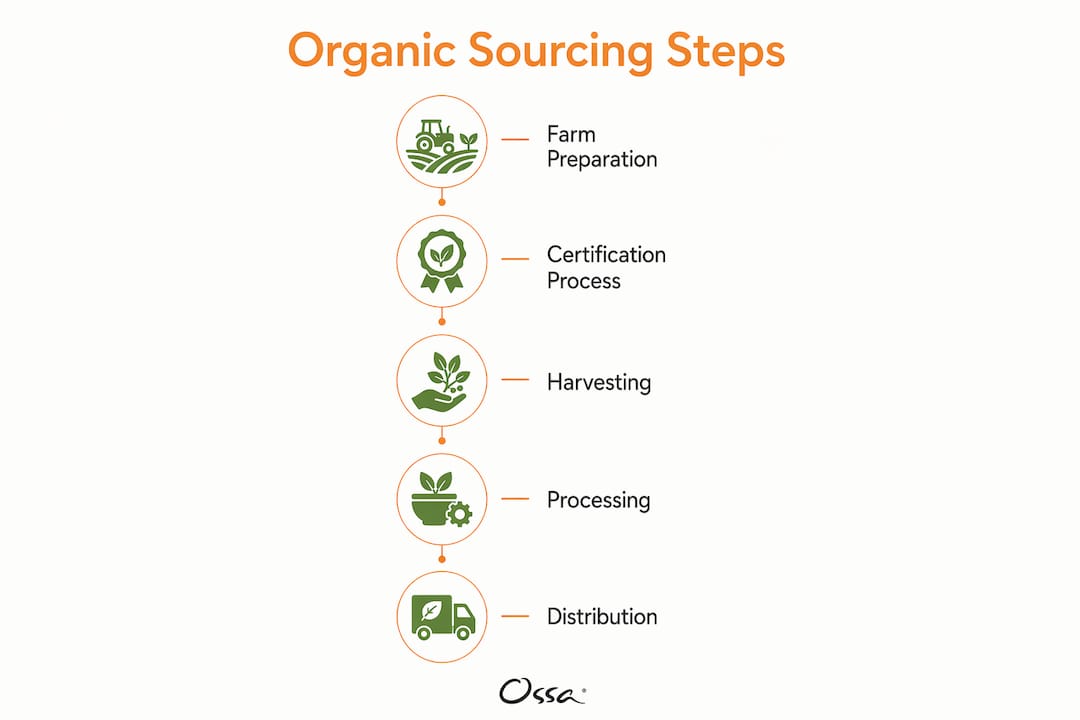
For clean-label commodity categories, the verification challenge is similar. A guide on clean-label verification in speciality coffee illustrates how even a single-origin product requires multi-stage documentation to support its claims.
Why are certificates no longer enough to verify organic claims?
A certificate is a point-in-time record. It confirms that a farm or processor met the required standards on the day of inspection; it says nothing about what happened between that date and the moment a product reached your kitchen. Procurement teams now rely on operational credibility: live batch documentation, mass-balance reconciliation (quantities purchased versus volumes sold), audit histories and coherent trade flows that hold up under scrutiny.
Practical verification checks buyers now require include:
-
Batch-level laboratory tests for pesticide residues
-
Transport logs and geolocation records for temperature-sensitive goods
-
Mass-balance reconciliation across the full supply chain
-
Audit histories showing consistent inspection outcomes
-
Chain-of-custody records covering every processing handover
For consumers, the equivalent is knowing what to ask. Brands with genuine traceability publish batch codes, name their certification bodies and can point to residue testing. Those that cannot are relying on logo recognition alone.
Pro Tip: If you are buying bone broth or other gut-health products and provenance matters to you, ask the brand directly: “Can you share batch documentation or residue test results for this product?” A confident, specific answer is a strong signal. Vague reassurances are not.
Understanding organic food integrity and what chain-of-custody actually means helps you ask the right questions at the point of purchase.
How do production risks and lower yields drive up organic prices?
Without synthetic pesticides or fertilisers, organic crops face greater pest pressure and weather sensitivity. Yields are typically lower per hectare, and labour requirements are higher. These are not marginal differences; they affect the economics of every farm that converts.
The cost increase does not stay with the farmer. It moves through the supply chain — processors charge more for mixed-facility scheduling and clean-down protocols, retailers apply higher margins to cover slower stock turns, and consumers pay the final price. Supply variability adds another layer: a poor growing season for an organic crop has a proportionally larger impact on price than the same event in a conventional supply chain, because the organic pool is smaller and less substitutable.
Mixed processing facilities carry hidden costs that rarely appear on a label. Validated clean-down protocols, separate scheduling, audited storage and dual traceability documentation are all required and must be defensible during unannounced audits. Those overheads are real and they feed directly into the price you pay. For a fuller breakdown of where costs accumulate, the organic price breakdown on the Ossa Organic blog is worth reading.
Which organic products matter most for gut health?
Not every organic purchase delivers the same gut-health benefit. Prioritising where you spend your organic budget is practical and sensible.
-
Bone broths and collagen-rich stocks: The quality of the source animal directly affects nutrient density. Organic, pasture-raised animals produce broth with a different fatty acid and mineral profile. This is where organic certification has the clearest impact on gut-health outcomes.
-
Dairy: Residues from conventional dairy farming can affect the gut microbiome. Organic dairy typically comes from animals with higher-welfare diets and no routine antibiotic use.
-
Fresh produce with thin or edible skins: Strawberries, spinach and apples absorb pesticide residues more readily than thick-skinned produce. Organic matters more here.
-
Spices and dried herbs: Often imported and heavily treated in conventional supply chains. Organic certification for these ingredients is worth checking.
For gut-health shoppers, the single highest-impact switch is usually bone broth. The sourcing of the animal — its feed, its environment, its welfare — flows directly into the finished product in a way that few other foods can match.
Ossa Organic concentrates its certification investment on core ingredients: the bones, the animals and the primary liquids. That is where the difference to gut health is greatest. For local sourcing options that complement this approach, the local organic sourcing guide covers practical steps for UK shoppers.
Pro Tip: For ingredients where organic certification is less critical — think minor spices in a recipe rather than the primary protein — conventional is an acceptable trade-off. Spend your organic budget where the residue risk or nutrient difference is highest.
How do you spot a legitimate UK organic product?
-
Check the certification body. Look for the Soil Association or OF&G logo. Both are Defra-approved and publicly searchable.
-
Find the registration number. A legitimate organic product carries a licence number. Verify it on the certifier’s website.
-
Check the batch code and date. Genuine traceability means every batch is identifiable. No batch code is a red flag.
-
Look at the origin for imported ingredients. Vague statements like “sourced internationally” without country of origin are worth questioning.
-
Search for published residue testing. Not all brands publish this, but those that do are demonstrating a higher standard of transparency.
Red flags to watch for:
-
Missing or unverifiable batch codes
-
Certification logos with no registration number
-
Prices significantly below market rate for organic goods
-
Origin statements that name a continent rather than a country
-
No named certification body anywhere on the label or website
Pro Tip: Learning how to read organic food labels takes about ten minutes and will save you from making purchases based on packaging alone. The registration number is the fastest single check.
Why do some brands not certify every ingredient?
Certifying every ingredient in a product is not always practical or proportionate. For minor stabilisers, processing aids or trace flavourings that appear in quantities under one percent, the documentation burden and annual certification cost can far exceed any consumer benefit.
UK organic regulations permit a small percentage of non-organic agricultural ingredients in a certified product, provided the organic version is genuinely unavailable. Brands operating within these rules are not cutting corners; they are making a defensible, legal trade-off.
Strategic brands allocate certification investment to the ingredients that materially affect product performance or consumer trust — not to every minor input on the label.
For gut-health consumers, the practical guidance is straightforward. If the primary ingredient (the bone, the meat, the main vegetable) is certified organic, the product is delivering its core health benefit. A non-certified minor spice or processing aid is unlikely to change that. Where caution is warranted is when a brand omits certification for its primary or highest-volume ingredient and offers no explanation.
Key takeaways
Organic sourcing is complex because certification, production economics, international logistics and verification practices all interact — and the cost of getting any one of them wrong falls on the supply chain and, ultimately, the consumer.
| Point | Details |
|---|---|
| Three-year conversion burden | Farmers carry full organic costs for three years before earning organic premiums, limiting supply. |
| Certificates are a starting point | Batch documentation, residue testing and mass-balance records are now the real verification standard. |
| Prioritise by gut-health impact | Bone broths, dairy and thin-skinned produce deliver the greatest benefit from organic certification. |
| Higher prices reflect real costs | Lower yields, mixed-facility overheads and import verification all feed into the price you pay. |
| Ossa Organic’s approach | Ossa Organic certifies core ingredients through the Soil Association and publishes batch-level traceability for its bone broths. |
Ossa Organic’s perspective on sourcing and certification
The complexity described in this article is not abstract for Ossa Organic. Every sourcing decision involves a genuine trade-off between cost, availability and the integrity of the finished product. The brand’s position is that certification investment should follow gut-health impact: the animals, the bones and the primary liquids are where organic status changes what ends up in your body.
Ossa Organic holds Soil Association certification and B Corp status, both of which require ongoing operational evidence rather than a one-time application. The founder’s background and the B Corp credential are publicly documented, which is the kind of transparency the consumer checklist in this article asks you to look for. Customers should expect Ossa Organic to be able to answer specific questions about batch provenance, and the brand’s product pages are the right place to start.
Ossa Organic bone broths: sourcing you can verify
Ossa Organic’s bone broths are the practical application of everything covered above. The Organic Beef Bone Broth Ambient 515ml and the Organic Free Range Chicken Bone Broth 500ml are both Soil Association certified, with batch codes on every unit. The Organic Chicken Bone Broth Ambient 515ml follows the same sourcing standard. Each product page carries certification details and origin information. If you want a structured way to use bone broth for gut health, the 14 Day Gut Reset programme gives you a clear framework. Check the batch codes and certification details on the product pages before you buy.
Useful sources and further reading
Primary sources used in this article:
-
Foodism: How organic sourcing works in the UK — covers the three-year conversion rule, inspection practices and UK supply chain dynamics.
-
FoodChain ID: Organic compliance and complexity for quality managers — operational credibility, mass-balance reconciliation and mixed-facility costs.
-
OrganicTargets4EU, Policy Brief #6 — supply chain frictions, downgrading risk and coordination failures.
-
NOW Organic: Why organic buyers need to pay closer attention when shipments get rejected — border checks, rejected shipments and documentation coherence.
-
WholeFoodValue: Common challenges in sourcing organic fruits — physical production risks and yield variability.
-
Source86: Organic vs conventional bulk ingredients in CPG — certification prioritisation for minor ingredients.
Ossa Organic resources for further reading:
-
How to find certified organic produce — practical verification steps for UK shoppers.
-
What makes food truly organic — production rules and prohibited inputs explained.
For certification verification, use the Soil Association’s public licence search or OF&G’s register directly. Batch-level transparency from a brand is the strongest single indicator that its organic claims are substantiated.
FAQ
What is the three-year conversion rule in UK organic farming?
Land must be free of prohibited substances, including synthetic pesticides and fertilisers, for at least three years before a harvest can be certified organic. Farmers carry full organic production costs during this period without access to organic price premiums.
Why does organic food cost more than conventional?
Lower yields, higher labour requirements, mixed-facility overheads and multi-stage verification all add cost at every point in the supply chain. Those costs are passed through to the retail price.
Which certification bodies should I look for on UK organic products?
The Soil Association and OF&G (Organic Farmers & Growers) are the two main Defra-approved bodies. Both conduct scheduled and unannounced inspections and publish searchable licence registers.
Is organic certification enough to guarantee product quality?
Certification is a starting point. Batch documentation, residue testing and mass-balance reconciliation are the operational checks that confirm organic status is maintained from farm to finished product.
Which organic products matter most for gut health?
Bone broths, dairy and thin-skinned fresh produce deliver the greatest gut-health benefit from organic sourcing. Ossa Organic’s Soil Association-certified bone broths are formulated with this priority in mind.